
Ever wondered what happened to well-known Supreme Court plaintiffs after their cases came to an end? Today, we’re launching a new series of Closer Looks exploring that very topic.
Read more Trump administration asks Supreme Court to clear the way for new mail-in voting restrictions
At the Court
On Monday, the Trump administration came to the Supreme Court on its emergency docket and asked the justices to clear the way for full implementation of President Donald Trump’s executive order on mail-in voting. For more on the dispute, see the On Site section below.
Morning Reads
Inside the fights to maintain TPS status for thousands after the Supreme Court sided with Trump
Devan Cole, CNN
One “month after the Supreme Court curtailed lower courts’ ability to block the Trump administration from revoking temporary deportation protections,” people who stand to lose those protections are still engaged in legal battles, in part because “the justices left the door open for TPS beneficiaries to bring constitutional challenges to the administration’s actions,” according to CNN. “In recent days, legal advocates representing … migrants from a handful of countries have either repackaged their earlier procedural arguments into new constitutional claims or signaled plans to do so soon.” “The constitutional claims are being made under the 5th Amendment’s Due Process Clause, which says the government cannot deprive a person of their ‘life, liberty or property’ without first following protocols and procedures laid out in federal law.” Meanwhile, the Trump “administration has claimed that the Supreme Court decision fully blessed its actions revoking the TPS designations.”
Employers Fear Labor Shortage as Many Immigrants Lose Protected Status
Miriam Jordan and Madeleine Ngo, The New York Times
As legal battles over the Temporary Protected Status program continue, business leaders and lawmakers are looking for alternative ways to allow TPS beneficiaries to continue working after they lose their work permits under the program. “[B]usiness organizations, led by the U.S. Chamber of Commerce, have mounted a campaign for action on Capitol Hill, joined by a growing number of state and local leaders from both parties,” according to The New York Times. “Congress can, and should, exercise its plenary authority over immigration policy to prevent significant disruption to America’s work force and avoid an unnecessary humanitarian crisis,” read a July 10 letter from the Chamber of Commerce to Senate leadership.
Attorneys for Florida death row inmates seek stays of execution from U.S. Supreme Court
Mitch Perry, Florida Phoenix
“Barring a last-hour intervention by the U.S. Supreme Court, two Florida death row inmates,” James Aren Duckett and Dominick Occhicone, “will be executed within hours of each other Tuesday at Florida State Prison,” according to the Florida Phoenix. Duckett has been on Florida’s death row for more than 30 years “after being convicted of murdering 11-year-old Teresa McAbee in 1987.” Occhicone was convicted in 1987 for the double murder “of his girlfriend’s parents, Martha and Raymond Artzner.” “Attorneys for both inmates filed for stays of execution Saturday with the U.S. Supreme Court.” If those requests are denied, Duckett and Occhicone will become the 11th and 12th inmates executed this year in Florida, which is responsible for “more than half of all executions in the United States since January 2025.” “At 80, Occhicone would be the second-oldest man executed since the death penalty was reinstated in 1976.”
Citing ‘common sense,’ James Comey’s team urges judge to toss seashells case
Ryan J. Reilly, NBC News
In April, former FBI director James Comey “was indicted by a grand jury in the Eastern District of North Carolina. … Prosecutors argued that an image he posted online of seashells grouped in the formation of the numbers ‘86 47’ was a threat against the president.” Now, attorneys for “Comey have asked a federal judge to dismiss” the case, “arguing that ‘dictionaries, context, precedent, and common sense’ gut the Trump administration’s claim,” according to NBC News. “The Supreme Court has rejected threats prosecutions based on speech far more directly threatening than Mr. Comey’s seashells post here,” the attorneys wrote in their . The DOJ’s response to Comey’s motions to dismiss are due by Aug. 18.
Sheldon Whitehouse’s Court-Packing Plan Is Unconstitutional
Dan McLaughlin, National Review
In a column for the National Review, Dan McLaughlin took aim at a Democratic “to expand the Supreme Court to a maximum of 18 justices, with presidents appointing new justices in the first and third years of their terms without a vacancy on the Court,” and to “sideline the most senior current justices from ruling on most of the Court’s docket.” McLaughlin described the bill as “radical and dangerous” and contended that it violates the Constitution, because, in his view, barring senior justices from hearing most of the court’s docket would amount to stripping them of life tenure on the court.
On Site
Trump administration asks Supreme Court to clear the way for new mail-in voting restrictions
By Amy Howe
The Trump administration on Monday asked the Supreme Court to allow it to fully implement an executive order signed by President Donald Trump that seeks to impose additional restrictions on mail-in voting. U.S. Solicitor General D. John Sauer called an order by a federal judge in Massachusetts that paused portions of the order in 23 states and the District of Columbia “extraordinary,” and he argued that it “flouts settled” doctrines governing when courts can weigh in on a dispute.
Announcing The SCOTUSblog Summit: 2026 Term Preview
By SCOTUSblog Staff
As we noted in yesterday’s newsletter, The SCOTUSblog Summit: 2026 Term Preview, an afternoon of conversations and analysis on the Supreme Court, will be held at the Johns Hopkins University Bloomberg Center in Washington, D.C. on Sept. 16. Registration will open soon.

How predictable is the Supreme Court from oral argument?
By Adam Feldman
In his Empirical SCOTUS column, Adam Feldman analyzed the 56 signed decisions in cases argued during the 2025-26 term, exploring whether certain features of the oral argument in those cases, like the number of words and speaking turns directed to each side, predicted the outcome.
Justices’ lucrative book deals deserve more scrutiny
By Gabe Roth
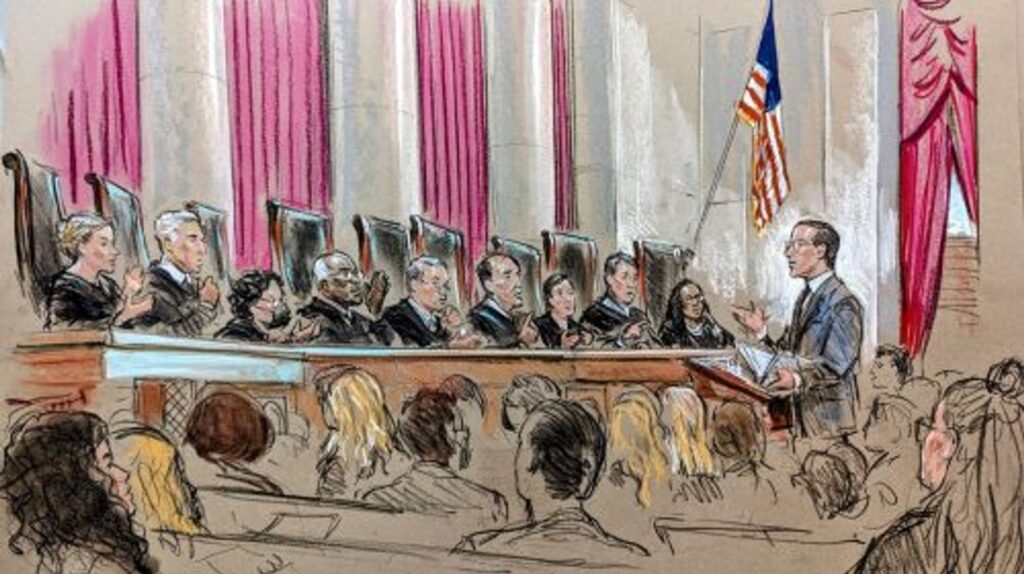
In a column for SCOTUSblog, Gabe Roth explained why he believes the justices’ practice of publishing and promoting books deserves the type of scrutiny that court-watchers to this point have primarily reserved for gifts and travel.
Why the Supreme Court decided the wrong issue in the transgender athletes cases
By Craig Konnoth
In a column for SCOTUSblog, Craig Konnoth revisited West Virginia v. B.P.J., in which the Supreme Court held that state bans forbidding transgender girls from participating in girls’ sports violated neither Title IX nor the equal protection clause of the 14th Amendment. Konnoth contended that the challengers’ case would have been stronger had they focused on what factors should determine whether someone is a biological female under federal law.
Podcasts
The Based Direction
Will Baude and Dan Epps discussed T.M. v. University of Maryland Medical System Corp., in which the Rooker-Feldman doctrine, pronounced dead in the Green Bag two decades ago, proved alive enough to reach state-court judgments still on appeal. They tried to figure out what the doctrine actually is and why the court’s committed formalists split down the middle.
Read more Why the Supreme Court decided the wrong issue in the transgender athletes cases
William Marbury
In the coming weeks, SCOTUSblog will be running a series of Closer Looks on some of the most well-known Supreme Court plaintiffs. We felt it made sense to start with William Marbury, from the rather minor case of Marbury v. Madison.
William Marbury was born in November 1762, likely on a tobacco plantation near Piscataway, Maryland. His grandfather, Francis Marbury, was an English immigrant, who made immense wealth off of property and served as a justice at the county court. Marbury’s father, also named William, inherited one-fifth of his father’s lands, but struggled to make money in the tobacco industry, which was hampered by Britain monopolizing the market and placing large duties on exports.
Marbury’s youth was spent moving from place to place as his father chased futile attempts to gain wealth. Perhaps influenced by his father’s failure in that regard, Marbury pursued a career in finance. In 1781, Marbury began working as a clerk to the Maryland auditor general and for much of the rest of the decade as a deputy tax collector.
In 1791, Marbury was named the deputy agent for the state of Maryland and then in 1796 the agent for the state, in which he handled financial agreements, collected back taxes, and sold estates. Around this time, he was welcomed into Potomac Federalist circles. In 1798, Marbury became an agent to the Washington Navy Yard, where he would be tasked with overseeing the construction of a naval yard at the Anacostia River.
In the waning days of the Adams administration, President John Adams nominated Marbury to serve as a justice of the peace for the District of Columbia. Marbury had actively worked to try and re-elect Adams through the Electoral College during the election of 1800.
Despite being confirmed by the Senate and Adams signing his commission, this was never delivered to Marbury. Newly elected President Thomas Jefferson, unwilling to allow more Federalists to take the bench, instructed Secretary of State James Madison not to deliver the commission, prompting Marbury to file suit.
In the case of Marbury v. Madison, the Supreme Court ruled that Marbury was entitled to his commission and that normally a writ of mandamus (an order to a government official to do his or her duties) would be the appropriate remedy. However, Marbury filed his lawsuit directly at the Supreme Court, and the court held that the relevant provision of the Judiciary Act of 1789 which purported to give the court original jurisdiction over the case was unconstitutional. As a result, the court lacked the authority to hear it and issue a writ of mandamus. This marked the first time that the Supreme Court declared an act of Congress to be unconstitutional – although it was perhaps not the first time that courts had engaged in .
Marbury never sought further legal action regarding his commission, resulting in him never becoming a justice of the peace. Instead, he continued his successful career in finance. He also involved himself in land speculation, purchasing land southeast of Washington D.C., as well as stock in Navy Yard Bridge Company, which had a bridge across the Anacostia River, and the Washington Turnpike, a toll road from Georgetown to Rockville, Maryland.
At the time of his passing in 1835, Marbury owned 37 enslaved people. His will stated that his estate would manumit his personal servant, Hamilton, after seven years. However, because the emancipation was delayed, it is unknown whether Hamilton was ever freed.
A portrait of Marbury facing a portrait of Madison hangs in the Supreme Court justices’ dining room – this was installed by Chief Justice Warren Burger in 1979.
SCOTUS Quote
JUSTICE THOMAS: “Mr. Phillips, I am still – I’m just not very good at metaphysics, and –”
MR. PHILLIPS: “I’m not very good at physics either.”
JUSTICE THOMAS: “Yeah. Well, no, I was good at physics. It’s just metaphysics that were a problem.”
Read more Justices’ lucrative book deals deserve more scrutiny
— (2022)