
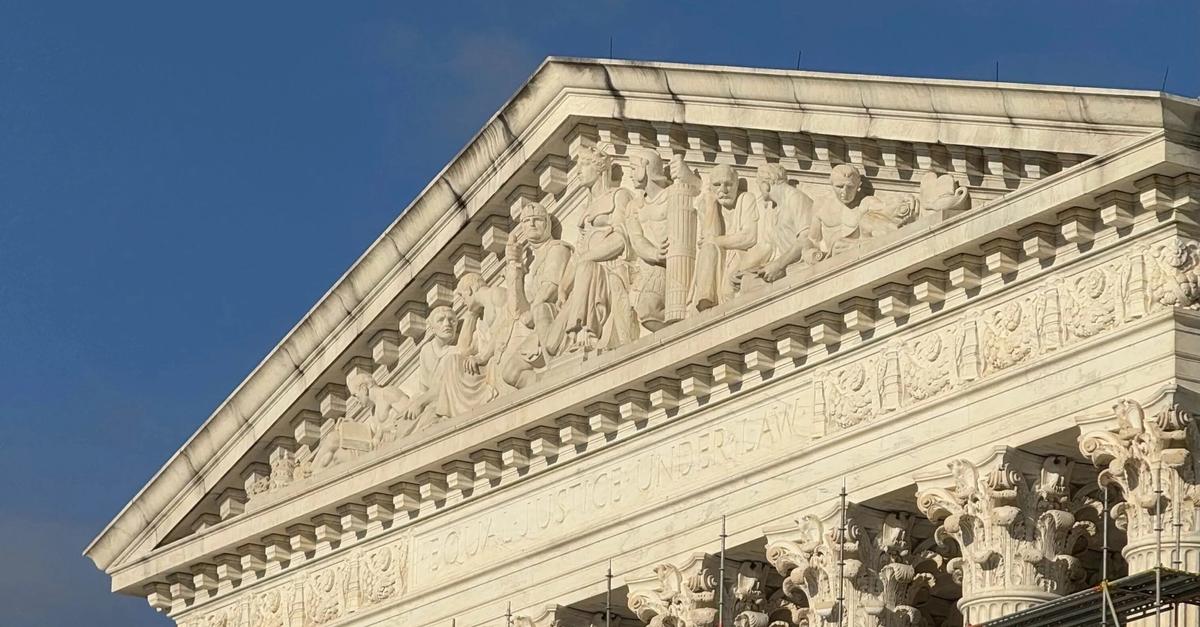
Believe it or not, back-to-school season is already here, at least in some parts of the United States. But we’ve still got about two months until it’s back-to-Supreme-Court season for the justices. Ever wondered why that is? Amy explores the significance of the first Monday in October in today’s Ask Amy.
At the Court
On Tuesday, the Supreme Court released its calendar for the , which lasts from Monday, Oct. 5, to Wednesday, Oct. 14. For more on the oral arguments in October, see the On Site section below.
Morning Reads
US appeals court reverses Jack Daniel’s win in dog-toy trademark case
Blake Brittain, Reuters
On Tuesday, the U.S. Court of Appeals for the 9th Circuit “overturned a win for Jack Daniel’s in a long-running trademark dispute with the maker of a ‘Bad Spaniels’ dog toy that the whiskey company accused of violating its trademark rights.” The toy at the center of the case “mimics Lynchburg, Tennessee-based Jack Daniel’s famous whiskey bottles with dog-themed alterations – replacing ‘Old No. 7’ with ‘the Old No. 2, on your Tennessee Carpet’ and alcohol descriptions with ‘43% Poo By Vol.’ and ‘100% Smelly.’” The toymaker, VIP Products, “sued Jack Daniel’s in 2014 after receiving a cease-and-desist letter, seeking a court ruling that it did not violate the whiskey maker’s trademark rights.” An Arizona court sided with Jack Daniel’s, but the 9th Circuit reversed in 2020, emphasizing “VIP’s free speech rights.” In 2023, the Supreme Court vacated that decision, holding that “VIP used the trademark to designate the source of its own goods, in a way that was not entitled to First Amendment protections.” Last year, a federal district judge “issued a permanent ban on sales of VIP’s toy,” but the 9th Circuit reversed that ban on Tuesday, “finding that ‘Bad Spaniels’ would not harm Jack Daniel’s reputation.”
ICE begins outfitting Haitian immigrants with ankle monitors, attorneys say
Arelis R. Hernández, Ted Hesson, and Lauren Kaori Gurley, The Washington Post
In a June 25 ruling, the Supreme Court cleared the way for the Trump administration to end deportation protections for Haitian and Syrian nationals under the Temporary Protected Status program. In recent days, the Department of Homeland Security has appeared to move toward removing “Haitian immigrants in Ohio” by summoning them to check-in appointments, where they are “outfitt[ed] with ankle monitors.” Attorneys for those Haitians told The Washington Post that they’ve been “instructed not to travel anywhere outside a 75-mile radius from their homes.” “Many of the Haitians outfitted with ankle monitors in recent days have ongoing asylum claims and no final order of deportation, their attorneys said.” Attorneys also said that “officers encouraged the immigrants to leave voluntarily and noted the $2,600 financial incentive DHS is offering those who choose to self-deport.”
Divided federal appeals court says Trump administration was wrong to terminate climate funds
Michael Phillis, Associated Press
On Tuesday, the full U.S. Court of Appeals for the District of Columbia Circuit “said the Trump administration improperly terminated billions of dollars in funds to boost clean energy projects, handing a win to a coalition of nonprofits picked to run the Biden-era effort,” according to the Associated Press. “Six of 10 judges agreed with a lower court judge that the Trump EPA likely violated the [law making the funds available] when it terminated the grants and tried to claw back funds based on a policy disagreement.” Tuesday’s decision overturns an earlier ruling by “a divided three-judge panel of the same appeals court,” which “said the Trump administration had broad power to cancel grants without having to face charges of illegality in federal court.” However, “Climate United Fund and other nonprofits won’t have access to their funds immediately as the decision will be put on hold for several days giving the Environmental Protection Agency time to ask the Supreme Court to step in.”
How to Save Congress From the Supreme Court
Matt Ford, The New Republic
In a column for The New Republic, Matt Ford contended that the Supreme Court’s “current conservative majority has gone to great lengths to expand presidential power while simultaneously weakening Congress” and argued that this effort is out-of-step with the founders’ vision for the country. “Contrary to the presidentialist narrative, the Framers drafted the Constitution to empower Congress, not to weaken it,” Ford wrote, adding that Congress was the “clear winner” when it came to “the checks and balances” outlined in the Constitution. He called on Congress to “rejuvenate itself” by, among other things, “rebuilding its institutional expertise” and “telling the truth about our constitutional order.”
On Site
Court announces cases it will hear in October, which include significant disputes on climate change and immigration detention
By Amy Howe
The Supreme Court will kick off its 2026-27 term with oral arguments in a lawsuit brought by a Colorado county seeking millions of dollars from oil and gas companies for their alleged role in exacerbating climate change. The calendar for the justices’ October argument session, released on Tuesday afternoon, indicates that Suncor Energy (U.S.A.) v. Commissioners of Boulder County will be the first case argued on Monday, Oct. 5 – the first Monday in October and the official start of the court’s new term.
When the court denies racism that others see
By César Cuauhtémoc García Hernández
In his Immigration Matters column, César Cuauhtémoc García Hernández revisited Mullin v. Doe, in which the court “allow[ed] the Trump administration to move forward with plans to end humanitarian immigration protection for” Haitians and Syrians and “concluded that top officials did not racially discriminate against Haitians.” “The majority’s narrow characterization of what constitutes a racial description,” he contended, “reveals a court wildly out of step with ordinary usage of a key concept that defines modern life around the world.”
Reproductive technologies and the federal constitutional vacuum
By I. Glenn Cohen
In a column for SCOTUSblog, I. Glenn Cohen reflected on the Supreme Court’s silence on what the Constitution might have to say about surrogacy, the destruction of embryos, and reproductive technologies such as gene editing. He asked, “What would a bold constitutionalizing project look like for this space?”
Read more Reproductive technologies and the federal constitutional vacuum
Podcasts
The Island of Rationality and the First Amendment
Welcome to the First Amendment-a-palooza, where Sarah Isgur and David French play the classics like: “Are license plates government speech?” and “Three cheers for Citizens United,” as well as “Owning a copy of Mein Kampf means you’re an idiot, but it’s still private speech.”
Ask Amy
Q: Why does the Supreme Court’s term begin on the first Monday in October. And can that be changed?
A: Under a federal law first passed in 1916, Congress directed the Supreme Court to “hold at the seat of government a term of court commencing on the first Monday in October of each year and may hold such adjourned or special terms as may be necessary.”
Because the start date is prescribed by law, rather than by the Constitution, Congress can change – and has changed – it. As Clare Cushman recounted in a blog post for the Supreme Court Historical Society, Congress initially established two separate terms for the court, in February and August. In the decades that followed, Congress reduced the number of terms to one but moved back the start date of the remaining term – first to January and then to December and after that to the second Monday in October. Finally, in 1916, Congress adopted the first-Monday start date that the court has followed for more than a century.
However, the court has not always held oral arguments on the first Monday in October. For example, in 2006, the Jewish holiday of Yom Kippur fell on , while 10 years later Rosh Hashanah fell on . On those days, the Supreme Court’s calendar designated the first Monday as a “nonargument” day – that is, a day when the justices (or at least some of them) take the bench, and may admit new lawyers to the Supreme Court bar, but do not hear arguments.
SCOTUS Quote
MR. SPITZER: “And it seems to me irrespective of what may have and I don’t know what happened or what the Court’s position will be but we should be preserved in the fulfillment of the compromise which we have in good faith carried out.”
JUSTICE FORTAS: “But you don’t know how we could do it?”
MR. SPITZER: “You’re the justice of the Supreme Court and I am not. I’m not –”
(Laughter.)
JUSTICE FORTAS: “I understand that but the –”
MR. SPITZER: “This is the first laugh I’ve gotten out of this proceeding so forgive me.”
— Protective Committee for Independent Stockholders of TMT Trailer Ferry, Inc. v. Anderson (1967)