
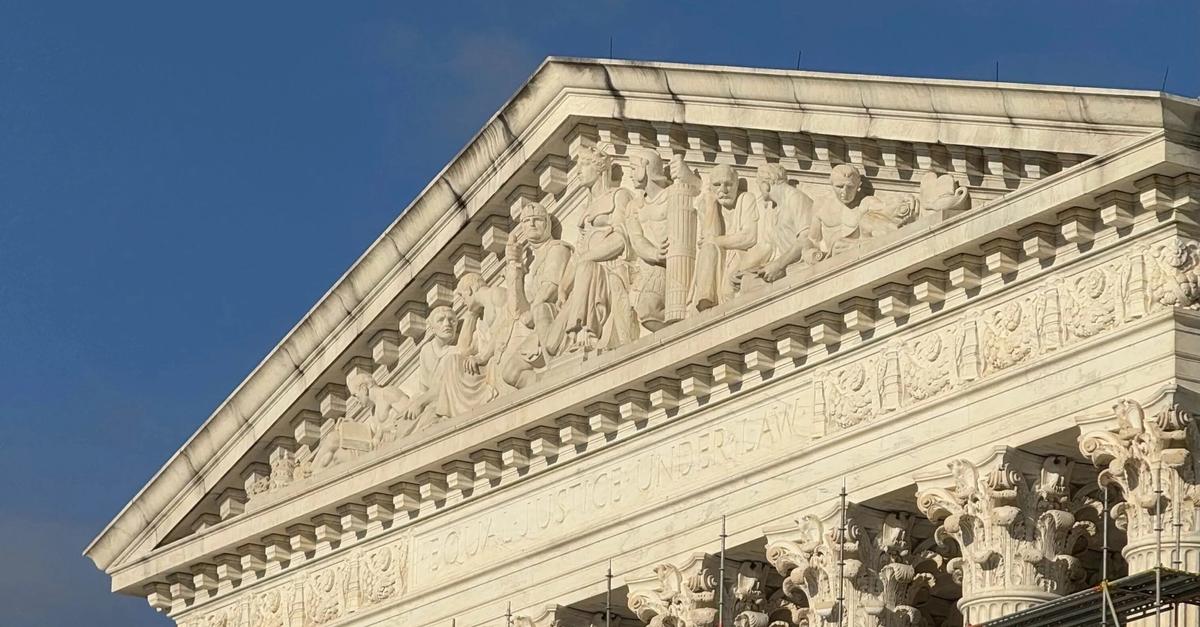
On this day in 1965, the Senate confirmed the appointment of Abe Fortas to the Supreme Court. Fortas ultimately served on the court for under four years, resigning in May 1969 amid a financial scandal and potential impeachment effort.
Read more The court should hold oral argument outside of the capital
At the Court
On July 27, the Trump administration asked the Supreme Court on its emergency docket to clear the way for the implementation of President Donald Trump’s executive order on mail-in voting. Twelve states – led by Alabama – later echoed this request in their own application. Last week, the group of 23 states and the District of Columbia challenging the order the court to deny these requests. The matter is now fully briefed, and the court’s ruling could come at any time.
Morning Reads
The Delusions of John Roberts
Margaret Talbot, The New Yorker
In a profile of Chief Justice John Roberts, The New Yorker explored Roberts’ path to the Supreme Court and how he, as chief justice, is navigating the Trump era. “[I]t must be confounding to have Roberts’s job these days,” Margaret Talbot wrote. “In one sense, he’s been getting so much of what he has long believed in: the weakening of the administrative state, the enlargement of Presidential power, and the rollback of affirmative action and of voting-rights protections for minorities, which he thinks our society no longer needs.” But he “is compelled to deal with a President especially likely to abuse” the power he’s gained. “For a man like Roberts, to whom the label ‘institutionalist’ attaches like an epithet in the Odyssey, perhaps the only thing worse than Trump’s excoriation of the Justices is his gratitude when they do what he wants.”
After Supreme Court Win, Trump Officials Under Pressure to Deport Haitians
Madeleine Ngo and Hamed Aleaziz, The New York Times
In a June 25 ruling on the Temporary Protected Status program, the Supreme Court cleared the way for the Trump administration to end deportation protections for about 350,000 Haitian nationals. Now, “[t]he Trump administration is facing pressure on the right to ramp up arrests of” these Haitians, but struggling to navigate a number of issues, according to The New York Times. “[L]ogistical challenges to deporting such a large group to an unstable country, and a lack of internal guidance within Immigration and Customs Enforcement, have complicated the effort. Some Republican politicians have also voiced concerns about the impact on certain industries if Haitian workers were deported en masse.”
Trump’s attack on ‘birth tourism’ faces uphill legal battle after Supreme Court ruling
Andrew Chung, Reuters
On Thursday, President Donald Trump signed two executive orders on birthright citizenship and “birth tourism” – that is, travel by pregnant woman to the United States so that their babies will have U.S. citizenship. Legal scholars told Reuters that the restrictions on birth tourism are unlikely to withstand Supreme Court scrutiny because the court’s June ruling on Trump’s original birthright citizenship order said “[t]hese children are citizens based on their birth on U.S. soil.” Scholars were more “divided over whether courts might allow” Trump “to expand historical exceptions to automatic birthright citizenship” by, for example, widening the exception that applies to the “children of diplomatic representatives” to include the children of “foreign government employees.” “Expanding the category of diplomats is potentially legal, depending on how it is done, said [Amanda] Frost, ‘though that requires giving those people significant immunity from U.S. law.’”
Tenn. death row inmate asks US Supreme Court to halt Thursday execution
NewsChannel5 Nashville
Attorneys for Anthony Darrell Dugard Hines, who was sentenced to death in Tennessee for the murder of Catherine Jenkins, have asked the Supreme Court to halt his execution, scheduled for Thursday. “The attorneys argue Hines faces a heightened risk of severe pain because of his medical condition and concerns surrounding Dr. Mark Fowler, a physician who participated in Tennessee’s failed attempt to execute Tony Carruthers in May. Carruthers’ May 21 execution was stopped after the state’s execution team was unable to establish the necessary IV access,” according to NewsChannel5 Nashville. “Hines, 66, has suffered two strokes this year and is partially paralyzed, according to his attorneys,” who say these conditions will complicate the execution process.
Author of ‘How to Kill a Federal Judge’ convicted on multiple counts
Shirley Henderson, ABA Journal
Phillip Ivers, 73, author of a book titled How to Kill a Federal Judge, “was found guilty Friday of two counts of distributing threatening communications and one count of threatening members of the judiciary,” according to the ABA Journal. Ivers was previously convicted in 2019 “of plotting to kill U.S. District Judge Wilhelmina Wright of the District of Minnesota and sentenced to 18 months in prison.” He was arrested again in 2025 after being discovered “printing copies of his book at a library in Wayzata, Minnesota.” “Prosecutors said Ivers informed police that he also sent copies of his book to all nine U.S. Supreme Court justices.”
On Site
12 angry men – or six?
By Anastasia Boden
In her In Dissent column, Anastasia Boden revisited Williams v. Florida, a 1970 case in which the court held that 12-person juries are not required under the Sixth Amendment. “Justice Thurgood Marshall dissented,” contending “that the court had cast aside both the historical meaning of ‘jury’ and an unbroken line of precedent,” according to Boden. The court will again consider whether juries must have 12 members this fall in Kian v. Florida.
The Supreme Court and the Indian nations
By Joseph William Singer
In a column for SCOTUSblog, Joseph William Singer explored the Supreme Court’s “complicated role in shaping the legal relationship between Indian nations and the United States and the state governments.” “[E]ven as Congress and the president have come to favor tribal sovereignty,” Singer wrote, an old debate over whether the Indian nations are to be treated as “independent political communities” or “savages” “continues to haunt the Supreme Court’s understanding of American law.”
Homer Plessy
This is the third entry in our series of Closer Looks on some of the most famous Supreme Court plaintiffs.
Homer Plessy, the plaintiff in the notorious 1896 case of Plessy v. Ferguson, in which the Supreme Court upheld the constitutionality of the doctrine of “separate but equal,” is generally believed to have been born on March 17, 1862 or 1863, in New Orleans. His father, Joseph, a carpenter, and his mother, Rosa Debergue, a seamstress, were both free Creole peoples of French and African descent. Plessy’s paternal grandfather Germain Plessy was a white Frenchman who moved to New Orleans after the Haitian Revolution. Both of his maternal grandparents were multiracial.
Plessy grew up in Louisiana during the Reconstruction era when Black political participation expanded and schools were integrated.
Plessy’s father passed away when he was around only seven years old. Two years later, his mother married Victor M. Dupart, a clerk for the U.S. Postal Service, who also worked on the side as a shoemaker. Dupart was likely responsible for one of Plessy’s first introductions to civil rights activism. Dupart was a member of the Unification Movement of 1873, a multiracial coalition that pushed for racial equality.
Read more Court announces cases it will hear in November, including religious discrimination dispute
Plessy, like his stepfather, became a shoemaker. Also like his stepfather, he was active in civil organizing in Louisiana when many of Reconstruction’s gains were dismantled and Jim Crow segregation was imposed. In 1887, he the vice president of the Justice, Protective, Educational, and Social Club, an organization that worked to ensure “our rights as citizens of this State and of the United States [are] protected and respected.”
In 1890, Louisiana passed the Separate Car Act, which required separate railcars for Black and white passengers. Under this law, Plessy, who himself as “seven-eighths Caucasian and one-eighth African blood,” was classified as “colored.” Plessy, through the Comité des Citoyens (Committee of Citizens), a civil rights organization, agreed to be a plaintiff for a test case to challenge the constitutionality of the Separate Car Act.
On June 7, 1892, Plessy bought a first-class ticket for a train from New Orleans to Covington, Louisiana, on the East Louisiana Railroad Company’s Number 8 train. The conductor, J.J. Dowling, approached Plessy and asked him, “Are you a colored man?” After Plessy answered in the affirmative, Dowling said: “Then you will have to retire to the colored car.” After refusing to move cars, a private detective, Chris Cain, along with a group of passengers, forced Plessy out of the train. Notably, Dowling, Cain, and the East Louisiana Railroad Company were all aware that Plessy was attempting to establish standing for a test case and were in contact and cooperating with the Comité ahead of time.
Plessy was charged with violating the Separate Car Act, and he argued that this was unconstitutional under the Constitution’s 13th and 14th Amendments. In November 1892, Judge John Howard Ferguson upheld the legality of the act. A month later, the Louisiana Supreme Court unanimously Ferguson’s decision. Plessy appealed to the U.S. Supreme Court.
In May 1896, the Supreme Court held that the Separate Car Act did not violate the Constitution’s 13th or 14th Amendments, establishing the doctrine of “separate but equal,” which allowed for the government to racially segregate groups if the facilities were of “equal” quality. Justice John Marshall Harlan wrote the sole dissenting opinion, declaring that “[o]ur Constitution is color-blind, and neither knows nor tolerates classes among citizens.” Nearly 60 years later, in the case of Brown v. Board of Education, the Supreme Court rejected Plessy’s “separate but equal” doctrine in the educational context, a decision that eventually led to the dismantling of the framework upheld in that case.
After the Supreme Court’s decision, Plessy to Ferguson’s courtroom where he entered a guilty plea and paid a $25 fine for violating the Separate Car Act.
Following the case, Plessy returned to life. The formation of major shoemaking companies resulted in a decline in local shoemakers, so Plessy sought employment in other fields, as a laborer, clerk, warehouseman, and an insurance collector. He remained active in New Orleans’ philanthropic and fraternal organizations the Société des Francs-Amis, the Cosmopolitan Mutual Aid Association, and the Scottish Rites Masons.
Plessy passed away on March 1, 1925. He was interred in the Debergue-Blanco family tomb in Saint Louis Cemetery located in New Orleans. In 2022, Louisiana Governor John Bel Edwards posthumously pardoned Plessy. The proclamation signed by Edwards praised Plessy for his “heroism and patriotism,” as well as his “unselfish sacrifice to advocate for and to demand equality and human dignity for all of Louisiana’s citizens.”
SCOTUS Quote
MR. MARTIN, JR.: “… Now, I think that you were right that for example the Indians were complaining that so much fishing was being allowed out in the Sound that no fish can get back to the river, perhaps they would have a right to bring a suit and perhaps the Secretary –”
JUSTICE BLACK: “Does the government have a right to bring one? Does the Attorney General have the right to bring [a suit] on the part of the Indians?”
MR. MARTIN, JR.: “Well, I think it may be possible being Secretary of Interior in view of his wide jurisdiction and they might have such a right.”
JUSTICE BLACK: “But why couldn’t [that] be done? Why should it be thrown into our lap in this vague fashion?”
Read more Weakening the protection against sex discrimination?
MR. MARTIN, JR.: “ … I didn’t throw it there.”
— Puyallup Tribe v. Department of Game of Washington (1968)