
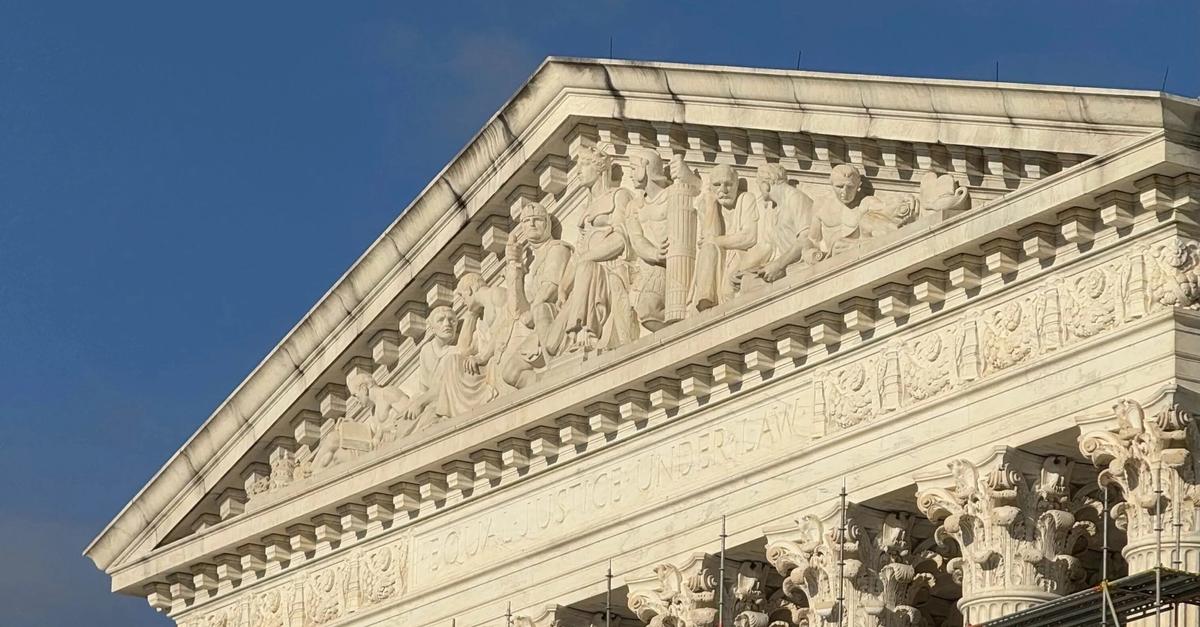
On this day in 1937, the Senate confirmed the appointment of Hugo Black to the Supreme Court. Black went on to serve for just over 34 years, and he remains among the longest-serving justices in the history of the court.
Read more Trump brings ballroom dispute to the Supreme Court
At the Court
On Friday, the Trump administration urged the Supreme Court to pause a lower-court ruling that would halt construction of a new White House ballroom. For more on the dispute, see the On Site section below.
The court will release the second of three summer order lists this morning at 9:30 a.m. EDT. (We discussed what these lists typically address in our July 13 newsletter.)
On July 27, the Trump administration asked the Supreme Court on its emergency docket to clear the way for the implementation of President Donald Trump’s executive order on mail-in voting. Twelve states later echoed this request in their own application. One week later, the group of 23 states and the District of Columbia challenging the order the court to deny these requests. Last Wednesday, the Trump administration the justices to “promptly” issue their decision.
Morning Reads
Supreme Court emergency docket roars back
Zach Schonfeld, The Hill
We’re in the midst of the court’s summer recess, but emergency docket work is ramping up, not slowing down. The justices are weighing two high-profile requests from President Donald Trump – on “his mail ballot restrictions and … White House ballroom construction” – and received several other emergency applications just in the past week, addressing “a contempt fight from Apple, an execution and even an effort to save a ‘vicious’ dog from euthanasia,” according to The Hill. The Trump requests “again put[] the high court in the hot seat after its string of key rulings on other aspects of Trump’s agenda.”
Angry at the Supreme Court, liberals push a slew of plans for overhauling it
Julian Mark, The Washington Post
After “significant conservative victories that pared back the 1965 Voting Rights Act, loosened campaign finance rules and increased presidential power” during the 2025-26 term, Democrat-led “proposals to overhaul the Supreme Court have reached something of a fever pitch,” according to The Washington Post. “One bill proposes increasing the number of Supreme Court justices from nine to 13. Another would cut their lifetime terms to 18 years. Others would create an enforceable ethics code and place standards on how the court rules from its relatively opaque ‘shadow docket.’” “There’s constant and building dismay about the increasingly appalling record of the court,” said Sen. Sheldon Whitehouse, a Democrat from Rhode Island, to the Post. “And I think the continuing interest in reform springs from continued dismay and concern about the court’s misbehavior.”
Appeals court dodges major ruling on Trump’s contentious use of obscure deportation law
Lawrence Hurley, NBC News
Last year, President Donald Trump tried to use “an obscure law called the Alien Enemies Act to deport alleged Venezuelan gang members.” The resulting lawsuit made it to the Supreme Court’s emergency docket, where the justices “blocked the government from immediately removing the alleged Tren de Aragua gang members without offering them any opportunity to challenge the move.” The Supreme Court sent the case back to the U.S. Court of Appeals for the 5th Circuit, where “a three-judge panel ruled against Trump” and then “the full 17-member court … agreed to rehear the case,” according to NBC News. On Thursday, the en banc 5th Circuit “dismissed the case because the Trump administration has now removed all three plaintiffs from the U.S. using alternative legal authorities.” “This development is unobjectionable,” wrote Judge Jennifer Walker Elrod. “The Supreme Court expressly said that the government could remove the named petitioners and putative class under other laws.”
ICE keeps racking up losses at the appeals courts on mandatory detention
Kyle Cheney, Politico
On Thursday, the U.S. Court of Appeals for the 1st Circuit became the seventh federal appeals court to reject the Trump administration’s effort to subject noncitizens apprehended within the country to mandatory detention without the “chance for a bond hearing to prove they could live safely in their communities.” A divided 1st Circuit panel “ that the Trump administration’s massive expansion of detention without bond was a distortion of decades-old immigration laws that were aimed primarily at recent border-crossers, not those who have resided in the country for years,” according to Politico. Federal appeals courts are now split 7-2 over this issue, “and both judges and attorneys expect the [Supreme Court] to jump at the chance to resolve an issue that has overwhelmed the courts for a year.”
Trump’s State Voter Rolls Push Wins Over More Appeals Judges
Eric Heisig, Bloomberg Law
On Friday, the full U.S. Court of Appeals for the 6th Circuit announced that it will not rehear a case on the Justice Department’s effort to access “Michigan’s unredacted voter rolls, though nine Republican appointees signaled some support for the Trump administration’s arguments,” according to Bloomberg Law. That backing was notable, because, until now, the Justice Department’s effort to collect voter rolls from “numerous states and Washington, DC” has garnered very little support from federal judges. “The department has had no success in cases where courts have ruled; 22 trial judges have also sided against it, most recently in Nevada on Friday. With cases pending before several other appeals courts, the issue appears destined for the US Supreme Court.”
On Site
Trump brings ballroom dispute to the Supreme Court
By Amy Howe
The Trump administration came to the Supreme Court on Friday, asking the justices to allow construction of the new White House ballroom to continue while a challenge to the project continues in the lower courts. U.S. Solicitor General D. John Sauer described the ruling by a federal district court that had temporarily blocked construction as “extraordinary and unlawful.”

Who exactly are the “friends of the court”?
By Amy Howe
From OT2016 through the beginning of OT2026, the Supreme Court made 24 amicus appointments, choosing lawyers to defend a lower-court decision. Of those 24 appointments, 19 (79%) were men, the vast majority of them white. And only two of the appointed amici did not clerk at the court. Amy analyzed the potential significance of this.
Understanding the court’s next major case on asylum seekers: Wassily v. Blanche
By Duncan Fulton
In a column for SCOTUSblog, Duncan Fulton explored Wassily v. Blanche, a case that will be argued during the 2026-27 term on “whether asylum beneficiaries are barred from obtaining lawful permanent residency if their asylum status has been terminated.” Fulton asserted that the case “is of considerable significance,” because “policy changes by the Trump administration have exposed far more immigrants to” potential termination of asylum status.
Read more Understanding the court’s next major case on asylum seekers: Wassily v. Blanche
So you want to attend an oral argument this term?
As Nora wrote about in her explainer on the Supreme Court lottery last year, the court launched a pilot program in December 2024 that allows members of the public to enter a “lottery” and apply online for the chance of a seat at oral argument – an alternative to camping out in front of the court with hopes of getting a spot the (now) “old-fashioned” way.
The lottery system continued through the 2025-26 term, and assuming no major changes are made, will again be implemented for the upcoming one. The window to enter the lottery begins “shortly after the calendar for a monthly argument session is released,” and, indeed, the clock is now running for the October and November argument sessions.
If attending an oral argument is a bucket-list item for you (or one of your friends or family members), here’s a quick recap of how the process works and what you need to know:
The mechanics are less painful than “government website” would suggest. As mentioned, applications open shortly after a monthly calendar is posted; you can either go to the Supreme Court website, and from there to “Courtroom Seating” (under the “Oral Arguments” dropdown) or directly to the Supreme Court’s “Online Ticketing” site. Once there, you click the blue “Continue” button, click a highlighted day on the reservation system’s calendar, and follow the prompts. The main thing to pay attention to here is that after you submit, the court sends you a validation email to the address you entered, and you have four hours to click through before your application lapses.
Applications for a given argument close four weeks before the argument date. Three weeks out, the court emails every applicant with one of three answers – selected, not selected, or waitlisted. Waitlisted applicants can still be called up as late as one business day before argument. If you are selected, you have 24 hours to confirm, after which your seat goes to someone else.
Each person may enter only once per argument, and a single application can cover up to four people, who are entered as a unit (either the whole group gets seats or none of them do). Submitting duplicate entries can get you disqualified, and there is no working the refs: the court’s FAQ states that the selection process is “entirely automated.”
Your odds depend heavily on the case (if more people enter, that means there’s less of a chance that you will be chosen at random), and tickets are non-transferable. If your plans change, cancel through the link in your ticket email; not showing up can cost you eligibility for future lotteries.
On the morning of the argument, plan to arrive an hour before it is scheduled to start, entering through the south visitor’s entrance beneath the right side of the front steps. Bring the ticket, printed out or on your phone, plus your ID. Since electronics (phones, smart watches, cameras, tablets) can’t come into the courtroom, you will put them in the lockers available downstairs. Attendees for the 10 a.m. argument are seated 15 to 30 minutes before the session begins.
If the lottery doesn’t break your way, seats are still set aside for people in line the morning of argument. Oh, and for anyone who can’t use the online system, the court accepts entries by phone or mail to the Marshal’s office.
SCOTUS Quote
MR. BROWNING: “Mr. Chief Justice, if I first can turn to your point and then respond to Justice Breyer’s question.”
Read more Who exactly are the “friends of the court”?
JUSTICE BREYER: “It’s the same point.”
CHIEF JUSTICE ROBERTS: “It’s the same point.”
— (2013)