
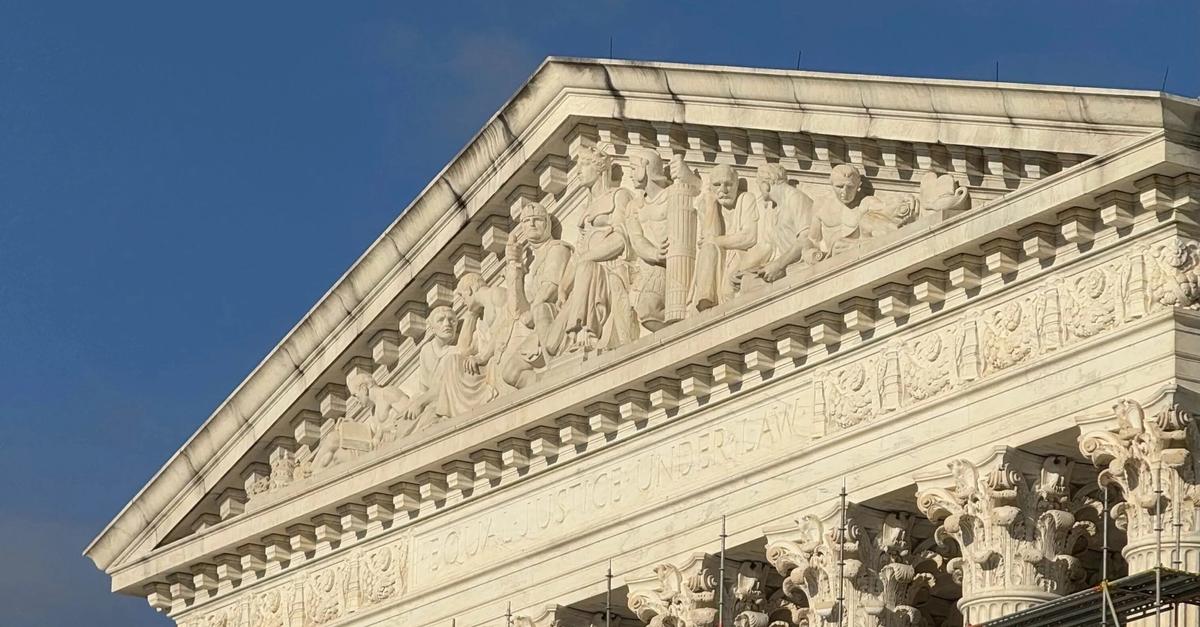
Forty-five years ago, President Ronald Reagan formally nominated Sandra Day O’Connor to the Supreme Court, fulfilling his campaign promise to appoint a woman. In a February closer look, we covered women on the Supreme Court shortlist in the years before O’Connor’s nomination.
Read more Supreme Court urged to leave in place order blocking construction of White House ballroom
At the Court
On Friday, the Trump administration urged the Supreme Court to pause a lower-court ruling that would halt construction of a new White House ballroom. The National Trust for Historic Preservation, the private nonprofit challenging the construction project, to this request on Tuesday, asking the court to leave the ruling in place. Find Amy’s coverage of the filing in the On Site section below.
Also on Tuesday, the court a request for a stay of execution from William Frances Silvia, who was sentenced to death for the murder of his estranged wife, Patricia Silvia, and attempted murder of her mother, Betty Woodard. Hours later, Silvia was executed in Florida.
On July 27, the Trump administration asked the Supreme Court on its emergency docket to clear the way for the implementation of President Donald Trump’s executive order on mail-in voting. Twelve states later echoed this request in their own application. One week later, the group of 23 states and the District of Columbia challenging the order the court to deny these requests. Last Wednesday, the Trump administration the court to “promptly” issue its decision.
Morning Reads
US judge allows Trump to end thousands of Ethiopians’ deportation protections
Nate Raymond, Reuters
With its June 25 ruling in Mullin v. Doe, the Supreme Court cleared the way for the Trump administration to end deportation protections for Haitian and Syrian nationals under the Temporary Protected Status program. The decision had ripple effects for several other TPS lawsuits, including a challenge to the administration’s effort to end legal protections for around 5,000 Ethiopian nationals. On Tuesday, the judge in the Ethiopia case, U.S. District Judge Brian Murphy, lifted his order protecting such individuals, which had been the last remaining “judicial block on the U.S. Department of Homeland Security terminating the Temporary Protected Status designation for individual countries,” according to Reuters. “James Percival, DHS’ general counsel, hailed the decision in a social media post. ‘All TPS terminations are in effect!’ he wrote.” Reuters noted that, although the Ethiopian nationals involved in the dispute before Murphy are now at risk for deportation, his order allows them “to continue to litigate over whether DHS’s action was motivated by racial or national origin animus in violation of the U.S. Constitution’s Fifth Amendment.”
DOJ asks court to reinstate Abrego Garcia charges
Sarah Davis, The Hill
On Monday, the Justice Department the U.S. Court of Appeals for the 6th Circuit to reinstate human smuggling “charges against Kilmar Abrego Garcia, following a lower court order earlier this year that found the Salvadoran man was the subject of a likely vindictive prosecution,” according to The Hill. In his order, U.S. District Judge Waverly Crenshaw had concluded that DOJ officials abused their “prosecuting power” by bringing the human smuggling charges, which are “connected to a 2022 traffic stop,” against Abrego Garcia after mistakenly deporting him to El Salvador last year. Abrego Garcia “reentered the U.S. in June 2025 after the Supreme Court said the White House must ‘facilitate’ his return.” In their Monday filing at the 6th Circuit, federal prosecutors contended that “[t]he government had an obvious interest in protecting the public by prosecuting Abrego after courts ordered his return.”
How the Supreme Court Kicked Off America’s Sports Betting Addiction Crisis
Madiba K. Dennie, Talking Points Memo
In a column for Talking Points Memo, Madiba K. Dennie argued that the Supreme Court’s 2018 ruling striking down a law “that prohibited sports gambling throughout much of the country” led to the current sports gambling crisis. “Before the Court’s decision in Murphy v. National Collegiate Athletic Association, only four states authorized some form of sports betting. One year after Murphy, 19 states and the District of Columbia authorized sports betting. Today, 39 states and Washington, D.C., have laws authorizing sports betting. Most allow people to place mobile bets, which means that millions of Americans now carry an addictive bankrupting device in their pockets,” Dennie wrote.
How the Supreme Court could use Trump’s ballroom to gut environmental law
Ian Millhiser, Vox
In a column for Vox on the White House ballroom dispute on the Supreme Court’s emergency docket, Ian Millhiser contended that the court’s determination as to whether the National Trust for Historic Preservation has standing to challenge the construction project “could have major ramifications for a wide range of laws that seek to conserve environmental resources or preserve sacred or historical sites” if it throws into question past rulings in which the court “held that plaintiffs who wish to observe something beautiful may often sue to enforce environmental statutes that seek to preserve that beauty.” “The stakes in [the case], in other words, are far greater than whether Trump can replace the East Wing with an eyesore,” Millhiser wrote. A win for Trump “could fundamentally wound America’s environmental protection regime.”
On Site
Supreme Court urged to leave in place order blocking construction of White House ballroom
By Amy Howe
Lawyers for the National Trust for Historic Preservation urged the Supreme Court on Tuesday afternoon to leave in place a ruling by a federal court in Washington, D.C., that would temporarily block construction of a new White House ballroom. Gregory Craig, who served as the White House counsel during the Obama administration, accused the Trump administration of “trying to outrun judicial review” by expediting construction on the ballroom so that “it will soon be ‘virtually impossible to deconstruct.’”
What if one vote had changed in the birthright citizenship case?
By Joshua R. Averbach & Roy T. Englert, Jr.
In a column for SCOTUSblog, Joshua R. Averbach and Roy T. Englert, Jr. explored what would have happened if one more justice had dissented in the birthright citizenship case, creating a 4-1-4 split. Under Supreme Court precedent, when the court “fails to produce a majority opinion, ‘the holding of the Court may be viewed as that position taken by those Members who concurred in the judgments on the narrowest grounds,’” but lower courts and commentators disagree on how to apply this precedent.
The chief justice should share much of his power
By Josh Blackman
For his series on what the Supreme Court can do better, Josh Blackman wrote about why he believes the chief justice should delegate his duty to preside over oral argument and the justices’ private conferences. “This reform would allow junior members to have a greater impact on the court and its practices,” Blackman wrote, and prevent the chief, “who is assigned zero powers at the court by the Constitution,” from “exercising sweeping powers for life.”
Podcasts
Trump’s Ballroom Blitz
Sarah Isgur and David French discuss President Donald Trump’s appeal to the Supreme Court on the construction of a White House ballroom, a religious liberty case about permits and prayer services, and a bit of reality TV litigation.
Ask Amy
Q: How do Supreme Court reporters coordinate or compete during “major” releases?
A: To be honest, there’s not a lot in the way of “competition” during “major” releases of opinions or orders. The Supreme Court is in many ways notoriously opaque, but it issues all of its opinions and orders to everyone at the same time – usually, both in person, by handing them out at the court’s Public Information Office, and online. (Major leaks are a different issue, and we are impressed by, but have a friendly envy of, our colleagues who land big scoops.)
Supreme Court reporters do sometimes coordinate informally when the court releases order lists, which (depending on the time of year) can be quite long. When we’re in the press room with paper copies of the lists in our hands, someone may shout “no grants” to confirm quickly that the court has not added any cases to its merits docket. Or if there is a particular case that we’re all following, someone may flag where the court has acted on it (or if it didn’t do so).
The Public Information Office’s distribution of orders and opinions can be chaotic on “big” days, but it’s also collegial. By tradition, reporters for “the wires” – Reuters, the Associated Press, and Bloomberg – get the spots closest to the desk from which orders or opinions will be handed out, so that they can dash quickly back to their cubicles. After that, it’s a free for all, but even then, reporters near the desk will often hand a copy back to colleagues who are further away.
SCOTUS Quote
GENERAL VERRILLI: “… And I will say, I do think, as the number of minority enrollees gets higher, the burden on the university to do that is going to get harder to meet. But I don’t think – I don’t think there is a number, and I don’t think it would be prudent for this Court to suggest that there is a number, because it would raise exactly the kind of problem that I – that I think Justice Kennedy identified in the Grutter dissent of creating hydraulic pressure towards that number.”
JUSTICE SCALIA: “We should probably stop calling it critical mass then, because mass, you know, assumes numbers, either in size or a certain weight.”
Read more What if one vote had changed in the birthright citizenship case?
GENERAL VERRILLI: “I agree.”
JUSTICE SCALIA: “So we should stop calling it mass.”
GENERAL VERRILLI: “I agree.”
JUSTICE SCALIA: “Call it a cloud or something like that.”
— (2012)