
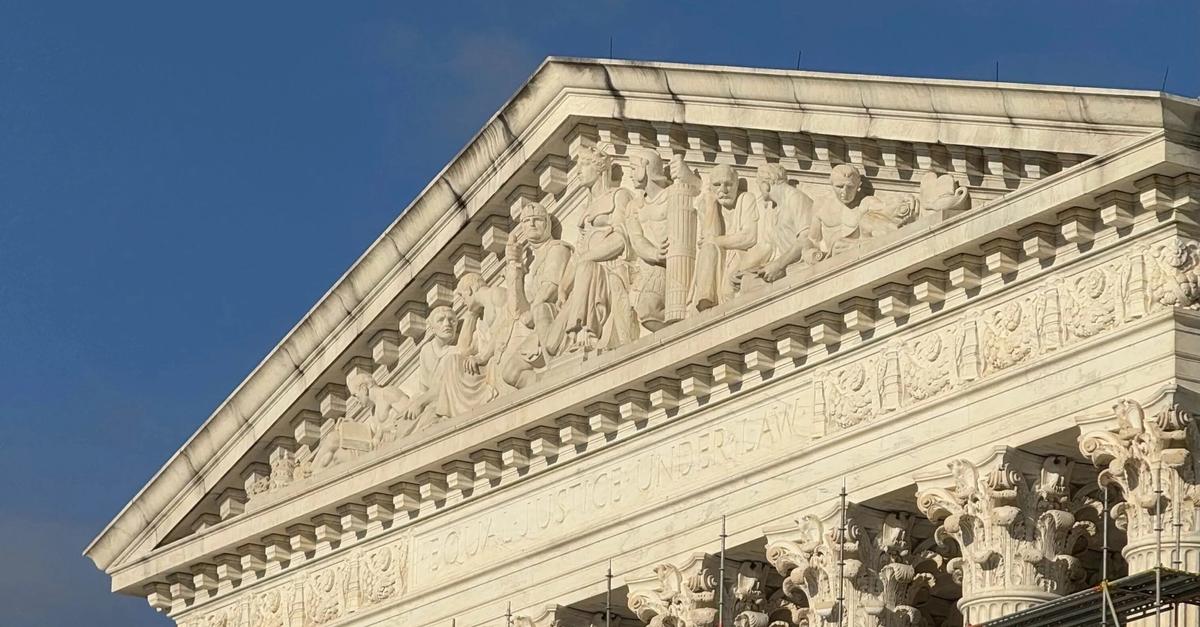
Yesterday marked 59 years since the Senate confirmed the nomination of Thurgood Marshall to the Supreme Court, clearing the way for him to become the first Black justice.
Read more Trump administration asks Supreme Court to consider ban on transgender persons in the military
At the Court
On Friday, the Trump administration the Supreme Court to consider the constitutionality of its ban on transgender service members in the military. For more on its petition for review, see the On Site section below.
On Aug. 21, Chief Justice John Roberts issued a , known as an administrative stay, allowing construction on the new White House ballroom to continue for now. The court could release its decision in the interim docket case at any time.
This Friday at 9:30 a.m. EDT, the court will release its third and final summer order list. (We discussed what these lists typically address in our July 13 newsletter.)
Morning Reads
US judge questions but won’t yet block Trump’s new birthright citizenship order
Blake Brittain and Nate Raymond, Reuters
On Friday, U.S. District Judge Deborah Boardman in Maryland “declined to immediately block U.S. President Donald Trump’s newest executive order limiting the number of people eligible for birthright citizenship, even as she sharply questioned its viability after the U.S. Supreme Court rejected his previous effort to do so,” according to Reuters. Boardman had been asked to impose “a temporary restraining order … by immigrant rights advocates who had last year secured a ruling from her blocking the Trump administration from enforcing his initial 2025 executive order curtailing birthright citizenship.” Boardman determined that she was unable to impose such an order at this time “because the plaintiffs’ [preexisting] lawsuit did not even mention Trump’s 2026 order.” However, “she said she would allow the groups to supplement their complaint and set a swift briefing schedule for the plaintiffs to once again challenge the order.”
Trump Administration Appeals Ruling Halting Mail-In Voting Rules
Zach Montague, The New York Times
On Thursday, U.S. District Judge Indira Talwani imposed a new block on President Donald Trump’s executive order on mail-in voting, preventing the U.S. Postal Service from imposing new restrictions on mail-in ballots. On Friday, the Trump administration her decision to the U.S. Court of Appeals for the 1st Circuit, “teeing up another series of legal decisions about whether the U.S. Postal Service can make changes to how ballots are handled ahead of the midterm elections,” according to The New York Times. The USPS seeks to enforce a new rule under which it “would not deliver mail ballots in states that do not share voter data with the agency” and “only deliver ballots that meet certain criteria,” including that they are mailed in specific types of envelopes. Talwani found that the rule “was likely unconstitutional and exceeded the agency’s authority.” The Times noted that the “issue will likely be settled by the Supreme Court.”
U.S. appeals court rules against prediction markets, sets up likely fight at Supreme Court
Davis Giangiulio, CNBC
On Friday, the U.S. Court of Appeals for the 9th Circuit “ prediction market platforms’ requests for injunctive relief against the Nevada Gaming Control Board, concluding that sports-related event contracts are not a derivative regulated by the federal government” and are, instead, subject to state gambling laws, according to CNBC. “Under scrutiny were the platforms’ sports-related event contract offerings, which 44 states argue are nothing more than sports betting. However, the platforms – and their federal regulator, the Commodity Futures Trading Commission – claim all event contracts, no matter the topic, are swaps. Swaps are a type of derivative under the purview of the CFTC, and the agency asserts that it has the exclusive jurisdiction to regulate all event contracts.” CNBC noted that “[l]egal experts have widely expected that the question of sports-related event contracts, and whether state gaming regulators or the CFTC has the right to regulate them, will eventually reach the Supreme Court,” adding that this “now appears very likely, as the 9th circuit’s decision contradicts a ruling from the 3rd U.S. Circuit Court of Appeals,” creating what’s known as a circuit split.
Appeals court delivers unsettling ruling — and says Supreme Court left it no choice
Elaine Mallon, Fox News
Last week, the U.S. Court of Appeals for the 7th Circuit determined that “decades-old Supreme Court precedent forced it to protect the in-home possession of AI-generated child sexual abuse material,” according to Fox News. “The Seventh Circuit said it was bound by a 2002 Supreme Court decision that rejected restrictions on sexually explicit depictions of fictional children when no actual child was involved in their creation. But two judges warned that modern AI can now generate images virtually indistinguishable from material depicting the abuse of real children.” “Technology may have overtaken and overwhelmed the reasoning used in those prior decisions,” said Hans von Spakovsky, a senior fellow with Advancing American Freedom, to Fox News.
Judge rejects Trump’s latest bid to challenge hush money conviction
Jeremy Roebuck, The Washington Post
On Friday, U.S. District Judge Alvin K. Hellerstein “rejected President Donald Trump’s latest bid to erase his hush money conviction, ruling he had waited too long to try to move the case” on efforts to conceal a payment made to adult-film actress Stormy Daniels “to federal court,” according to The Washington Post. Hellerstein also concluded that, even if Trump had acted sooner, “there was no legal basis for removal” to federal court, rejecting Trump’s contention that federal courts must assess how to apply the Supreme Court’s 2024 ruling on presidential immunity to the case. “There is no way that discussions regarding hush money payments to cover up the President’s relations with Stormy Daniels could be an official act,” Hellerstein wrote. “An affair, or a cover-up of an affair, is not within the ‘outer perimeter’ of the President’s official responsibilities.”
On Site
Trump administration asks Supreme Court to consider ban on transgender persons in the military
By Amy Howe
The Trump administration on Friday asked the Supreme Court to weigh in on whether a ban on transgender service members in the military violates the Constitution. U.S. Solicitor General D. John Sauer called a decision by a federal appeals court that barred the government from enforcing the ban “gravely erroneous.”
The Supreme Court of Israel
By Zachary Shemtob
For SCOTUSblog’s series on different supreme courts around the world, Zach spoke with law professor Keren Weinshall about the Supreme Court of Israel.
Read more The Supreme Court of Israel

The Supreme Court’s realignment roundup: October Term 2025
By Richard Re
In recent years, Richard Re has written about an unfolding “legal realignment,” observing that “legal views once associated with the right” have been embraced “by the left, and vice versa.” In his Controlling Opinions column, Re explored how this trend continued during the 2025-26 term.
When was Justice Barrett not in the majority?
Chief Justice John Roberts and Justice Brett Kavanaugh each landed in the majority 95% of the time during the 2025-26 term. But right behind them was Justice Amy Coney Barrett, at 92%. She was in dissent in five cases. (This is a slight increase from last year, when she was in the majority 89% of the time.)
While Roberts did not write separately in any of the three cases in which he was not in the majority, and Kavanaugh authored only a single dissent in one of his three, Barrett was more vocal: She wrote dissents – in T.M. v. University of Maryland Medical System Corp., Chatrie v. United States, and Trump v. Cook– and joined her colleagues’ dissents in Bowe v. United States and Pitchford v. Cain.
Barrett’s first break with the majority came in a 5-4 January decision resolving two complicated questions about federal habeas procedure. Justice Sonia Sotomayor, writing for the court in Bowe, held that the block on filing cert petitions in 28 U.S.C. § 2244(b)(3)(E) does not reach federal inmates clearly enough to strip the court of jurisdiction, leaving them free to ask the Supreme Court for review if an appellate panel denies them permission to file a successive motion – and that Section 2244(b)(1)’s bar on refiling the same claim does not reach federal inmates. Justice Neil Gorsuch dissented, arguing in Part I of his dissent that the statute’s text and structure extend the entirety of Section 2244(b)(3) to federal prisoners. In Part II of his dissent, he argued that the bar on repeat claims reaches federal prisoners, too. Justices Clarence Thomas and Samuel Alito joined in full; Barrett joined only Part I, the jurisdictional argument.
In late May, the court reversed and remanded in Pitchford, which concerned a Mississippi man sentenced to death. The 1986 case of requires a judge, when the defendant raises a claim that the peremptory strikes of jurors were conducted for race-based reasons, to run a three-step inquiry: the defendant makes a preliminary showing of discrimination, the prosecutor gives a race-neutral reason for each strike, and then the defense gets a chance to argue that reason is a pretext. Here, after the prosecutor struck four of the five Black prospective jurors, the trial judge seemingly declared his reasons to be race neutral and moved on, never reaching that third step. The Supreme Court held 5-4 that the Mississippi Supreme Court was unreasonable in ruling that Terry Pitchford had waived his chance to argue pretext. Kavanaugh wrote for the majority, joined by Roberts, Sotomayor, Elena Kagan, and Ketanji Brown Jackson. Barrett joined Gorsuch’s dissent in full alongside Thomas and Alito. Specifically, Gorsuch wrote that federal habeas law gave the state court far more room than the majority allowed, and that Pitchford had never made the pretext argument at trial in the first place.
Then, in June, Barrett released her first dissent of the term.
The court held 5-4 in T.M. v. University of Maryland Medical System Corp. that the Rooker-Feldman doctrine, which generally prevents federal district courts from reviewing state-court judgments, applies even when the state-court judgment is still subject to further review in state court. In a 12-page dissent, joined by the (unusual) trio of Roberts, Kagan, and Gorsuch, Barrett wrote that the doctrine “stands on shaky ground” and that prior caseshad deliberately kept its “footprint small” by confining it to suits filed “after the state proceedings ended.” “Still, the news is not all bad,” she wrote, because the majority “repeatedly emphasizes that the doctrine is ‘narrow.’”
Later in June, the court ruled 6-3 in Chatrie that law enforcement’s use of a geofence warrant to obtain Google location data was a “search” under the Fourth Amendment. Alito dissented, warning that the majority’s reasoning “will send seismic waves through our Fourth Amendment doctrine” even though it would not change the outcome for the petitioner in that specific case. Barrett joined Alito’s dissent as to several parts and also filed a dissent of her own. In a three-sentence opinion, Barrett wrote that she had “no quarrel with” Carpenter v. United States, the 2018 decision holding that police need a warrant to obtain historical cell phone records, or with the court’s decision to take the case. But she agreed with Alito that under existing precedent, including Carpenter, “Chatrie had no reasonable expectation of privacy” in data about his public movements that he had provided to Google.
Barrett dissented alone the same day in Cook, when the court denied the government’s application for a stay and left Federal Reserve Governor Lisa Cook in her seat. “[T]he constitutional status of the Federal Reserve is entirely outside the scope of this case,” she wrote, adding that the government “expressly waived any constitutional challenge to the removal restriction, so the parties did not brief it.” Barrett also asked how Cook was compatible with Trump v. Slaughter, allowing for the removal of a commissioner of the Federal Trade Commission, decided the same day: “How can history support both a categorical rule and a carveout?” Barrett asked.
Notably, four of the five cases in which Barrett dissented were 5-4 splits, with Barrett’s overarching theme being that the court should have decided the cases more narrowly (with the exception of Pitchford, where she would have had the state court’s ruling stand). As she put it in Cook, “[w]hile a modest approach would have been appropriate, the Court chooses to go big.”
SCOTUS Quote
JUSTICE KENNEDY: “Can you tell us how many attorneys and how many staff in the Justice Department are involved in the preclearance process? Is it 5 or 15?”
Read more The Supreme Court’s realignment roundup: October Term 2025
GENERAL VERRILLI: “It’s a – it’s a very substantial number and –”
JUSTICE KENNEDY: “Well, what does that mean?”
GENERAL VERRILLI: “It means I don’t know the exact number, Justice Kennedy.”
— (2013)