
Welcome to September, the final month of the justices’ summer recess. This time next month, we’ll be busy previewing the first oral arguments of the 2026-27 term.
Read more Republican groups file emergency application to court on broadcasting rates for political ads
At the Court
On Monday, the Supreme Court, by a 5-4 vote, the Trump administration’s request to allow construction on the new White House ballroom to continue. Chief Justice John Roberts wrote a dissenting opinion, joined by the court’s three Democratic appointees. For more on the decision, see the On Site section below.
Justice Samuel Alito’s for 2025 was released on Monday morning. Find Amy’s overview of it in the On Site section.
Two Republican groups have asked the court on its interim docket to block a decision by the U.S. Court of Appeals for the 4th Circuit preventing political parties and joint fundraising committees from paying preferential broadcast rates for political ads. For more on the request, see the On Site section.
Also on Monday, a Michigan group urged the court on its interim docket to require Michigan election officials to put on the November ballot its proposal for requiring proof of citizenship to vote in the state. Learn more about the request in the Morning Reads section.
This Friday at 9:30 a.m. EDT, the court will release its third and final summer order list. (We discussed what these lists typically address in our July 13 newsletter.)
Morning Reads
US Supreme Court asked to revive proof-of-citizenship plan in Michigan
Todd Spangler, Detroit Free Press
On Monday, Americans for Citizen Voting – Michigan, a group seeking to place a proposal for requiring voters in the state “to prove their citizenship status before voting” on the ballot for the Nov. 3 election, asked the Supreme Court on its interim docket to order “the Michigan Secretary of State’s office to declare the constitutional amendment proposal proper and order it placed on the November ballot ahead of the Sept. 4 meeting of the Board of State Canvassers to finalize the listing,” according to the Detroit Free Press. The emergency application addresses the board’s Aug. 24 vote on the proposal. “[T]he board deadlocked 2-2 along partisan lines over whether the group had provided enough valid petition signatures to place the proposal before the voters, effectively barring it” from appearing on the ballot. Americans for Citizen Voting claims “the board waited more than five months to raise questions about the signatures and then relied on a small sample the group does not consider representative of the whole” to make its decision.
Special education access case appealed to Supreme Court
Kara Arundel, K-12 Dive
Two Massachusetts families have filed a petition for review with the Supreme Court, asking the justices “to hear their challenge to a state regulation that allows their private school children to access public school special education services but only at a public school or a ‘neutral’ location,” according to K-12 Dive. “The families, whose children with disabilities attend Jewish day schools, said in their July 20 petition that the Massachusetts’ policy penalizes private school students who have a constitutional right to attend private schools but who want access to publicly funded special education services. They are asking the high court to determine whether its ‘unconstitutional conditions doctrine’ means that governments generally may not make a benefit like special education services conditional on surrendering their constitutional right to attend private schools.” K-12 Dive noted that “[t]he case highlights the tension building between those supportive of private school choice programs that use taxpayer funds and those protective of publicly funded services staying in public schools.”
$42 Million Abu Ghraib Jury Verdict Is Overturned on Appeal
Mattathias Schwartz, The New York Times
On Friday, the U.S. Court of Appeals for the 4th Circuit “overturned a landmark jury verdict that found a Virginia contractor liable for the abuse of three Iraqis detained” in Abu Ghraib prison more than 20 years ago, according to The New York Times. The same 4th Circuit panel “had previously upheld the verdict. But that was before the Supreme Court in June set new limits on the federal courts’ jurisdiction over violations of international law” in Cisco Systems, Inc. v. Doe I. The panel said “that the new precedent ‘effectively overruled’ their previous finding that U.S. courts had jurisdiction over the plaintiffs’ claims through the Alien Tort Statute,” which “gives non-U.S. citizens the right to sue in federal court for some violations of international law.” The former Abu Ghraib prisoners “could now file a new lawsuit, appeal to the Supreme Court, or ask [for] the case to be heard again by a larger appellate panel.”
March on Washington renews focus on voting rights after Supreme Court gutting
Adelle M. Banks, Religion News Service
A major Supreme Court ruling on voting rights was in the spotlight on Friday at a program commemorating the 63rd anniversary of the March on Washington. Speakers addressed Louisiana v. Callais, in which the Supreme Court in April curtailed a key provision of the Voting Rights Act. “The Callais decision by the Supreme Court shot a bullet in the heart of voting rights, but they don’t understand we’re not going back. We will not let them turn back the hands of time,” said the Rev. Al Sharpton at the event. Similarly, Martin Luther King III, the son of the Rev. Martin Luther King Jr., “decried the state of voting rights in America,” according to Religion News Service. “The fact that we still have to fight to maintain and renew voting rights in this country is beyond abysmal and a truly national disgrace,” he said.
On Site
Supreme Court allows construction on White House ballroom to continue
By Amy Howe
The Supreme Court on Monday paused a ruling by a federal judge in Washington, D.C., that would have halted above-ground construction of the new White House ballroom. In an eight-page, unsigned opinion, the majority emphasized that it was not deciding whether the project was legal. Instead, it stressed, the plaintiff likely lacks a legal right, known as standing, to challenge the project at all.

Justice Alito’s financial disclosure for 2025 is released
By Amy Howe
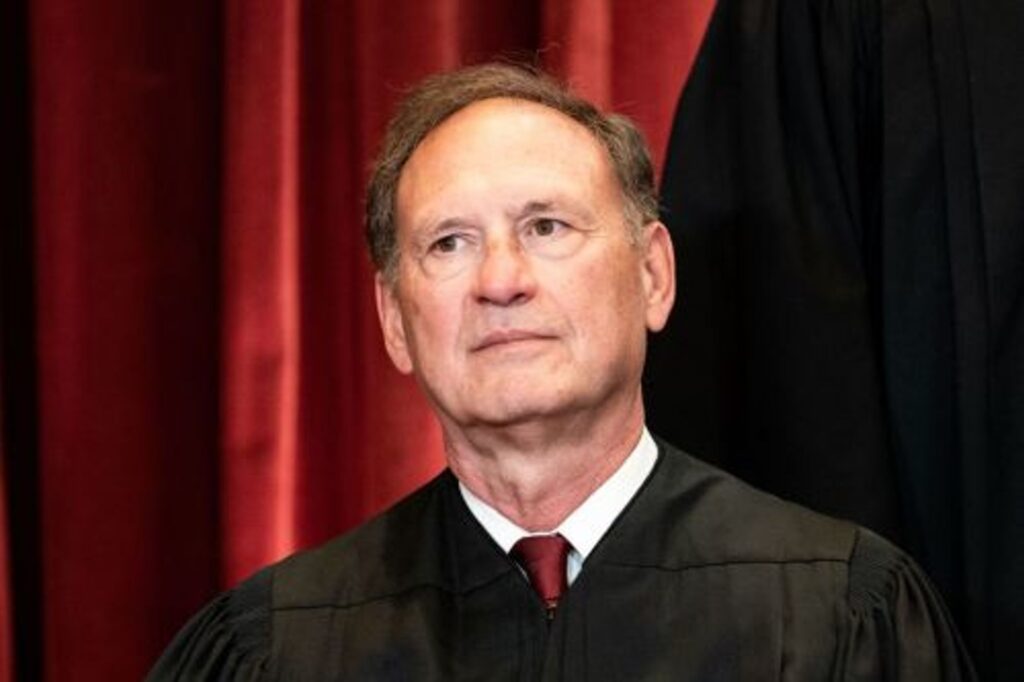
Justice Samuel Alito reported travel to the United Kingdom, Italy, and Arizona in 2025, as well as $33,333 in income from the publication of a book. The news came as part of Alito’s annual financial disclosure, which was filed on Aug. 11 and released on Monday morning.
Republican groups file emergency application to court on broadcasting rates for political ads
By Amy Howe
Two Republican groups asked the Supreme Court to temporarily pause a ruling by a federal appeals court that, they told the justices, “rewrote longstanding rules about preferential broadcast rates for political ads.” With the upcoming midterm elections just over two months away, the National Republican Congressional Committee and the National Republican Senatorial Committee urged the court to move quickly to block the decision by the U.S. Court of Appeals for the 4th Circuit.
The 3-3-2-1 court?
By Adam Feldman
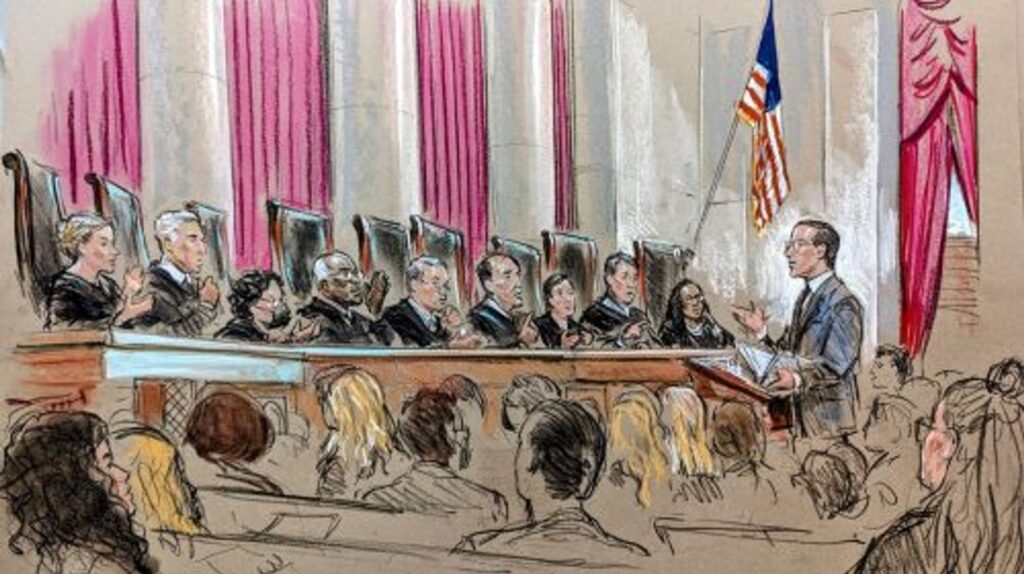
In his Empirical SCOTUS column, Adam Feldman built on his previous analysis of each justice’s judicial ideology by exploring how these results change if you look only at closely decided (6-3 or 5-4) rulings. Feldman found that “[t]he closely divided docket makes almost every justice look more ideological.”
The “born free and equal” clauses and Lawrence v. Texas
By Steven Gow Calabresi
In his Born Free and Equal column, Steven Calabresi highlighted the role of the “born free and equal” clauses in 2003’s Lawrence v. Texas, which struck down as unconstitutional so-called “sodomy” laws banning oral and anal sex. He explained why he believes the case was rightly decided but not for the reasons articulated in Justice Anthony Kennedy’s majority opinion.
Read more Supreme Court allows construction on White House ballroom to continue
Roscoe Filburn
This is the sixth entry in our Closer Look series about famous Supreme Court plaintiffs. Today, we look at Roscoe Filburn, the farmer who challenged the Agricultural Adjustment Act of 1938, which limited how much wheat could be grown on a farmer’s own land. In a landmark decision, the Supreme Court ruled against Filburn, holding that a lack of commercial activity can still allow congressional action under the commerce clause if it undermines interstate commerce.
Roscoe Curtiss Filburn was born on Aug. 2, 1902, in Dayton, Ohio. For five generations, Filburn’s maternal family labored as farmers in Ohio. His maternal grandparents, John and Susannah Smith, farmed 640 acres of land, which was ultimately divided among their seven children. Filburn’s mother, Mary Elizabeth, inherited the family home, 95 acres of farmland, and nine acres of woodland in what is now suburban Dayton.
Filburn would continue the family tradition and become a farmer himself. He grew crops and raised livestock. Filburn’s farm was apparently popular, selling fresh milk and eggs to about 75 customers per day. Additionally, Filburn grew winter wheat, which he would harvest in the summer. Filburn would then sell part of his yield but also use it to feed his cattle and poultry, make flour for personal use, and produce seed for the following season.
Congress passed the Agricultural Adjustment Act of 1938 to replace its predecessor, the Agricultural Adjustment Act of 1933. The AAA of 1938 was enacted in an effort to help prop up the struggling agricultural industry, which was dealing with crop surpluses and reduced income. Under the legislation, to control crop surpluses, the secretary of agriculture would create a national allotment of acres that could be used to produce wheat. The allotment would then be appropriated to states and ultimately to individual farmers.
Filburn’s allotment in 1940 was for 11.1 acres of wheat, but he planted 23 acres of it. By planting past his allotment, Filburn cultivated an extra 239 bushels of wheat. Administrators of the AAA fined Filburn 49 cents per excess bushel that he grew and placed a lien of $117.11 on his entire wheat yield.
Filburn challenged the excess penalty in court and a panel of three district court judges sided with him. Claude R. Wickard, the secretary of agriculture, appealed the decision directly to the Supreme Court. At the court, Filburn claimed that the wheat he grew would be entirely for personal use and did not implicate interstate commerce, and the fines – which Congress justified under the Constitution’s commerce clause – could thus not be enforced against him.
In a unanimous decision, the Supreme Court sided against Filburn. “That appellee’s own contribution to the demand for wheat may be trivial by itself is not enough to remove him from the scope of federal regulation where, as here, his contribution, taken together with that of many others similarly situated, is far from trivial,” Justice Robert Jackson wrote in his majority opinion.
The decision remains controversial to this day. Critics of Filburnargue that it gives Congress near unlimited power to enact regulations under the commerce clause. In the late 1990s and early 2000s, the Supreme Court appeared ready to reduce the commerce clause’s reach, striking down two statutes as exceeding Congress’ power. Although it has not invalidated a law on these grounds since, in 2012 the Supreme Court determined the Affordable Care Act’s individual mandate could not be upheld on commerce clause grounds, but ultimately upheld the mandate under Congress’ taxing power.
As for Filburn, he returned to private life after his Supreme Court case and rarely spoke about it. In the 1950s, he changed the spelling of his last name from Filburn to Filbrun, although the reason is unknown. (Family records show that the family last name was originally “Filbrun” before the family immigrated to the United States from Germany.)
During the 1950s, Filbrun purchased Beverly Shop, a woman’s beauty store, which his wife and daughter managed.
In 1966, Filbrun convinced the other successors to his grandparent’s 640-acre farm to collectively sell the land to developers. Much of the land became the site of the Salem Mall, which operated from 1966 until 2005. Today, the site of that building is being redeveloped as a hub for businesses. Filbrun’s property also became home to a residential subdivision and his nine acres of forest was developed into commercial real estate. Filbrun died on Oct. 4, 1987, at the age of 85.
SCOTUS Quote
JUSTICE ALITO: “Well, if they’re not your witnesses, then they’re – they’re Atlantic Marine’s witnesses. So why should … the inconvenience of Atlantic Marine’s witnesses be a factor that weighs against Atlantic Marine’s position that the case should be tried in Norfolk?”
MR. ALLENSWORTH: “They were neither Atlantic Marine’s witnesses, nor our witnesses. They were nonparty witnesses …”
JUSTICE SCALIA: “Just volunteer witnesses? Are they just going to walk in the courtroom and say, I’d – I’d like to testify?”
Read more Justice Alito’s financial disclosure for 2025 is released
(Laughter.)
MR. ALLENSWORTH: “Exactly.”
JUSTICE SCALIA: “Surely, they’re one side’s or the other’s, aren’t they?”
MR. ALLENSWORTH: “Your Honor –”
JUSTICE SCALIA: “What kind of – what kind of proceedings do they have in there?”
— (2013)