
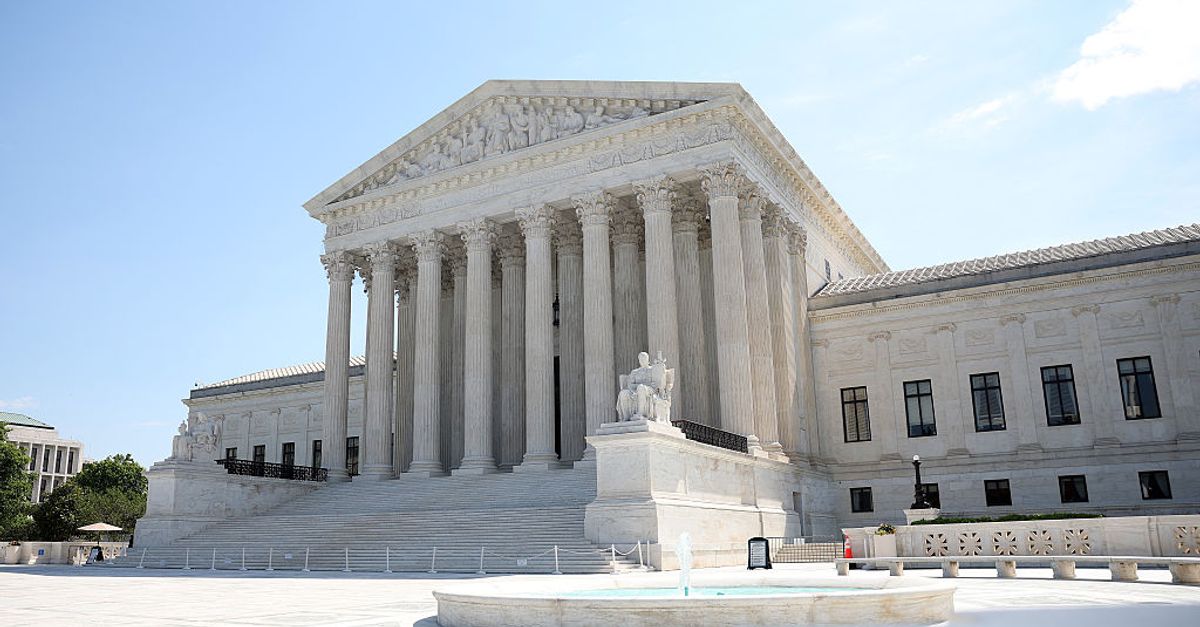
One of SCOTUSblog’s most popular features is our live blogging during major oral arguments and opinion hand down days. Throughout these live chats, our moderators (led by Amy) not only provide what’s happening at the court in real time, but we also feature plenty of comments and questions by readers (and, yes, we apologize for not including yours).
Read more Judicial ethics in the spotlight
Although such questions and comments usually concern when a particular opinion is likely to be released (we don’t know until the last opinion announcement day) and whether there is live audio from the courtroom (there is not), every once in a while we also get some levity. Given this, we thought it might help relieve the summer doldrums to dig out some of the best lines posted in live blogs during the 2025-26 term.
Before getting to this term, however, we wanted to feature our favorite comment from the 2024-25 term which, indeed, inspired this very piece. This was an entirely earnest question, met with a less than earnest response:
(For those still wondering, the clerks are not actually entombed with their justices. Rather, as Zach said, they will be subsumed (consumed?) by the chambers of another justice. When Justice Antonin Scalia died in 2016, for example, his four law clerks were reassigned – providing other justices with a fifth clerk through the end of the term.)
The 2025-26 term
Returning to the recently concluded term, we hosted 29 live blogs, from November’s oral argument in Learning Resources v. Trump (the tariffs case) to the final day of opinion announcements on June 30 – and folks kept things lively the whole way through.
There were at least two recurring topics every blog session: the box count and #WaitingForAmy. While you can read more about the box count here (and below), the TLDR is that the Supreme Court’s Public Information Office uses boxes to bring copies of the day’s opinions to the press room at 9:55 a.m. (five minutes before they are announced by the court). From the number of boxes, Supreme Court watchers can get an idea (albeit not a precise one) of how many opinions may be released that day, as each box typically contains one to three of these.
As for the “Waiting For Amy” hashtag, that is somewhat self-explanatory – Amy is live from the press room when opinions are announced and reports back to the live blog what opinion has been released and its result, sometimes before it is posted on the court’s website. (Please email if you would like a “Waiting For Amy” sticker. We’re serious.)
Anyway, let’s begin with November’s live blog.
Waiting for tariffs
During the Learning Resources on Nov. 5, Justice Brett Kavanaugh asked Benjamin Gutman, the solicitor general of Oregon, about the “donut hole” in the statutory language of the International Emergency Economic Powers Act. (Gutman represented a group of 12 states that brought a lawsuit in the Court of International Trade against the tariffs imposed under IEEPA by President Donald Trump.)
“Why would a rational Congress say: Yeah, we’re going to give the President the power to shut down trade [but couldn’t levy a 1% tariff]. I mean, think about the effects. But you’re admitting that power’s in there,” Kavanaugh asked.
Gutman replied: “I think it absolutely does because it’s a fundamentally different power. It’s – it’s not a donut hole; it’s – it’s a different kind of pastry.”
A few live blog participants had fun with that response:
The second commenter is referring to the “major questions” doctrine, the idea that Congress must be explicit when it wants to delegate power to the president for decisions with vast economic or political significance. The doctrine ended up playing a significant role in the tariffs decision, with Chief Justice John Roberts agreeing with the challengers partly on that basis (joined by Justices Neil Gorsuch and Amy Coney Barrett – although they disagreed on aspects of the doctrine’s nature).
Read more The history the court would rather not see
Moving on. When the first opinion hand down day of the term rolled around on Jan. 9, the court released Bowe v. United States, a case concerning complicated questions of federal habeas law (that you can read about here if you’re so inclined – our executive editor certainly is). To put it mildly, readers – many of whom were expecting the tariffs case – were somewhat disappointed.
This pattern persisted the following week. Although folks continued to hope for the tariffs decision, they instead received Barrett v. United States (which held that the double jeopardy clause precludes a defendant from receiving two convictions for a single act that violated two firearm offenses), Case v. Montana (which held that officers who entered a man’s home without a warrant didn’t violate his Fourth Amendment rights since they had an “objectively reasonable basis for believing” that someone inside needed emergency assistance), and Bost v. Illinois State Board of Elections (which decided that candidates can challenge laws on mail-in ballots). While all of these were arguably significant cases, many of our readers were once again let down, with one comparing the experience of waiting for the tariffs ruling to, well, childbirth.
On Feb. 20, we gathered for yet another opinion release day.
About six minutes after this exchange, the court released its long-awaited opinion in Learning Resources, 107 days after the case was argued (and perhaps delayed by a massive concurrence by Gorsuch).
The box count
As described earlier, a recurring theme on the live blog was the “box count.” Per Kelsey’s Closer Look on the subject: “The box question typically sparks a series of additional questions from blog newcomers and veterans alike. What are these boxes you’re speaking of? Why do they matter? And, more recently, do the boxes seem heavy or light?”
Such questions came up on Feb. 25, when the court released its opinions in Villarreal v. Texas (which held that a court can order a defendant and their lawyer not to discuss the defendant’s testimony during an overnight recess) and The GEO Group, Inc. v. Menocal (rejecting an ICE contractor’s right to an immediate appeal from a district court judgment).
The box count – and each box’s puffiness – proved a popular topic throughout the rest of the term:
Also:
And:
Everything else
On March 2, the justices heard argument in United States v. Hemani, a case about whether prosecuting an individual for knowingly possessing a gun while being an unlawful user of a controlled substance is consistent with the Second Amendment. By nature, this would not seem likely a particularly humorous topic. Nevertheless, things took a turn when the justices began questioning whether “habitual drunkard laws” (which justified disarming individuals around the time of the founding) could historically be compared to laws concerning drug users – and then showed a rather shallow knowledge of certain drugs.
Approximately a month later, on April 1, the birthright citizenship case came before the court, perhaps the most anticipated argument of the term. Unsurprisingly, this yielded a great deal of live blog comments, but, again, some unexpected humor (especially given the seriousness of what was being argued).
Lastly, some honorable mentions:
May 21, 2026:
May 21, 2026:
May 28, 2026:
June 11, 2026:
June 18, 2026:
June 18, 2026:
June 23, 2026:
June 23, 2026:
June 25, 2026:
And to wrap things up on June 30, our last live blog of the term:
As we always say at the live blog’s end: Thanks for joining us and see you next time.
Read more Heller and Bruen are here to stay