
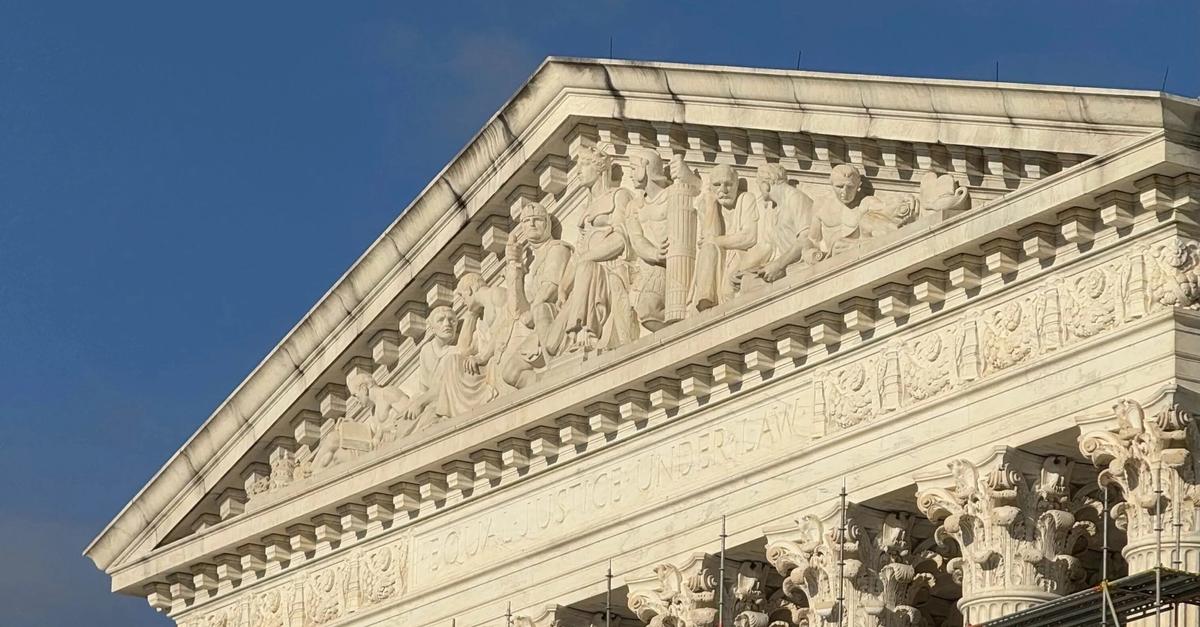
The U.S. Senate confirmed Sonia Sotomayor’s nomination to the Supreme Court on this day in 2009 on a 68-31 vote.
Read more The justices should hold regular press conferences
At the Court
Last week, the Trump administration asked the Supreme Court on its emergency docket to clear the way for the implementation of President Donald Trump’s executive order on mail-in voting. Twelve states – led by Alabama – later echoed this request in their own application. On Monday, the group of 23 states and the District of Columbia challenging the order the court to deny these requests. The matter is now fully briefed, and the court’s ruling could come at any time.
On Tuesday, the court released its calendar for the .
Morning Reads
Trump admin refunds $100 billion in ‘liberation day’ tariffs
Kevin Breuninger, CNBC
In a Tuesday in the U.S. Court of International Trade, the Trump administration shared that “it has refunded about $100 billion of the tariff revenue that was collected before President Donald Trump’s ‘liberation day’ duties were struck down by the Supreme Court,” according to CNBC. That figure “represents about 60% of the roughly $166 billion the government says it raked in from the sweeping tariffs Trump imposed in 2025.” Approximately $29 billion in additional refund requests “have been accepted for processing” and are awaiting action from the administration.
Court confirms that temporary deportation protections for Haitians are no longer in place
Devan Cole, Priscilla Alvarez, and Tami Luhby, CNN
On Wednesday, U.S. District Judge Ana Reyes “officially allowed the Trump administration to end temporary deportation protection for hundreds of thousands of Haitians, marking the final step, for now, in a months-long case that made its way to the Supreme Court,” according to CNN. In a brief order, Reyes explained that her decision barring the Department of Homeland Security from ending Haitians’ participation in the Temporary Protected Status program “is no longer in effect.” CNN noted that “[t]he order puts to bed a lingering question that had caused confusion among the roughly 350,000 Haitians benefiting from the program. Following the Supreme Court’s decision in late June” stating “that federal courts do not have the power to review challenges to the Homeland Security secretary’s decision to end TPS” “it remained unclear when, exactly, the protections would be officially gone.”
Mississippi lawmakers launch redistricting process after Supreme Court ruling
Taylor Vance, Mississippi Today
On Monday, Mississippi lawmakers “took the first steps toward potentially redrawing Mississippi’s legislative, congressional and judicial districts in the wake of the U.S. Supreme Court’s landmark Louisiana v. Callais decision that weakened minority voting protections,” according to Mississippi Today. The Joint Redistricting and Reapportionment Committee “will solicit input from voters in eight different areas of the state over the next two months on how the districts should be redrawn in light of the Callais decision.” Voting rights activists who spoke with Mississippi Today said they “worry the hearings are merely a façade, and lawmakers have already made up their mind to dismantle majority Black districts.”
This federal judge ruled against Trump. Then the threats began.
Joanna Slater, The Washington Post
The Washington Post profiled U.S. District Judge John McConnell, who, like other federal judges across the country who have ruled against the Trump administration, is navigating “a wave of threats unlike anything” he has previously experienced. Since the beginning of last year, McConnell has “received credible death threats. A MAGA activist doxed his daughter. Two Republicans in Congress started impeachment proceedings against him. An insurance company even canceled McConnell’s homeowner’s policy (the insured party was too risky, the firm indicated, with an attached link to one impeachment effort).” The Washington Post noted that “McConnell’s experience is not unique. In recent years, federal judges and Supreme Court justices have faced increasing risks to their safety.” McConnell told the Post that “he was heartened by statements by Chief Justice John G. Roberts Jr., who has said criticism of judges as individuals – rather than of their rulings – is ‘not appropriate.’”
Is Trump’s New Tariff Lever IEEPA 2.0?
Ilya Somin, The Dispatch
In late July, President Donald Trump “used Section 301 of the Trade Act of 1974 to impose massive new tariffs on 60 U.S. trading partners, including the European Union, Canada, Australia, Japan, South Korea, and more.” In a column for The Dispatch, Ilya Somin compared these new tariffs to those tariffs imposed under the International Emergency Economic Powers Act and struck down by the Supreme Court in February. “Unlike IEEPA, Section 301 does authorize tariffs. But it sets limits that Trump’s policy blatantly transgresses,” Somin argued. “It is important that the courts continue to hold the line by striking down presidential tariff power grabs.”
On Site
What does the Trump administration want from the Supreme Court next?
By Kelsey Dallas
Last week, the federal government joined President Donald Trump’s personal legal team in asking the Supreme Court to review an $83.3 million defamation judgment against the president. That’s far from the only notable petition for review from the Trump administration pending before the court this summer.
The justices should hold regular press conferences
By Josh Blackman
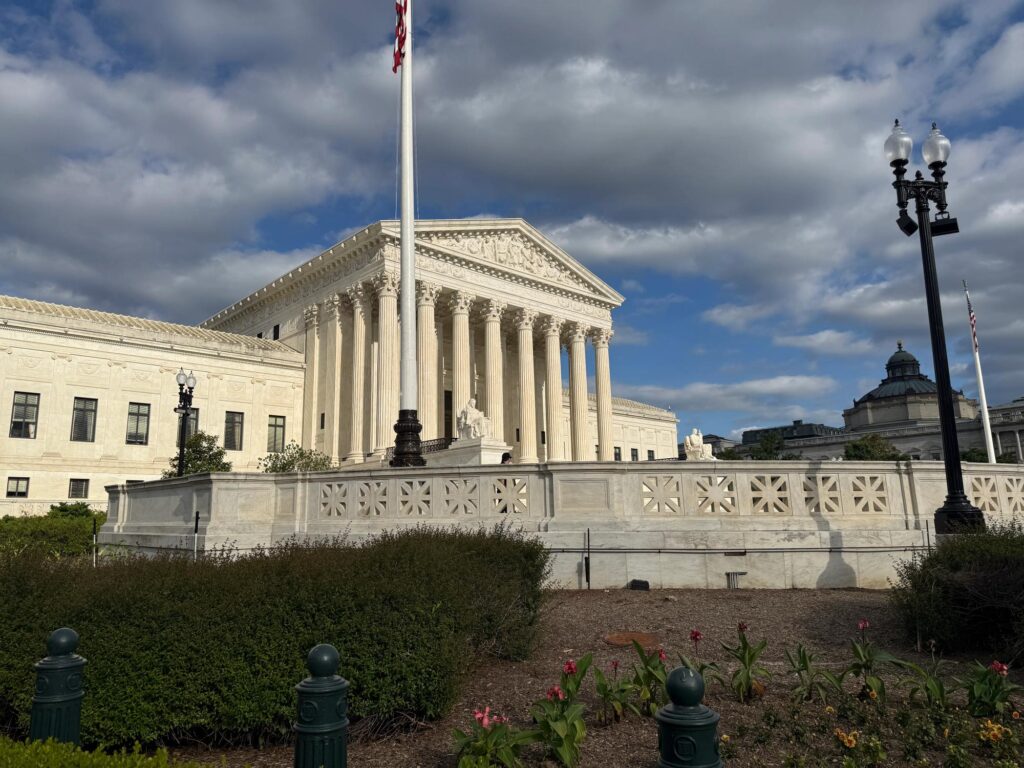
For his series on what the Supreme Court can do better, Josh Blackman wrote about why Supreme Court justices should hold regular press conferences. “By allowing the American people to hear the justices in their own words, such press conferences would actually promote the court’s perception as an institution, without changing a single word of an opinion,” according to Blackman.
Podcasts
Dobbs and Bruen Plus Time
Akhil Amar and Andy Lipka continue making their way through the 20 most constitutionally significant cases of the Roberts court and discuss Dobbs v. Jackson Women’s Health Organization and New York State Rifle & Pistol Association v. Bruen, two cases that have continued to have resonance with the American people and with the justices.
United States v. Hembree
The Supreme Court appears to be in its Second Amendment era. During the 2025-26 term, it decided two gun rights cases, striking down a Hawaii law requiring concealed-carry permit holders to receive express permission from property owners before bringing a gun onto private property that’s open to the public and barring the government from prosecuting a Texas man who regularly used marijuana on charges that he violated a federal law prohibiting users of illegal drugs from having a gun. And on June 30, the court took up a significant Second Amendment case, on Americans’ right to own AR-15s and similar semiautomatic rifles. That case will likely be argued in the fall.
Read more What does the Trump administration want from the Supreme Court next?
Soon, the Supreme Court will confront yet another pressing gun rights question when it considers a petition for review focused on 18 U.S.C. § 922(g)(1), the federal statute that prohibits an individual who has been convicted of a crime punishable by imprisonment for a year or more from owning a gun. The federal courts of appeals are divided over whether the “felon in possession” statute, as it is commonly known, satisfies the Second Amendment as applied to all felons convicted of such a crime or if it is unconstitutional as applied to felons convicted of certain nonviolent felonies.
The case began in 2022, when Charles Hembree was charged with violating 922(g)(1). He was covered by the statute because, four years earlier, he had been convicted of possession of methamphetamine. Hembree filed a motion to dismiss the indictment, contending that the felon in possession statute was unconstitutional as applied to him. After a federal district court denied his motion, Hembree accepted a plea agreement under which he retained the right to appeal the court’s decision on the motion. He was sentenced to six months of imprisonment, followed by three years of supervised release.
Hembree then asked the U.S. Court of Appeals for the 5th Circuit to review the district court’s decision on his motion to dismiss, again contending that the felon in possession statute violates the Second Amendment as applied to him. The federal appellate court it was unconstitutional after applying the “history and tradition” framework outlined by the Supreme Court in 2022’s New York State Rifle & Pistol Association v. Bruen, which requires considering whether the challenged regulation “is consistent with the Nation’s historical tradition of firearm regulation.” Rejecting the government’s argument that laws addressing drug possession are comparable to early laws targeting possession of contraband, such as a stolen horse, and that disarming Hembree is comparable to early Americans’ effort to disarm “dangerous individuals,” the 5th Circuit held “that the government did not meet its burden to prove that history and tradition support simple possession as a valid felony predicate under §922(g)(1).”
In April, the government . But rather than ask the justices to take up the case for argument and resolve the circuit split over the felon in possession statute, it asked them to hold the petition for review until they decided United States v. Hemani, the Second Amendment case on the Texas man who regularly uses marijuana, which centered on a different piece of the same law: 922(g)(3). “If appropriate,” wrote U.S. Solicitor General D. John Sauer, “the Court should … grant certiorari in this case, vacate the court of appeals’ judgment, and remand the case for further consideration in light of Hemani.”
Just under two months after the government filed the petition for review, the court handed down Hemani. Writing for the majority, Justice Neil Gorsuch specifically that it did not address the felon in possession statute. Hembree highlights “the narrow nature” of the ruling in his responding to the petition, asserting that “Hemani does not affect the outcome here.” He urges the justices to deny the petition, noting that they denied three other petitions concerning this same statute brought by the government in recent months.
Indeed, in addition to those three earlier petitions from the government on the felon in possession statute, the court this year has denied several petitions addressing the statute filed by defendants. United States v. Hembree is expected to be considered by the justices for the first time at their “long conference” on Sept. 28, and we should know sometime in October if this denial streak will continue.
SCOTUS Quote
JUSTICE ALITO: “And what if it was put on the license place? Would that be a technical trespass? Is that the property of the driver?”
MR. LECKAR: “Well, a license plate, as I understand it, is the property of the State, and driving is a privilege. But it’s not a technical trespass in this particular case. Mr. Jones had the –”
JUSTICE SCALIA: “Is that right? I don’t own my license plate? I didn’t know that. How do you know that?”
(Laughter.)
JUSTICE SCALIA: “How do you know that? I paid for my license plate.”
(Laughter.)
JUSTICE KENNEDY: “We don’t need to get into it, but ‘Live Free or Die’ was spelled on the license plate.”
Read more The October argument session
— (2011)