
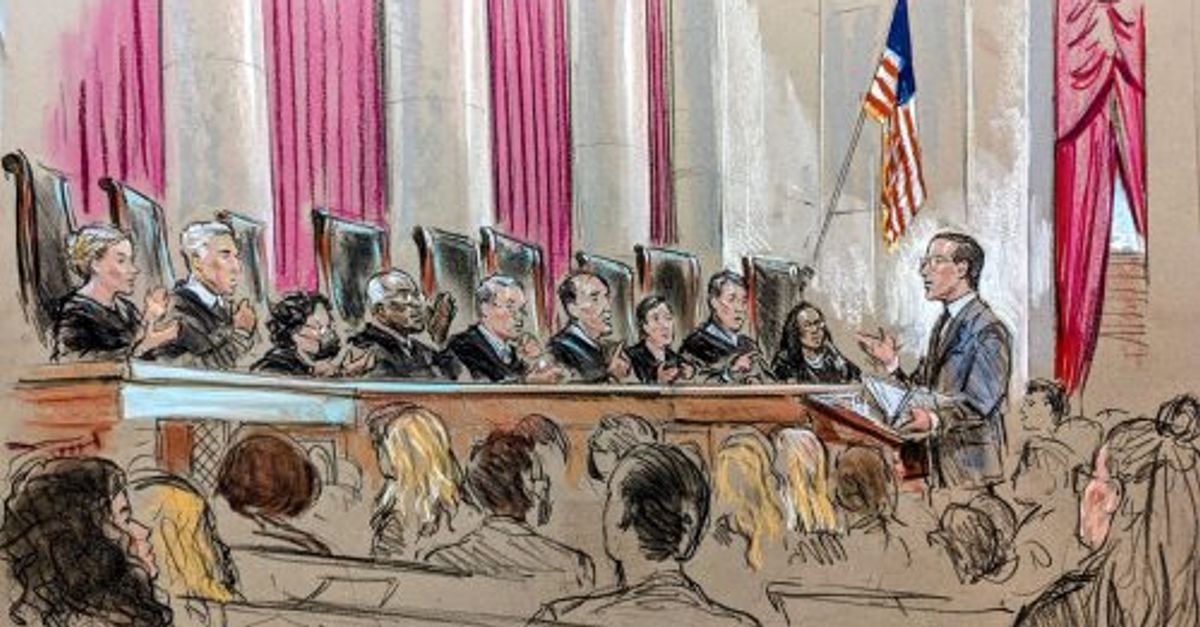
Justice Amy Coney Barrett recently resisted a label that has followed several members of the current Supreme Court. Asked whether her occasional breaks with the court’s conservative majority meant she was a swing vote, Barrett said the term made her sound “sort of flighty.” She preferred “independent, or just following the law.”
Read more Tariff refunds reach $100 billion mark
The older idea of a swing justice referred to a durable position near the court’s ideological center. Justices Lewis Powell, Sandra Day O’Connor, and Anthony Kennedy often supplied the vote that allowed one side to form a majority. Scholar Neal Devins has argued that the post-Kennedy court lacks a comparable figure because its six-member conservative majority is more cohesive and more closely tied to partisan appointment politics than earlier courts.
The 2025-26 term offers some for that account. Chief Justice John Roberts and Justice Brett Kavanaugh each voted with the majority in 95% of cases, followed by Barrett at 92%. About one-fifth of the term’s decisions divided 6-3 along conventional ideological lines. And Justices Sonia Sotomayor, Elena Kagan, and Ketanji Brown Jackson dissented together in nearly one-quarter of the court’s cases.
But the current court also has several centers of cross-ideological influence. Roberts most often builds narrow majorities with the support of the court’s liberal bloc. Kavanaugh frequently supplies the accompanying vote. Justice Neil Gorsuch is the most consistent bridge in dissent with the liberals. Jackson has cast several consequential crossover votes while remaining closely aligned with Sotomayor and Kagan. And Justice Amy Coney Barrett’s record combines a smaller number of pivotal majority votes with several notable dissents alongside her liberal colleagues.
This article measures those alliances. The principal comparison covers the 2022-23 through 2025-26 terms, when all nine current justices served together. That common period provides the same court composition and the same set of close-case votes. The analysis also examines recurring pairs and groups and tracks how this has changed over the last few terms.
The majority makers
Roberts has been the current court’s central majority builder. He participated in 12 cross-bloc 5-4 majorities since Jackson joined the court. Each majority contained the three liberal justices and two conservatives. Seven paired him with Kavanaugh, four with Gorsuch, and one with Barrett.
The Roberts-Kavanaugh pairing appeared in Allen v. Milligan, where Roberts wrote for a majority that included Sotomayor, Kagan, Jackson, and Kavanaugh in a Voting Rights Act dispute. These same five justices joined together in Cruz v. Arizona, which concerned Arizona’s application of a change in capital-sentencing law. In Williams v. Reed, Kavanaugh wrote for Roberts and the three liberals in holding that Alabama could not use administrative-exhaustion rules to block a federal civil-rights challenge over delayed unemployment benefits.
The most recent term concentrated the pattern. In Bowe v. United States, Sotomayor wrote for Roberts, Kavanaugh, Kagan, and Jackson in a dispute over successive federal post-conviction motions. In Pitchford v. Cain, Kavanaugh wrote for Roberts and the three liberals in a capital case involving the prosecution’s strikes of Black prospective jurors. Roberts and Kavanaugh formed the same five-justice coalition in Trump v. Cook, a dispute over the attempted removal of Federal Reserve Governor Lisa Cook. Another 2025-26 term crossover came with Barrett in Watson v. Republican National Committee, where Barrett wrote for Roberts and the three liberals in a challenge to Mississippi’s treatment of absentee ballots received after election day.
Kavanaugh’s role is closely tied to Roberts. Seven of his eight pivotal appearances included the chief justice. Gorsuch has been Roberts’ other – albeit less frequent – partner in joining him and the three liberals.
From the other end of the ideological spectrum, Jackson’s pivotal majorities follow a different pattern. In Bittner v. United States, she was the only liberal in a majority with Roberts, Justice Samuel Alito, Gorsuch, and Kavanaugh over penalties for non-willful foreign-account reporting violations. In Harrington v. Purdue Pharma, she was the only liberal in a majority rejecting nonconsensual releases for members of the Sackler family. In two cases, Jackson and Sotomayor joined three conservatives. Yet Jackson’s votes here should not be interpreted as evidence of general centrism. Across most divided cases, she remained closely aligned with Sotomayor and Kagan. Roberts’ record is more consistent: he repeatedly forms a four-justice core with the liberals and draws a fifth vote from Kavanaugh, Gorsuch, or Barrett.
The dissent bridge
Gorsuch’s most distinctive crossover behavior appears in dissent. He joined an ideologically opposite-bloc-led dissent in eight of his 46 dissents during the period under review, a rate of 17.4%.
In Arizona v. Navajo Nation, for example, Gorsuch wrote for Sotomayor, Kagan, and Jackson in arguing that the federal government’s treaty obligations required greater attention to the Navajo Nation’s water needs. The same four justices dissented in Campos-Chaves v. Garland, where Jackson argued that immigrants ordered removed in absentia should be able to seek rescission when the government failed to provide statutorily required notice. This group aligned again in Riley v. Bondi, subject to Gorsuch’s partial join, and in USPS v. Konan, where Sotomayor argued that the Federal Tort Claims Act’s postal exception did not cover the intentional withholding of mail.
Gorsuch and Jackson also formed a two-justice dissent in Bufkin v. Collins, Delligatti v. United States, and Monsanto Company v. Durrell. The cases involved veterans’ benefits, the definition of a crime of violence, and federal pesticide preemption. Their recurrence across unrelated subjects makes the pairing notable even though it represents a small share of both justices’ total votes.
Barrett has a smaller cross-bloc dissent record. She joined or wrote for liberal-led dissents in Fischer v. United States, Ohio v. Environmental Protection Agency, and City and County of San Francisco v. EPA. The latter two involved environmental regulations and administrative procedure.
Read more The justices should hold regular press conferences
Jackson’s dissent record points in the opposite direction from her cross-ideological joining with the majority. She dissented 63 times during the four terms, and only two dissents were with conservative colleagues. The vast majority of her dissenting votes were thus squarely within the liberal bloc.
Recurring pairs, trios, and foursomes
Roberts and Kagan are the broadest cross-bloc pair. They voted on the same side in 75 of 131 non-unanimous cases during the common period, including 71 shared majorities and 15 of the 27 5-4 decisions. Roberts and Kavanaugh are the leading pivotal pair. They supplied the two conservative crossover votes in seven of the 14 liberal-led 5-4 majorities. Gorsuch and Jackson are the leading current cross-bloc dissent pair, with nine shared dissents during the common period.
Two foursomes summarize the broader structure. Roberts and the three liberals appeared together in the majority in 53 non-unanimous cases and 12 of the 27 5–4 decisions. Gorsuch and the three liberals formed the clearest recurring mixed dissent group. Barrett and the three liberals formed a smaller, more issue-specific alliance in dissent.
These relationships explain why a single agreement statistic is insufficient. Roberts-Kavanaugh captures joint control of the court. Roberts-Kagan captures broad shared voting. Gorsuch-Jackson captures cross-bloc dissent. Each pairing reflects a different form of influence. The trio and foursome results add another layer: Roberts repeatedly begins with the liberal bloc and apparently searches for one more conservative vote, while Gorsuch repeatedly joins a liberal dissent that is already one vote short of changing the judgment.
Coalition drift
The following measures describe coalition drift over these terms; that is, whether certain justices over time have become more likely to vote with their ideological opposites. This can reflect changes in a justice’s approach, changes in the docket, or movement by other justices.
Barrett’s coalition drift is the most notable over the last few terms. That said, her change is large in percentage terms because her underlying dissent count remains small. Next up is Roberts, whose increase in joining cross-bloc coalitions comes primarily from being the justice in the majority. Gorsuch’s score is high because his dissent alliances persist while he also participates in some Roberts-centered majorities. On the other end, Justice Clarence Thomas recorded no pivotal vote or directional crossover dissent from the 2023-24 through 2025-26 terms. And Alito recorded no difference during any of these periods. (Jackson’s tenure is too short for a firm trend.)
The bottom line? Over time, Barrett has drifted the most, although this is based on only a few cases. Thomas has gone in the opposite direction, becoming less and less likely to join cross-ideological coalitions. Alito, meanwhile, has not changed at all.
Interpretation and limits
These measures show that while certain justices are much more likely to vote with their ideological opposites than others, members of each bloc are not interchangeable. For example, on the conservative side, the chief justice, Gorsuch, Kavanaugh, and Barrett all engage in coalition drift (though for Kavanaugh this has decreased over time). Thomas and Alito, on the other hand, rarely do so.
This cannot, however, identify who persuaded whom or which vote arrived last. And this describes votes rather than motivation.
Fractured opinions create another limitation because a justice may support the judgment without joining the controlling rationale. Sample size also remains important. Barrett’s dissent percentage rests on only three cases. Jackson’s rests on four pivotal majorities. Gorsuch’s dissent pattern, meanwhile, is supported by more events and a longer record.
So what can we say?
The mix of issues undoubtedly shapes the results. Roberts and Kavanaugh have formed pivotal coalitions across voting rights, capital procedure, public benefits, federal jurisdiction, and presidential power. Gorsuch’s dissents with the liberals focus on tribal rights, immigration, veterans’ law, criminal law, and federal preemption. Barrett’s liberal-aligned dissents are more concentrated in administrative and environmental disputes.
More granularly, Roberts led in majority-side outcome leverage. Kavanaugh was his most frequent partner. Gorsuch provides the strongest dissent-side connection across blocs. Jackson has cast several consequential crossover votes while remaining predominantly aligned with the liberal bloc. Barrett’s record shows an emerging dissent-side pattern whose durability remains uncertain.
To put it in different terms: Roberts anchors narrow majorities. Gorsuch anchors mixed dissents. Kavanaugh, Jackson, and Barrett connect the blocs in smaller sets of cases. Future terms will show which relationships persist and which remain tied to a particular docket.
Read more What does the Trump administration want from the Supreme Court next?