
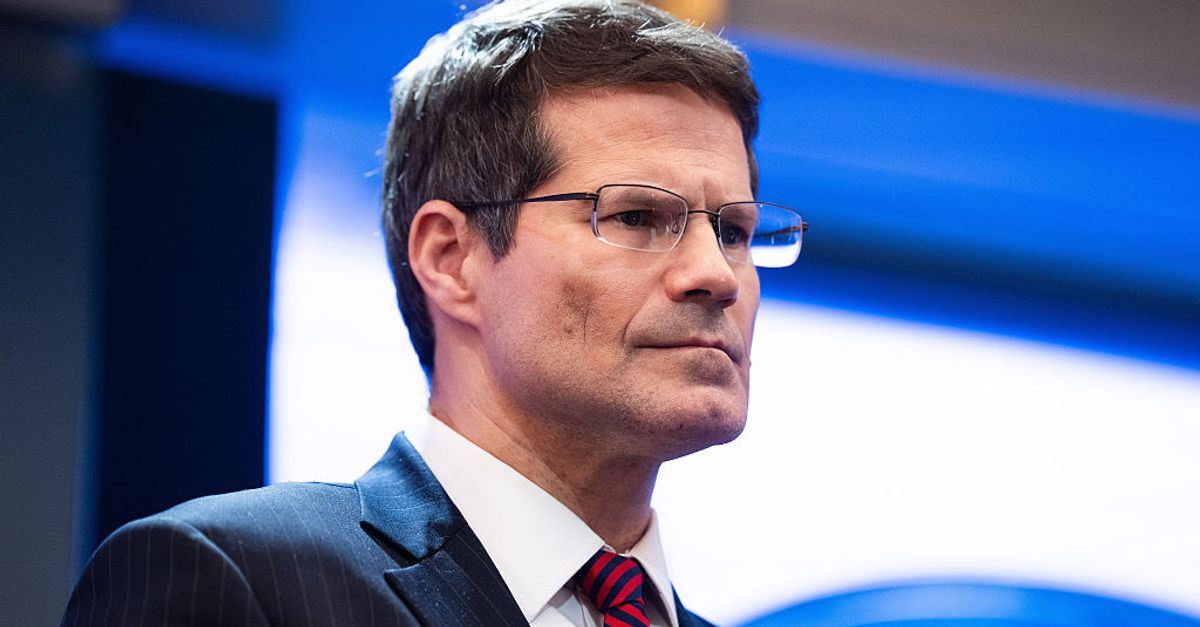
Three weeks after D. John Sauer was confirmed as the 49th solicitor general, law professor and podcast co-host William Baude speculated that Sauer might be “either fired or disbarred by the time his term is up.” Baude’s co-host, Dan Epps, was discussing the dilemma that, in their view, Sauer likely faced – navigating the tensions between his obligations as the government’s top lawyer before the Supreme Court and the expectations of Donald Trump, the president who appointed him.
Read more New election disputes on the interim docket
More than 16 months later, Sauer is still on the job. Although the briefs that he has filed and the arguments that he has made before the justices have at times seemed unorthodox – appearing to echo language used by Trump himself – he has largely appeared to pull off a tricky balancing act.
As Stephen Wermiel recently wrote for this blog, when Congress created the role of solicitor general in 1870, it required the occupant of the office to be “learned in the law.” Solicitors general have such a unique relationship with the court that they are sometimes referred to as the “tenth justice”: they not only have an office at the court, but the court often seeks their advice on whether to grant review in cases in which the federal government is not involved – a maneuver known as a “call for the views of the solicitor general.” At his Executive Functions substack, Harvard law professor Jack Goldsmith wrote in April 2025 that, “[b]ecause of the SG’s special role before the Court, the office has traditionally had in practice (though not in law) strong independence from the Attorney General and the president.”
When Trump nominated him in November 2024, Sauer’s resume resembled those of others who had preceded him in the job. A former college wrestler at Duke University, Sauer studied at Oxford as a Rhodes Scholar before going on to Harvard Law School and a clerkship for the late Justice Antonin Scalia. As the solicitor general of Missouri, Sauer argued (and won) a high-profile death penalty case in 2018 before going into private practice.
But one qualification in particular stood out: Sauer had successfully represented then-candidate Trump in 2024 as his private lawyer in the prosecution brought by Special Counsel Jack Smith regarding Trump’s role in the Jan. 6, 2021, attacks on the U.S. Capitol. In Trump v. United States, the court agreed with Sauer that former presidents have broad immunity from criminal prosecution for their official acts while in office.
After Sauer was nominated to serve as the solicitor general, but before he took office, he served notice that the solicitor general’s traditional independence from the White House might be, at least in some cases, a thing of the past. He filed a “friend of the court” on Trump’s behalf in TikTok v. Garland, in which the court unanimously upheld a federal law that required the social media giant to shut down in the United States unless its Chinese parent company could sell off the U.S. company. Sauer’s brief urged the justices to block the law from going into effect so that the Trump administration could “pursue a negotiated resolution that could prevent a nationwide shutdown of TikTok.” More notably, the brief described the president with glowing language that appeared as if it could have been drafted by Trump. “President Trump,” Sauer wrote, “alone possesses the consummate dealmaking expertise, the electoral mandate, and the political will to negotiate a resolution to save the platform while addressing the national security concerns expressed by the government.”
Sauer used a similar tone in defending one of Trump’s signature initiatives, the sweeping tariffs that he imposed in a series of executive orders under the International Emergency Economic Powers Act. In August 2025, he sent to the U.S. Court of Appeals for the Federal Circuit asking it to put its ruling on hold if (as it did) it upheld the Court of International Trade’s decision striking down the tariffs. Sauer told that court that “[t]here is no substitute for the tariffs and deals that President Trump has made.” Describing the recent trade deals that the president had conducted with (among others) the EU and the UK, Sauer cautioned that “[i]f the United States were forced to unwind these historic agreements, the President believes that a forced dissolution of the agreements could lead to a 1929-style result.” “In such a scenario,” Sauer continued, “people would be forced from their homes, millions of jobs would be eliminated, hard-working Americans would lose their savings, and even Social Security and Medicare could be threatened. In short, the economic consequences would be ruinous, instead of unprecedented success.”
After the Supreme Court agreed to take up the case and fast-track it, Sauer filed a with language that many saw as hyperbolic. “To the President,” Sauer wrote, “these cases present a stark choice: With tariffs, we are a rich nation; without tariffs, we are a poor nation.” Quoting Trump directly, he contended that, “[o]ne year ago, the United States was a dead country, and now, because of the trillions of dollars being paid by countries that have so badly abused us, America is a strong, financially viable, and respected country again.”
At the Nov. 5, 2025, in the tariffs case, Sauer again quoted the president. He told the justices that Trump “has declared that these [trade] emergencies are country-killing and not sustainable, that they threaten the bedrock of our national and economic security, and that fixing them will make America strong, financially viable, and a respected country again.”
And when asked by Justice Neil Gorsuch whether, under IEEPA, the president could “impose a 50 percent tariff on gas-powered cars and auto parts to deal with the unusual and extraordinary threat from abroad of climate change,” Sauer responded that “[i]t’s very likely that that could be done.” He then added that “obviously, this Administration would say that’s a hoax, it’s not a real crisis” – prompting Gorsuch to comment, “I’m sure you would.”
On Feb. 20, 2026, the court – by a vote of 6-3 – Trump’s tariffs. The opinion by Chief Justice John Roberts hinted that some of the administration’s rhetoric surrounding the tariffs may have backfired. Three justices – Roberts, Gorsuch, and Justice Amy Coney Barrett – concluded that the tariffs violated the “major questions” doctrine, the idea that Congress must speak very clearly if it intends to delegate the power to make decisions of vast economic or political significance. Pointing to the Trump administration’s brief in the Supreme Court, Roberts noted that, “[i]n the President’s view, whether ‘we are a rich nation’ or a ‘poor’ one hangs in the balance. These stakes dwarf those of other major questions cases.”
Shortly after the tariffs decisions was released, the line between the solicitor general’s office and the White House was blurred once again when Sauer appeared at Trump’s press conference reacting to the ruling. Sauer stood alongside U.S. Trade Representative Jamieson Greer and Commerce Secretary Howard Lutnick while Trump “congratulate[d] Justices Thomas, Alito, and Kavanaugh” – the three justices in the dissent – “for their strength and wisdom and love of our country.” By contrast, Trump denounced the challengers in the lawsuit as “sleazebags” and called the court’s three Democratic appointees a “disgrace to our nation.” Trump alleged that Gorsuch and Barrett, whom he had nominated to the court during his first term, were “an embarrassment to their families,” and he suggested “that the court has been swayed by foreign interests.”
Read more Republican groups file emergency application to court on broadcasting rates for political ads
Sauer has also used bold language more recently to defend another one of the president’s pet projects, the construction of a new ballroom where the East Wing of the White House once stood. After two lower courts in Washington, D.C., ordered the Trump administration to halt above-ground construction on the project, Sauer filed an emergency application with the Supreme Court, seeking to put the lower courts’ rulings on hold. The application included several quotes in a declaration from Joshua Fisher, Director for White House Management and Administration, that were Trump-like in their rhetoric. Fisher stated, for example, that “[t]he ballroom is funded by contributions from President Trump and some of the most prominent and successful corporations and people in America.” He indicated that the project “is already being adjudged to be one of the most beautiful of its kind, anywhere in the country,” and that it includes columns that “are made from the highest-grade Indiana limestone, which was shipped to Italy, and are being carved by some of the greatest artists anywhere in the world.”
In other cases, including high-profile ones, however, Sauer has used language that, although strong at times, was significantly less extreme than what he employed in the tariffs case. In the challenge to Trump’s first executive order on birthright citizenship, which would have denied automatic U.S. citizenship to the children of undocumented immigrants and parents who are only in the United States temporarily, Sauer’s emphasized the problem of so-called “birth tourism,” in which pregnant women come to the United States to give birth so that their children will receive U.S. citizenship. That phenomenon, he suggested, “raises national-security concerns” and “‘demeans’ U.S. citizenship by extending it to people who lack any meaningful ties to the country.” But he merely characterized the challengers’ arguments in favor of birthright citizenship as “plainly incorrect” and “untenable.”
After a majority of the court the executive order as unconstitutional, Trump called the decision a “miscarriage of justice” and “absolutely insane” on social media, and he pledged to ask the Supreme Court to reconsider its ruling “IMMEDIATELY.” Approximately one month later, however, the time to file a petition for rehearing expired without any action by the Trump administration. Although there is no way to know for sure, Sauer may have dissuaded the president from asking the court to weigh in again – which would likely be a good strategic decision both because a petition would have faced long odds and because it might help to demonstrate some independence from Trump.
Sauer has also made concessions to mollify the justices. At the oral argument in Trump v. CASA, the Trump administration’s challenge to the legality of “universal” or “nationwide” injunctions, Justice Elena Kagan expressed concern about the consequences of the rule that the government was seeking. Even if every lower court that considered the question struck down the president’s order, she suggested, without nationwide application the government would have no incentive to appeal an adverse decision to the Supreme Court because it would still be able to enforce the policy “against the vast majority of people to whom it applies.” “If I were in your shoes,” Kagan , “there is no way I’d approach the Supreme Court with this case.”
Gorsuch then pressed Sauer on this point after Sauer emphasized that three cases on the merits of the birthright citizenship order were moving forward in the federal courts of appeals. “When you lose one of those,” Gorsuch asked, “do you intend to seek” Supreme Court review? “If we lose, yes, absolutely,” Sauer responded.
During Sauer’s tenure as solicitor general, the Trump administration has continued making frequent trips to the Supreme Court to seek emergency or interim relief after lower courts have blocked its initiatives.
During the first 19 months of Trump’s second term, the administration has filed approximately 30 applications on the court’s interim docket – more than the George W. Bush and Obama administrations collectively filed in 16 years. The increase in volume (and the court’s willingness to intervene) has been a source of frustration for some justices. In testimony before Congress in July, Kagan suggested that the court itself was part of the problem: granting so many applications for relief, she posited, makes other litigants more likely to file their own applications, because they believe that they too might succeed.
Although the federal government has been – by far – the most frequent litigant on the emergency docket, the Trump administration has undeniably been very successful: at one point, from April through December 2025, it effectively prevailed on all of its applications for emergency relief.
Commentators have also, however, noted that while Sauer has repeatedly sought emergency relief, he has not done so in every high-profile case in which the government lost in the lower courts, strategically choosing which cases the court may be most receptive to. Last year, for example, Sauer declined to ask the Supreme Court to temporarily reinstate another of Trump’s personal lawyers, Alina Habba, after a federal appeals court invalidated her appointment as the U.S. attorney for New Jersey. On Aug. 22, 2026, that Trump’s appointment of John Sarcone as the U.S. attorney for the Northern District of New York was not valid and that, as a result, he did not have the power to issue grand jury subpoenas to New York Attorney General Letitia James. The Department of Justice has indicated that it planned to appeal the ruling in Sarcone’s case, although it has not yet done so.
Trump’s second term has not yet reached the halfway point, so it’s too soon to tell whether Sauer will be able to continue his occasionally Trumpian rhetoric without alienating the justices. But it’s also possible that Sauer may not serve the full four years for a different reason: he has been mentioned as a potential Supreme Court nominee if Justice Clarence Thomas or Justice Samuel Alito were to step down.
Read more Supreme Court allows construction on White House ballroom to continue