
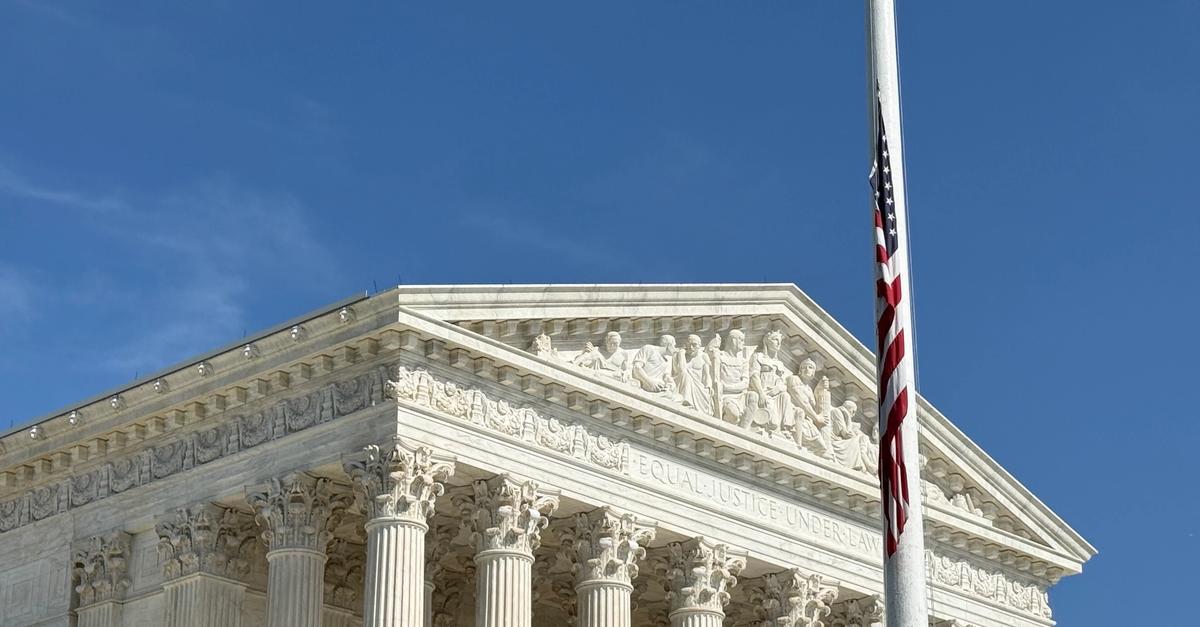
The Trump administration returned to the Supreme Court on Thursday afternoon, the justices to temporarily pause an order by a federal judge in Boston that blocks the government from implementing parts of a U.S. Postal Service rule on mail-in ballots. U.S. Solicitor General D. John Sauer told the court that the order by U.S. District Judge Indira Talwani “partially nullifies the Postal Service’s efforts to address the risk that the federal mails will be used to perpetrate voter fraud—a particularly pernicious species of fraud that dilutes the votes of lawful voters, prevents election results from reflecting the will of the American people, and undermines ‘public confidence in the integrity of the electoral process.’”
Thursday’s filing was the second time in less than six weeks that the Trump administration came to the Supreme Court seeking to clear the way to implement restrictions on mail-in voting. In March, President Donald Trump signed an executive order that directed federal agencies to take a series of steps on mail-in voting. The first provision instructs the Department of Homeland Security to create lists of the adult U.S. citizens in each state and to send those lists to states at least 60 days before a federal election. The second provision tells the U.S. attorney general to “prioritize the investigation and, as appropriate, the prosecution of State and local officials … who issue Federal ballots to individuals not eligible to vote in a Federal election.” And the third provision requires states to give the U.S. Postal Service a list of voters to whom the states intend to send mail ballots, and it prohibits the USPS from mailing ballots to voters who are not on the lists of “enrolled” voters that the USPS will create.
A group of 23 states, led by California, and the District of Columbia went to federal court in Massachusetts to challenge the government’s implementation of the order. They argued that the executive order conflicts with provisions in the Constitution that give states the power to determine voter eligibility and to set the “Times, Places, and Manner” of holding congressional elections.
Talwani barred the federal government from implementing the challenged restrictions on or before Nov. 3, 2026, in the District of Columbia and the 23 challenging states.
After the U.S. Court of Appeals for the 1st Circuit to pause Talwani’s order while the litigation continued, the Trump administration on July 27 asked the Supreme Court to step in – as did a group of 12 states, led by Alabama, that had joined the case on the Trump administration’s side.
Nearly a month later, the Supreme Court allowed the Trump administration to begin implementing the executive order. In a 10-page, unsigned , the majority wrote that it was too soon for courts to consider the states’ challenge because the order had not yet been carried out – and, as a result, the states have not suffered the kind of injury that would allow their lawsuit to proceed.
Read more Court reform is liberal-coded nowadays. But it shouldn’t be.
Shortly after the court’s ruling, Talwani lifted an injunction that she had issued in a separate challenge, brought by the League of Women Voters, to one provision of the executive order. But in , Talwani issued a temporary restraining order that blocked the Trump administration, for 14 days, from requiring states to comply with several provisions of the new Postal Service , such as ballot envelope design requirements and the submission of voter data into a USPS portal.
The Trump administration on Thursday asked the justices to freeze Talwani’s order (and to issue an administrative stay, which puts the order on hold while they consider the government’s request). Sauer pushed back against suggestions “that the Postal Service is trying to federalize the rules for mail-in voting.” Instead, he wrote, “the Postal Service’s final rule imposes only modest envelope-design and addressee-information requirements for federal-election ballots sent via U.S. Mail.” The Postal Service has the authority to create such rules, Sauer asserted, as it has done in other contexts – for example, to “impos[e] certain processing requirements on the mailing of cremated remains and replica explosives” – and “to adopt rules that specifically govern election-related mail, such as the use of the Election Mail logo and prioritizing ballot mail for delivery.”
If Talwani’s order is not put on hold, Sauer asserted, it will cause “serious irreparable harm.” Among other things, he stressed, even before the temporary restraining order expires on Sept. 14, “two States—North Carolina and Alabama—will begin sending ballots to voters, the first as soon as September 4. Once those ballot envelopes enter the mailstream, there is no retrieving them.”
The court directed the challengers to file a response by 10 a.m. EDT on Tuesday, Sept. 8.
Read more Judge temporarily halts Trump’s latest birthright citizenship order