
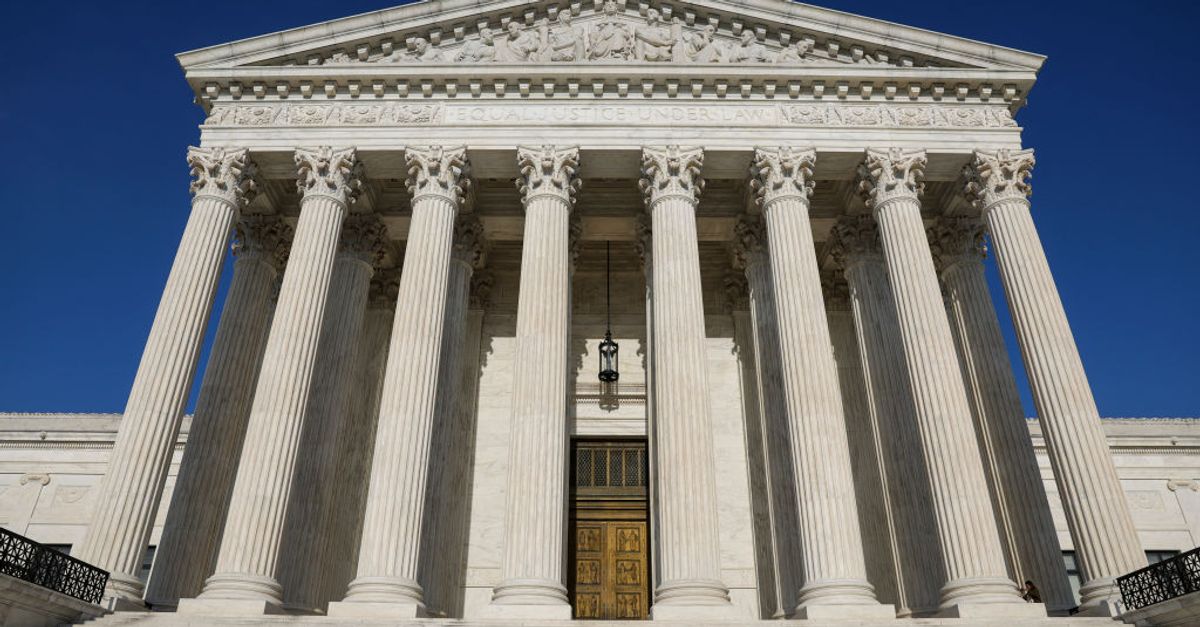
The Supreme Court on Monday in Whitton v. Dixon sided with a death row inmate for the second time in less than a week, holding in an that the U.S. Court of Appeals for the 11th Circuit improperly included DNA evidence that was not presented to the jury in its assessment of whether a witness’ false testimony during the trial of Gary Richard Whitton had violated Whitton’s due process rights. The justices tossed out the 11th Circuit’s opinion and sent the case back to that court for additional proceedings, allowing Whitton’s challenge to go on.
Read more Court asked to bar Alabama from using state’s preferred map
Last Thursday, in Pitchford v. Cain, a divided court threw out the conviction and death sentence of Terry Pitchford, who had spent approximately two decades on Mississippi’s death row. In an by Justice Brett Kavanaugh, joined by Chief Justice John Roberts and Justices Sonia Sotomayor, Elena Kagan, and Ketanji Brown Jackson, the court held that the judge in Pitchford’s 2006 trial had not properly analyzed whether the prosecutor had violated the Constitution’s ban on racial discrimination in jury selection.
And one week before that, in another 5-4 ruling, the court announced that it had dismissed Hamm v. Smith as “improvidently granted,” a decision that left in place Joseph Smith’s win before the 11th Circuit, which held that Smith is intellectually disabled and therefore cannot be executed. The Supreme Court was considering how to assess intellectual disability when a defendant has taken multiple IQ tests, but five justices – Sotomayor, Kagan, Kavanaugh, Barrett, and Jackson – sidestepped the question, leaving it up to states, at least for now, to draw their own conclusions.
These three recent rulings continued a trend that SCOTUSblog columnist Daniel Harawa highlighted last year – namely, that death row inmates find more success on the court’s oral argument docket than on its emergency docket, where the justices address requests for stays of execution. Indeed, “more success” might be an understatement. The court has not paused an execution since July 2024 and has denied more than 75 such requests since then, typically without a noted dissent.
Over the same time period – and with the encouragement of President Donald Trump after he returned to office – states such as Florida began scheduling executions that had been paused, fueling a nationwide surge in capital punishment, as I previously reported. Forty-seven people were put to death in 11 states in 2025, which was the highest annual execution total in the United States since 2009.
So far this year, 14 people have been put to death, according to the Death Penalty Information Center, and 11 more executions are scheduled to take place before the end of December. As noted above, the Supreme Court has denied all requests to delay an execution that it has received in 2026, although not all of those executions were ultimately carried out. On May 21, Tennessee called off the execution of Tony Carruthers, who had filed several unsuccessful stay requests with the Supreme Court, after prison officials tried for more than an hour, and ultimately failed, to find a vein. Tennessee Gov. Bill Lee has said that it will be at least a year before Carruthers’ execution is rescheduled.
In addition to denying requests from defendants to delay executions, the Supreme Court granted a request from Texas officials to vacate a stay put in place by another court. In Guerrero v. Busby, the U.S. Court of Appeals for the 5th Circuit had paused Edward Lee Busby’s execution to give itself more time to consider Busby’s claim that he was intellectually disabled and therefore could not be executed. On May 14, in a one-paragraph, unexplained , the Supreme Court cleared the way for Busby to be executed hours later.
Justice Elena Kagan noted that she would deny the application, but she did not explain why. Justice Ketanji Brown Jackson dissented from the denial in an opinion joined by Justice Sonia Sotomayor, describing the 5th Circuit’s stay as “a modest, responsible step” and questioning why the Supreme Court was “unable to tolerate even a brief delay” on the path toward Busby’s execution. “In capital cases,” Jackson wrote, “we rarely intervene to preserve life. I cannot understand the Court’s rush to extinguish it, much less in the circumstances of this case.”
Jackson’s dissent was the first separate writing in a capital case since February, and the first dissenting opinion in such a case since October 2025. That’s when Sotomayor wrote a striking concerning nitrogen gas execution, which involves breathing pure nitrogen gas and leads to death from lack of oxygen.
Specifically, Sotomayor’s dissent in Boyd v. Hamm, which both Kagan and Jackson joined, described what it might feel like to die by suffocation and characterized this method of execution as “experimental” and “cruel.” Anthony Boyd, Sotomayor wrote, “asks for the barest form of mercy: to die by firing squad, which would kill him in seconds, rather than by a torturous suffocation lasting up to four minutes. The Constitution would grant him that grace. My colleagues do not.”
A similar dissenting opinion could be coming this month, when the court is expected to consider a request to delay an execution from Jeffery Lee, who is scheduled to be executed in Alabama with nitrogen gas on June 11 and who has challenged that execution method under the Eighth Amendment, which prohibits the infliction of “cruel and unusual punishments.” He contended that nitrogen hypoxia causes excessive suffering, citing reports from previous executions about how long it took for the people being executed to be pronounced dead and how they shook violently during the process.
Last week, U.S. District Judge Emily C. Marks sided with Alabama officials, holding that nitrogen gas execution is constitutional. “While Lee establishes that death by nitrogen hypoxia involves some suffering, he fails to show that the protocol is cruel and unusual in violation of the Eighth Amendment,” Marks wrote. Lee’s attorneys have indicated that they will appeal the decision. The case will go first to the U.S. Court of Appeals for the 11th Circuit before it is appealed to the Supreme Court.
As I have previously reported, it’s conceivable – based on Sotomayor’s dissent in Boyd and other, related opinions – that the court could take up a case on nitrogen gas execution for argument in the near future (although that would only be possible in Lee’s case if it first agrees to delay his execution). As of this week, the court has added 11 cases to its oral argument docket for the 2026-27 term, none of which are capital cases.
Read more Court rejects broad interpretation of compassionate release statute