
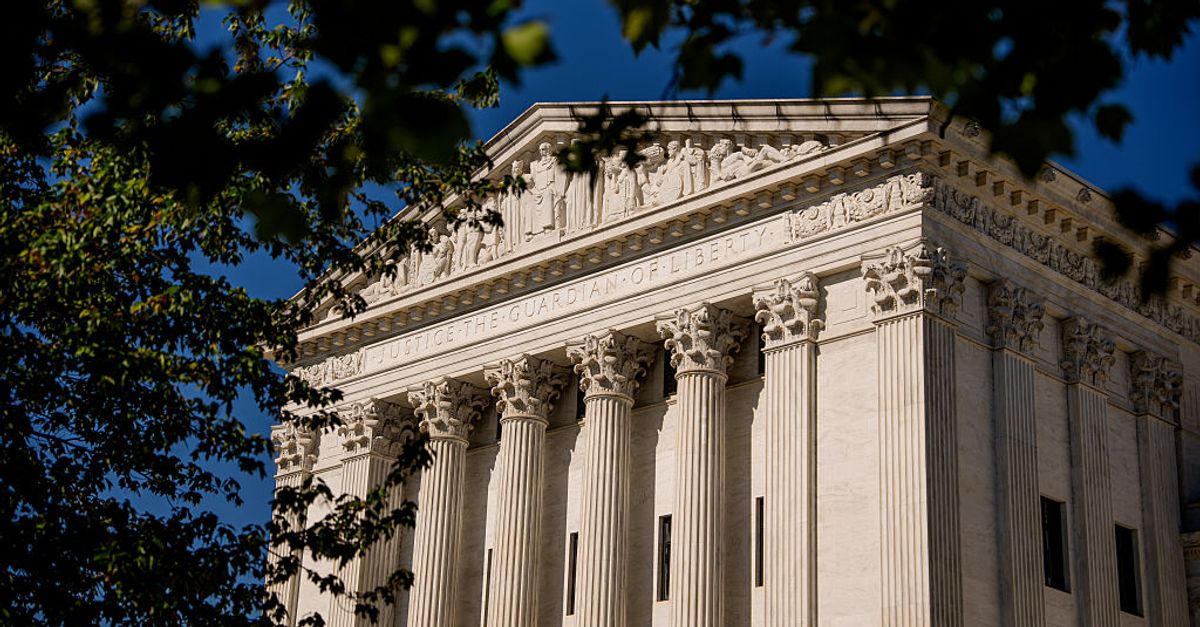
The Supreme Court on Monday morning added one new case, involving the ability to sue federal officials for violating constitutional rights even when there is no law specifically authorizing such a claim, to its docket for the 2026-27 term.
The announcement came as part of a list of released from the justices’ June 18 conference. The justices will meet for another conference – the final regularly scheduled conference before their summer recess – on Thursday, June 25. The court is likely to release orders from that conference on Monday, June 29, at 9:30 a.m. EDT.
More than 50 years ago, in , the Supreme Court ruled that a private individual could sue a federal agent for violating his Fourth Amendment rights, even when there was not a specific law authorizing a claim for damages. In 1980, in Carlson v. Green, the justices allowed the mother of a prisoner who died after prison staff failed to provide adequate treatment for his asthma attack to sue those employees under Bivens. Since then, however, the court has repeatedly rejected efforts to rely on Bivens, explaining (among other things), that the case should not apply in a “new context.”
In Nielsen v. Watanabe, the Supreme Court granted the federal government’s request to weigh in on whether an inmate can rely on Bivens to sue prison officials for violating his constitutional rights. Kekai Watanabe contends that his coccyx was fractured in a fight, but prison officials did not send him to the hospital and refused several requests for medical treatment.
The U.S. Court of Appeals for the 9th Circuit allowed Watanabe’s lawsuit to go forward, pointing to Carlson.
Read more A victory for the defendant in United States v. Hemani, but little guidance for the lower courts
Francis Nielsen, the staff nurse whom Watanabe sued, in October, asking the justices to take up the case. His lawyer, Jeffrey Lamken, argued that the court has “limit[ed] Bivens to … three circumstances in which the Court previously recognized Bivens actions,” and that Watanabe’s case does not fall within those three circumstances.
Moreover, Lamken contended, the courts of appeals are divided over several issues arising from the case, including whether the availability of an alternative remedy for prisoners – such as the Prison Litigation Reform Act – means that a case arises in a “new context” from one of the three existing Bivens circumstances, and also whether, for purposes of whether something constitutes a “new context,” the severity of a prisoner’s injuries matter. Watanabe, Lamken noted, “here complains that he did not receive sufficiently prompt treatment for a fractured coccyx; the plaintiff in Carlson died on the scene as a result of egregious conduct.”
Represented by Zachary Tripp, the justices to leave the 9th Circuit’s ruling in place, telling them that his case “does not extend Carlson v. Green … beyond its original context. Watanabe alleges a violation of the same constitutional right (the Eighth Amendment) for the same kind of conduct (deliberate indifference to a serious medical need) injuring the same kind of plaintiff (a federal prisoner) under the same circumstances (failure to provide adequate treatment) against the same class of officers (medical staff at a federal prison) as in Carlson.”
After considering the case at its conferences on June 11 and June 18, the court granted review. The case will likely be argued in the fall, with a decision to follow sometime in 2027.