
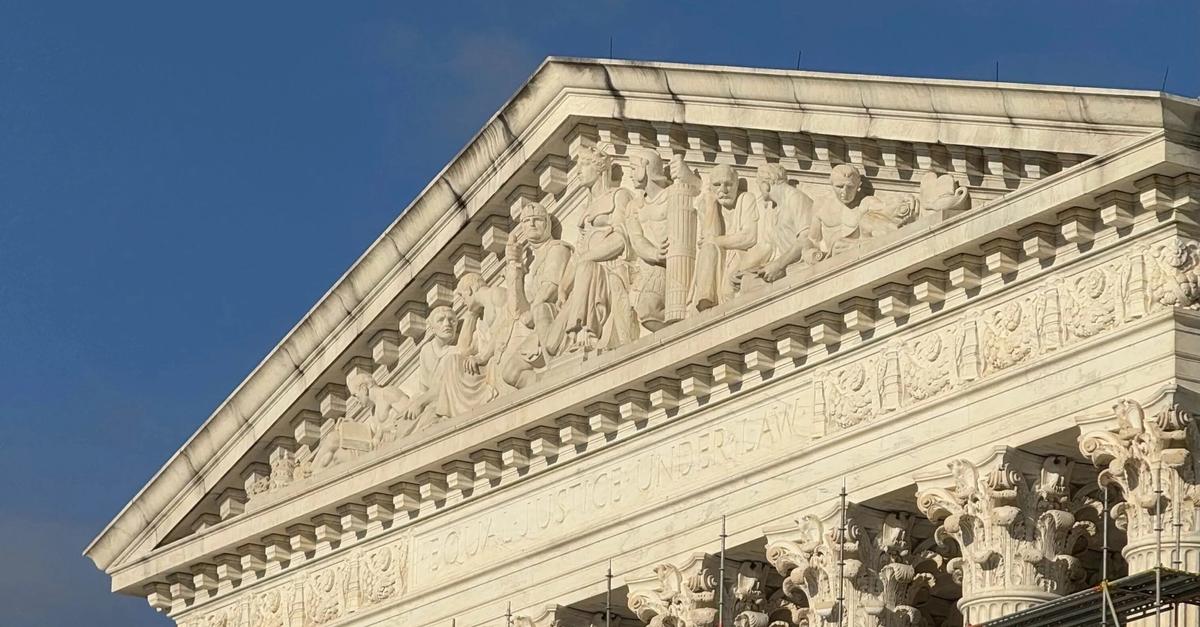
Justice Elena Kagan was sworn in on this day in 2010.
At the Court
Last week, the Trump administration asked the Supreme Court on its emergency docket to clear the way for the implementation of President Donald Trump’s executive order on mail-in voting. Twelve states – led by Alabama – later echoed this request in their own application. On Monday, the group of 23 states and the District of Columbia challenging the order the court to deny these requests. The matter is now fully briefed, and the court’s ruling could come at any time.
Read more What is “trapped in amber”? An originalist explanation
Morning Reads
Trump again tries to restrict birthright citizenship after Supreme Court ruling
Will Weissert and Rebecca Santana, Associated Press
On Thursday, President Donald Trump announced “that he is once more trying to limit the number of people who are born in the country who can become American citizens, in a sign that even after his first attempt at limiting birthright citizenship was rejected by the Supreme Court, he’s ready to try again,” according to the Associated Press. “The president said he was signing two executive actions on immigration, including one limiting the number of people eligible for
U.S. citizenship after being born in the United States, while another focused on stopping people from coming to the U.S. to give birth.” The new order on birthright citizenship, released on Thursday evening, is “narrower in scope than the previous one shot down by the Supreme Court and appear[s] to focus on restricting automatic citizenship to specific categories of people, including children born to adults with connections to foreign embassies or organizations as well as anyone considered an ‘alien enemy’ of the United States. It also aim[s] to restrict birthright citizenship to anyone whose parents ‘engaged in fraudulent activity to obtain citizenship.’” The second order “seeks to curb what Trump called ‘birth tourism’ by increasing restrictions on visitors to the U.S. who want to obtain visas to give birth while in the country.”
Marquette Law School Poll finds national approval of Supreme Court now at 47%, has remained below 50% since November 2025
Kevin Conway, Marquette Today
A new survey from the Marquette Law School Poll showed that “47% of adults approve of the way the United States Supreme Court is handling its job, while 53% disapprove.” “Approval of the Court varies substantially across party lines, with 74% of Republicans approving of the Court, while 35% of independents and 22% of Democrats approve [of it].” The survey also identified a partisan gap in views on the Supreme Court’s relationship with President Donald Trump. While 77% of Democrats say “the Court rules for Trump often or fairly often,” just 37% of Republicans hold that belief. “Among all adults, 54% say the Court is going out of its way to avoid a ruling Trump might refuse to obey, while 46% say the Court is not avoiding such a decision.”
Legal battle over Jewish charter school begins in Oklahoma City federal court
Nuria Martinez-Keel, Oklahoma Voice
On Wednesday, a legal battle began over the Oklahoma Statewide Charter School Board’s rejection of a Jewish charter school’s effort to open in the state and “operate using taxpayer funds,” according to Oklahoma Voice. The case may eventually bring the issue of religious charter schools back to the Supreme Court, which, in 2025, deadlocked 4-4 over the constitutionality of opening a Catholic charter school in Oklahoma after Justice Amy Coney Barrett recused. The 4-4 vote left in place an Oklahoma Supreme Court decision holding that the state constitution requires charter schools to be non-religious. Supporters of religious charter schools claim that this requirement amounts to unconstitutional “religious exclusion.”
Democrats urge appeals court not to overturn mifepristone regulations
Nathaniel Weixel, The Hill
In a May on its emergency docket, the Supreme Court allowed for the mailing of mifepristone, one of two drugs used in medication abortions, by pausing a ruling from the U.S. Court of Appeals for the 5th Circuit that would have required in-person dispensing. The dispute over access to the abortion pill “is now back before the 5th Circuit, which will hold oral arguments in September,” according to The Hill. This week, “[t]he entire congressional Democratic caucus filed an amicus,” or friend-of-the-court, brief with the 5th Circuit, urging the court “not to reinstate an in-person requirement.” “Decades after FDA’s initial approval of mifepristone and years after the in person dispensing requirement was eliminated, Louisiana now seeks to re-impose this onerous nationwide restriction on all Americans. Granting such relief would undermine the science-based statutory framework Congress requires and threatens patient access to reproductive health care,” the brief said.
Edgy Vanity Plates Test Limits of Free Speech
Adam Liptak, The New York Times
In his newsletter for The New York Times, Adam Liptak explored what he called “[t]he next great First Amendment battleground:” license plates. “[C]ourts are splintered over whether and how states can censor the messages the plates convey,” he explained. The key question in disputes over the messages drivers choose for their vanity license plates is whether those messages are a form of government speech. If they are, “the First Amendment does not figure in the analysis,” according to Liptak. “The government, the Supreme Court has ruled, … can refuse to endorse messages with which it disagrees.” On Friday, a panel of the U.S. Court of Appeals for the 4th Circuit ruled that “vanity plates are private speech subject to First Amendment protections” in a case on a Virginia plate carrying a message that’s critical of law enforcement. Virginia “announced on Wednesday night that it would seek Supreme Court review.”
On Site
Beyond the swing justice: majority makers, dissent bridges, and coalition drift on the Supreme Court
By Adam Feldman
In his Empirical SCOTUS column, Adam Feldman explored “centers of cross-ideological influence” on the current court, such as majority coalitions bringing together Chief Justice John Roberts and the liberal bloc and dissenting coalitions uniting the three liberal justices with Justice Neil Gorsuch.
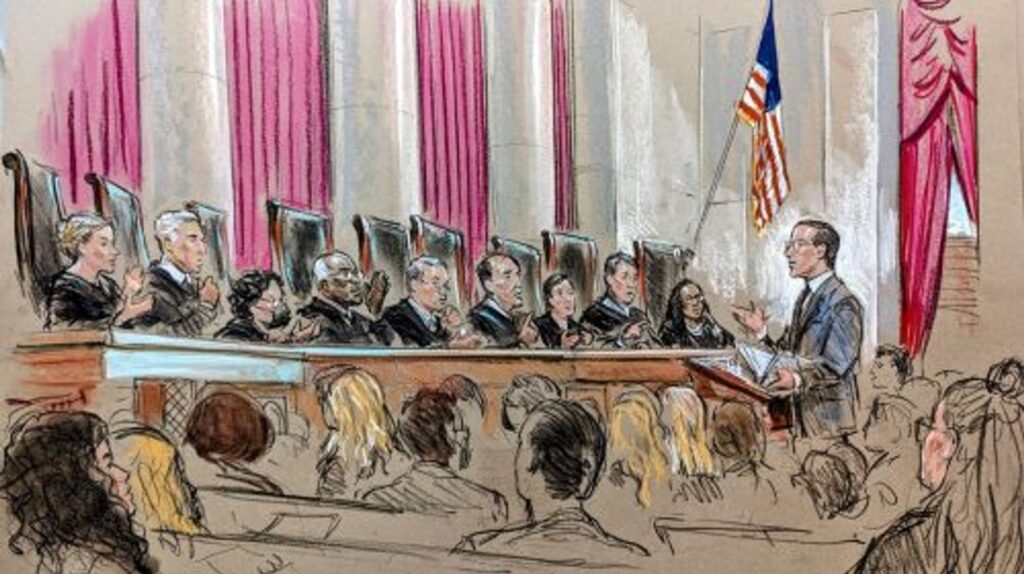
What is “trapped in amber”? An originalist explanation
By Haley Proctor
In her A Second Opinion column, Haley Proctor reflected on the legal world’s recent focus on the phrase “trapped in amber,” discussing its relationship with originalism. “Properly understood,” she wrote, “originalism indeed holds that law is fixed – ‘trapped in amber,’ if you will. But the circumstances to which it applies are not. The problem with the amber metaphor is that courts increasingly use it without distinguishing law from its application.”
Podcasts
Fauci Pleads the Fifth | Interview: Elie Honig
Sarah Isgur and David French are joined by CNN senior legal analyst Elie Honig to discuss Anthony Fauci’s invocation of the Fifth Amendment. Then it’s on to a constitutional game show where each member of this three-person team picks two constitutional amendments they would magically ratify and one amendment they would veto.
Justice William Paterson
Justice William Paterson is, to date, the only justice to have been born in Ireland and is one of only six justices to have been born outside of the United States.
Read more Beyond the swing justice: majority makers, dissent bridges, and coalition drift on the Supreme Court
Paterson was born in December 1745 in County Antrim. In 1747, before he turned two, the family left for America and arrived in Delaware. His father sold tin goods throughout the colonies before opening a general store in Princeton in 1750, across the road from the soon-to-be-built Nassau Hall, today the oldest building at Princeton University (and which served as a battleground during the American Revolution). Aided by local real-estate purchases, Paterson’s father was able to fund his son’s education. Admitted to the College of New Jersey (today Princeton University) at 14, Paterson helped establish the Cliosophic Society with Aaron Burr, a “social and debating club” whose name he likely coined. After graduating in 1763 and earning a graduate degree three years later, he read law under Richard Stockton and was admitted to the bar in 1768.
After the American Revolution began, Paterson served as a delegate to and secretary of New Jersey’s provincial congresses, recording the state’s first official constitution in 1776, while also serving as an officer in the Somerset County Minutemen and on the Council of Safety, which organized New Jersey’s militia. As the state’s first attorney general from 1776 to 1783, Paterson “actively prosecuted Loyalists” while also maintaining a busy private practice. Tragically, his infant daughter died in June 1783 and his wife Cornelia passed away that November, four days after the birth of their son.
The Constitutional Convention proved Paterson’s “finest hour.” According to fellow delegate William Pierce, Paterson was “one of those kind of Men whose powers break in upon you, and create wonder and astonishment.” Championing the small states, Paterson introduced the New Jersey Plan (sometimes known as the Paterson Plan), proposing a one-chamber legislature where every state would vote as an equal. A week after the “Great Compromise” established equal state representation in the Senate – two members per state, protecting small states, to balance against another chamber with proportional representation – Paterson departed the Convention on July 23, leaving the drafting to others. He reappeared in September to sign the Constitution, becoming one of seven foreign-born signers.
Elected to the first Senate, Paterson drafted the Judiciary Act of 1789 alongside his old Princeton classmate (and future chief justice) Oliver Ellsworth, which set the initial number of justices on the Supreme Court at six. Indeed, the act’s first nine sections (which created the district and circuit courts, among other things) are in Paterson’s handwriting. Paterson then became the first person ever to resign from the Senate, trading his seat to become the second governor of New Jersey.
President George Washington nominated Paterson to the Supreme Court in 1793 but withdrew the nomination the next day over a procedural issue. Washington then renominated him on March 4 and he was confirmed that same day. (Washington later offered him the role of Secretary of State in 1795, which Paterson declined.)
One of Paterson’s most important statements came while riding circuit, in 1795’s Vanhorne’s Lessee v. Dorrance, where his jury charge asked “What is a Constitution? It is the form of government, delineated by the mighty hand of the people.” He continued that “every act of the Legislature, repugnant to the Constitution, is absolutely void” – which Chief Justice John Marshall drew on in Marbury v. Madison. In 1796’s Hylton v. United States, Paterson wrote that the carriage tax (a federal tax on carriages kept for the owner’s personal use, passed by Congress in 1794) was “indirect,” meaning it could stand under the Constitution. Two years later in Calder v. Bull, Paterson joined three colleagues in a unanimous judgment (only four justices heard the case and each wrote a seriatim opinion) confining ex post facto clauses – which prevent Congress and the states from passing laws that reach backward onto past conduct – to criminal laws only.
In 1803, Paterson was injured in a coach accident while riding circuit. Although the crash wasn’t fatal, it left him with health problems that never went away. Hoping a New York spa could help with his symptoms, he headed there in September 1806 but never arrived, dying en route at the Albany home of his daughter. Paterson was buried at his daughter’s husband’s manor. When the manor was destroyed around 1900, his remains were reinterred in Albany Rural Cemetery.
SCOTUS Quote
JUSTICE GINSBURG: “How is – how is that determined, that a substantial composite of the general public would find the – the mark shocking or offensive? I mean, if – considering what’s involved in this case, if you were to take a – a composite of, say, 20-year-olds, do you think that that answer would be they would find it shocking?”
MR. STEWART: “I – I think not – I think there are certainly some segments of society that are more likely to find particular marks shocking than others. I – the – the PTO, it – its initial determination was that this mark would be perceived by a substantial segment of the public as the equivalent of the profane past participle form of a well-known word of profanity and perhaps the paradigmatic word of profanity in our language.”
Read more Tariff refunds reach $100 billion mark
— (2019)