
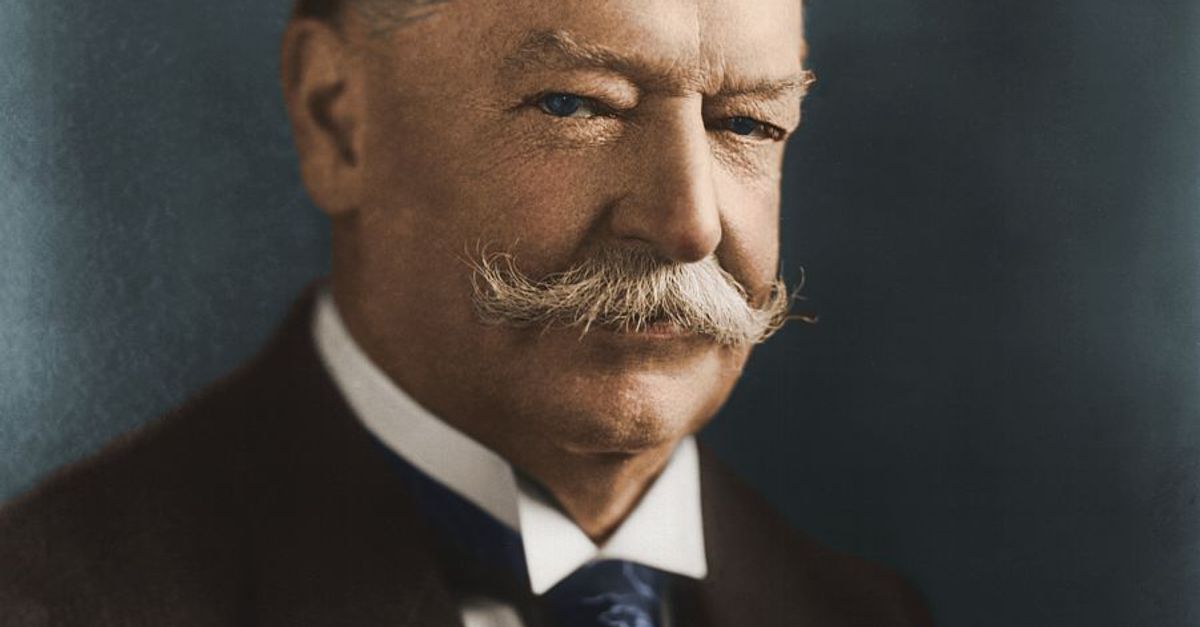
As summer comes to a close, I thought SCOTUSblog readers might appreciate a brief escape from the day’s dreary headlines to something a bit different: the little-known physical transformation of President and later Chief Justice William Howard Taft. People remember Taft as a heavy president, but few are aware that he lost a great deal of weight later in life when he headed the court. Indeed, Chief Justice John Roberts himself recently honored Taft and his many remarkable achievements and noted Taft’s struggle and ultimate success in slimming down. So what’s the story here – and what can we learn from it?
Read more Why religion and education will be in the spotlight next term
***
William Howard Taft was born in 1857 in Cincinnati, Ohio, and served in many public offices from early adulthood. President Benjamin Harrison appointed him U.S. solicitor general in 1890 when Taft was only 32 years old, still the record for the youngest solicitor general in U.S. history. Two years later, Harrison nominated Taft to the U.S. Court of Appeals for the 6th Circuit, which he served on for eight years. In 1900, President William McKinley appointed Taft governor-general of the Philippines, which had recently come under U.S. control after the Spanish-American War. President Teddy Roosevelt appointed him secretary of war in 1904.
In 1908, Taft was elected president. He lost his re-election bid in 1912 when Roosevelt decided to run against him as a third-party candidate, splitting the Republican vote, and opening the way for Woodrow Wilson’s election. When Taft left the White House, he accepted an offer to teach at Yale Law School. But Taft’s dream was to serve as chief justice of the United States. While president, Taft had elevated Edward White from an associate justice to chief justice in 1910. He told his attorney general at that time, “There is nothing I would have loved more than being Chief Justice of the United States.” His wish became reality in 1921, when, after the death of White, President Warren Harding appointed Taft, then 63, to replace him. Taft enjoyed being chief justice so much that he once said, “I don’t remember that I ever was President.”
During his tenure, Taft ruled in two cases in particular that have had a considerable impact on recent Supreme Court decisions. One was 1926’s Myers v. United States, which recognized the president’s power to remove executive officers. The Supreme Court relied heavily on Myers in last June’s decision in holding that the president had the authority to fire a commissioner of the FTC at will. Taft also voted with the unanimous majority in favor of parental rights in 1925’s Pierce v. Society of Sisters, which declared unconstitutional an Oregon law passed by voter initiative that required all school age children to attend public schools. The Supreme Court relied on Pierce last March in its parental rights decision , and it will likely prove influential in similar such cases in the years to come.
Taft’s legacy impacts today’s Supreme Court in at least other two major ways, both based on skills he developed as president on how to lobby the legislative branch. First, he successfully urged Congress to pass the Judiciary Act of 1925, which gave the Supreme Court more control over its docket, by eliminating most mandatory jurisdiction cases (that is, cases the court was required by federal law to hear). When Taft became chief justice, the Supreme Court faced a five-year backlog of cases that had piled up. The discretion the court now has to set its docket came from Taft’s efforts.
Taft’s second lasting impact on the Supreme Court was his successful lobbying of Congress for funds to build a new and separate Supreme Court building. Before Taft’s tenure as chief justice, the Supreme Court never had a building of its own. From 1810-1860, it met in the dimly lit basement of the U.S. Capitol. In 1860, it moved up to the Old Senate Chamber. The growing population of the United States and the westward expansion added more people and more states, so the Senate and the House of Representatives outgrew their respective chambers. Congress added new chambers on the north and south ends of the Capitol, freeing up the old Senate space for the Supreme Court. But there was no space for the justices to have chambers (individual offices) in the Capitol, so the justices had their offices at their homes. They met for conference in the basement of the Capitol.
This was inadequate for the third coequal branch of government. Taft convinced Congress to designate funds for construction of the Supreme Court building, located across the street from the Capitol on the east side. The Supreme Court moved into its new building in October 1935, but alas, Taft never got to see it. Like Moses who gazed upon the Promised Land but did not enter it, Taft died in 1930 before workers completed the new Supreme Court building.
***
But enough about that. Let’s move on to what you’re here for: What did Taft do to lose all that weight? According to an article in Harvard Health Publishing, written by Dr. Howard E. LeWine, Taft struggled with his weight throughout his entire life. He weighed 243 pounds when he graduated from Yale as an undergraduate (he graduated from Cincinnati Law School), but his weight shot up after that. In 1905, when he served as secretary of war, Taft weighed 314 pounds. He was 5 foot, 11 inches tall.
Taft wrote to a British physician and noted expert on obesity, Dr. Nathaniel Yorke-Davies, to ask for advice on what to do. Yorke-Davies replied with detailed letters (which survive today) explaining the steps he should take. The Harvard article summarized Yorke-Davies’ advice to Taft to eat “lean meats, a little fish, vegetables, plain salad, avoidance of sugar, and minimal carbohydrates,” essentially an early version of the keto diet. Taft lost 59 pounds between December 1905 and April 1906.
But Taft was still two years from taking office as president and that is when the pounds came back on in a familiar tale of yo-yo dieting thanks to a stressful job. Taft bore the obvious challenges from serving as president, but also, three months into his presidency, Taft’s wife suffered a stroke. He devoted much time to her care, including helping her regain the ability to speak. All of that triggered stress eating. Chief Justice John Roberts wrote in his article that during his presidency, Taft gained 75 pounds. One year into his term in 1909, Taft weighed 354 pounds. When he left the White House in 1913, he was 335-340.
And that is how most people today remember Taft – the rotund president who had to order a huge bathtub for the White House to accommodate his immense girth. Indeed, Taft’s weight was a running joke even before he became president: In the early 1900s, he once sent a telegram to Secretary of War Elihu Root, telling him that he “Took long horseback ride today; feeling fine.”The secretary immediately cabled back: “How’s the horse?”
Read more House to vote on number of justices
As one writer observed,
They made infinite jests about his fatness – and no one heard or repeated the jokes with greater savor than Taft himself. Making a speech he would pause, with an effect of suspense, just long enough to intensify the audience’s attention; then throughout the immense torso and up into the broad features would run little tremors and heavings, rising to a climax in a rumbling chuckle as infectious as only a fat man could achieve, and Taft would tell a story in which the point was, as he would say in an engaging falsetto, “on me.”
Taft’s expansive waistline also generated many stories about him getting stuck in a bathtub while president (you may have learned this as a child). Amazingly, the Smithsonian Magazine took a deep investigative dive into this historical question. Yes, it reports, but this happened in 1909 not at the White House but on a steamboat on the Mississippi River. Specifically, the magazine found a story from 1929, written by one Lewis Freeman, detailing how Taft visited a steamboat named the Oleander that he had taken down the Mississippi River. Freeman interviewed the workers who accompanied Taft on the trip 20 years earlier in this “floating White House.” They showed Freeman the suite where Taft had stayed. They said that they tried to find a bigger bathtub for the suite for Taft’s trip but were unable to do so. The Smithsonian Magazine wrote:
According to Freeman, the crew shared multiple versions of what exactly happened next, but they all agreed on one thing: Taft had “made the serious mistake of trying to bathe the whole of his considerable bulk at once.” Though the president managed to get into the tub, Freeman wrote, “it took Archy Butt, a Secret Service man, and two or three state governors to overcome the suck of the vacuum beneath and drag him out.”
Stories of Taft getting stuck in a bathtub then took on a life of their own. Newspaper articles detailed at least six instances around the country where Taft supposedly became stuck in bathtubs. They reported how bellhops pulled him free from bathtubs at hotels in Albuquerque; Denver; and Portland, Oregon. Taft also allegedly got stuck in bathtubs in private residences in Erie, Pennsylvania; Wichita, Kansas; and Nashville, Tennessee.
***
But enough about bathtubs. After Taft lost the presidential election of 1912 and accepted an offer to teach at Yale Law School, he began focusing once again on losing weight, returning to his proto-keto diet. Importantly, he also adopted a physical regimen after Harding appointed him chief justice in 1921.
Upon becoming chief, Taft moved from Yale in Connecticut to a house in northwest D.C. in the Kalorama neighborhood (2215 Wyoming Avenue NW). When the weather was not terrible, Taft walked to work, 3½ miles from his home to the Supreme Court, then (as noted above) housed in the Old Senate Chamber in the Capitol. He also walked home after work. Photos exist of a jaunty, well-attired Taft with cane and hat, strolling down the streets of D.C. to the Capitol. When the weather was bad, he would take a car to the court or back home. But he diligently stuck to his walking regimen. The summer before he died in 1930, at age 72, he weighed 244 pounds, almost the same weight he was when he graduated from college. His habit of walking became so well-known at the time of his death, that a year later, in 1931, officials renamed a bridge that spanned Rock Creek in northwest D.C. as the William Howard Taft Bridge because he walked across it so many times as chief.
Why do people today remember Taft as heavy but not that he slimmed down?Perhaps because Taft was more in the public eye as president, and less so as chief justice, when he was a good deal thinner. There were no cameras in the court to show his trimmer figure. It must also be said that Taft likely did not help dispel his image in the public’s mind when he continued to wear a walrus mustache, evoking allusions to the blubberous mammal cavorting on ice floes.
***
So what can we learn from the example of Chief Justice Taft?
First, prioritize your health in order to maximize your effectiveness at work. Lawyers are under constant stress, and that promotes stress eating. Taft faced that brutal reality and fought it (although far more successfully as chief justice than president).
Second, try and eat like Taft’s British doctor advised him: vegetables, fruits, and whole grains. Consume lean protein and cut down on refined sugar.
Third, in getting physical exercise, it can be best to incorporate it as part of your life the way Taft did in walking roundtrip from his home to work. Walk wherever you can, especially in the morning to take advantage of that early sun. Take breaks from the computer, get up from your desk, and walk around the block or inside the office (or do some squats every hour). Take the stairs or take steps up an escalator to get that cardio burst. (Although there are no records of Taft lifting weights, we should also hoist the iron several times a week to build muscle mass.)
Then, look to the big picture and think how you can invest your time and efforts to build things greater than yourself that will outlast you. Taft did that in a way few other chief justices have achieved. He effectively lobbied Congress to pass the Judiciary Act of 1925, fundamentally changing the way the Supreme Court takes and decides cases today. He also oversaw the construction of the first and only standalone home for the Supreme Court. Ironically, Taft’s two most enduring accomplishments as chief justice came from the skill he developed from lobbying Congress, a skill he acquired from a job he did not enjoy, being president.
We would all benefit from “Taft-maxxing.” It may sound cliché, but taking care of our physical selves helps us build things to help others and which will endure beyond our lifetime.
Read more Enhance the Supreme Court minority’s procedural powers