
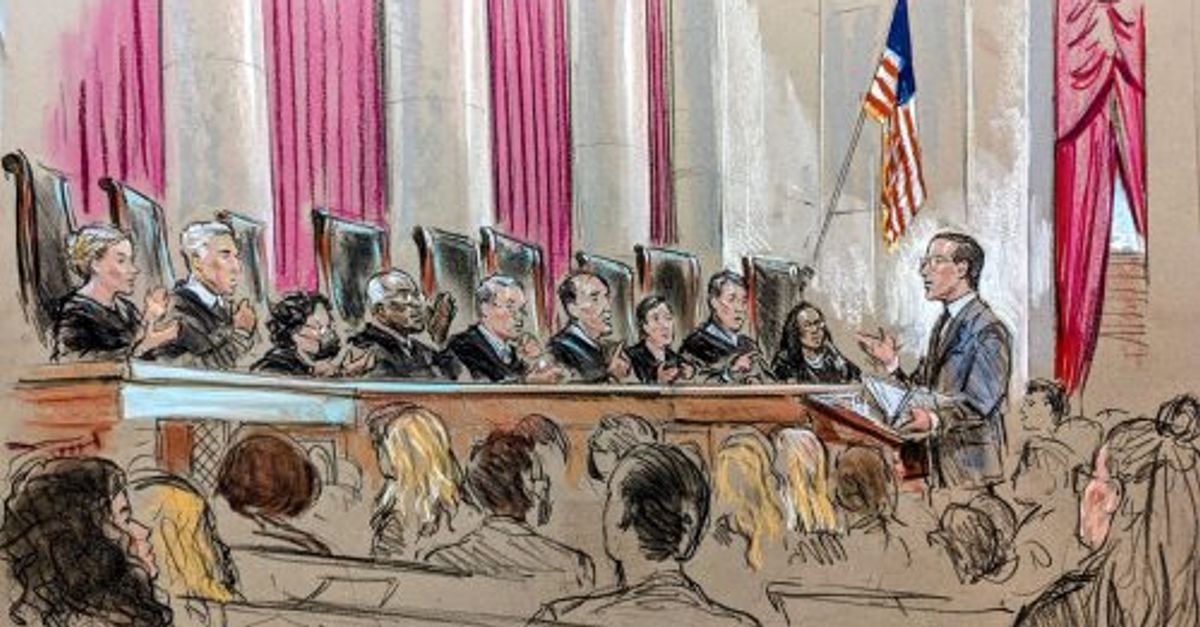
The current court is often described as composed of six Republican-appointed conservatives and three Democratic-appointed liberals. And that shorthand explains many of the court’s most visible decisions. But it also misses one of the central patterns in close cases. While a 6-3 decision can reflect a familiar ideological split, it can also expose serious disagreement inside the conservative majority.
Read more Court clears the way for Alabama to use its preferred congressional map
Two October Term 2025 cases demonstrate the difference. In Louisiana v. Callais, in which the court made it more difficult to successfully bring claims of racial gerrymandering under the Voting Rights Act, the court divided along the standard ideological axis. Justice Samuel Alito wrote for Chief Justice John Roberts and Justices Clarence Thomas, Neil Gorsuch, Brett Kavanaugh, and Amy Coney Barrett. Justice Elena Kagan dissented, joined by Justices Sonia Sotomayor and Ketanji Brown Jackson. The case fits the public image of the current court: the six conservative justices on one side, the three liberal justices on the other.
That kind of lineup usually appears when the case maps onto a high-salience constitutional or political conflict. Callais involved the structure of political representation and racial redistricting – an area where questions about race, voting power, constitutional limits, and judicial supervision often produce ideologically recognizable coalitions.
Learning Resources v. Trump, in which the court struck down certain of the Trump administration’s tariffs, produced the same numerical split but a very different court. Roberts wrote for a judgment coalition that included Sotomayor, Kagan, Gorsuch, Barrett, and Jackson. Thomas, Alito, and Kavanaugh dissented. The 6-3 vote therefore revealed a cross-bloc majority rather than a conservative-liberal divide.
That difference matters because Learning Resources turned on a different set of judicial instincts. Instead of lining up cleanly around partisan or ideological stakes, the justices divided over institutional role, statutory authority, remedial scope, and the degree of judicial control over executive action. The case shows how a six-conservative court can still fragment when the dispute implicates certain values.
Together, the two cases frame the article’s central distinction. Close votes measure how narrowly the court divides. Ideologically close votes measure whether that division follows the expected conservative-liberal axis. The two categories overlap in many headline cases, especially those involving race, religion, guns, abortion, presidential power, and the authority of major agencies. But they separate in cases where legal method, procedure, text, remedy, or institutional role reorganize the justices into different coalitions.
That distinction changes how the court should be described. The Roberts court is certainly conservative in direction, especially in major constitutional and regulatory cases. Yet its close decisions show more than polarization. They also reveal recurring internal divisions among the court’s conservatives over how far to move, how broadly to write, and how much authority courts should exercise in technically complex disputes.
Ideological close cases cluster in high-salience constitutional and regulatory disputes
The clearest ideological close cases tend to involve issues that already dominate national politics. When the court decides cases about abortion, guns, religion, race, presidential power, or the administrative state, the legal question often maps onto a familiar political divide. In those cases, the vote count usually tells two stories at once: the case was close, and the justices divided along the court’s standard ideological axis.
Dobbs v. Jackson Women’s Health Organization is the most obvious example. The six conservative justices formed the majority that overruled Roe v. Wade, while the three liberal justices dissented. New York State Rifle & Pistol Association v. Bruen, which recognized a Second Amendment right to carry firearms, followed the same pattern in the Second Amendment context. Students for Fair Admissions v. Harvard was decided similarly in the area of affirmative action. It is the same structure across cases dealing with administrative law, agency adjudication, gender-related regulation, parental rights regarding their children’s exposure to LGBT+ materials, and executive power.
These cases are not interchangeable, but they share one feature: the legal issue sits near a major constitutional or political fault line. The court’s ideological blocs become more visible when the case asks how far government may regulate, how much power agencies may exercise, how courts should treat race-conscious policies, or how strongly constitutional rights limit elected institutions.
That does not mean every salient case divides ideologically. Allen v. Milligan, a 2022 Voting Rights Act case in which the court recognized a redistricting map as likely racially discriminatory, and 2020’s June Medical Services v. Russo, which struck a Louisiana law requiring doctors who perform abortions to have admitting privileges at a nearby hospital, are important counterexamples. But the pattern is strong enough to matter. The closer a case is to a high-salience constitutional dispute, the more likely a close vote is to become an ideological vote.
Figure 1 above shows that ideological close votes are concentrated in the issue areas most likely to track national political conflict. Religion, guns, race, voting, presidential power, and major administrative-power disputes have high ideological shares. Technical categories such as civil procedure, jurisdiction, Indian law, immigration, criminal procedure, and intellectual property produce more cross-bloc outcomes. The pattern supports the article’s core distinction: close votes become more predictably ideological when the case sits near a major constitutional or political fault line.
Non-ideological close cases often arise in technical areas
The cross-bloc cases tend to come from different areas of law and different types of legal questions. As noted above, they often involve statutes, jurisdictional rules, criminal procedure, immigration provisions, Indian law, remedial limits, or agency procedure. These cases can be important (such as the tariffs dispute), but they usually do not arrive at the court already mapped onto a familiar political conflict.
That is why they scramble the blocs. In 2020’s Borden v. United States, for example, Kagan wrote for a majority that included Justices Stephen Breyer, Sotomayor, Gorsuch, and Thomas. The case involved the Armed Career Criminal Act and whether crimes committed with a reckless mental state qualified as “violent felonies.” The lineup was unusual, but the division made sense on legal-method grounds: textual analysis and criminal-law principles cut across ordinary ideological expectations.
Niz-Chavez v. Garland, decided that same term, produced a similar pattern in immigration law. Gorsuch wrote for a majority that included Thomas, Breyer, Sotomayor, Kagan, and Barrett. The dispute concerned the statutory notice required to stop a noncitizen’s period of continuous presence. The case had obvious real-world stakes, but the coalition formed around statutory precision rather than a simple pro-immigrant/pro-government divide.
Indian-law cases show another recurring version of the same phenomenon. In McGirt v. Oklahoma, Gorsuch joined the liberal justices in a 5–4 decision recognizing the continuing force of tribal reservations in eastern Oklahoma. That coalition reflected Gorsuch’s distinctive approach to tribal sovereignty, treaty language, and historical legal commitments. It also showed how one justice’s methodological commitments (and interest in a particular area of law) can reorganize the court.
These cases point to a broader pattern. Technical cases are not necessarily low-stakes cases. Many reshape important areas of law. But they often divide the justices over interpretive tools rather than ideological identity. Textualism, institutional restraint, remedial caution, federalism, and views about judicial role can all produce close votes that look very different from Dobbs, Bruen, or Callais.
Figure 2 above shows where non-ideological close cases are most common in the close-case dataset. Civil procedure and jurisdiction, criminal law and criminal procedure, immigration, Indian law, business and statutory cases, and technical administrative-law disputes account for a large share of cross-bloc outcomes. The graph highlights the other side of the ideological pattern: cases farther from the most visible constitutional fault lines more often produce unexpected coalitions.
Several recurring non-ideological coalitions appear
The non-ideological cases are not random. They reveal recurring coalitions that sit alongside the court’s formal ideological blocs. These coalitions often form around legal method, institutional role, or the justices’ preferred level of judicial intervention.
One recurring pattern is Gorsuch plus the liberal justices. That alignment appears most often in criminal statutory cases, Indian-law disputes, and cases involving close readings of text. McGirt v. Oklahoma, described above, is the clearest example. The result crossed ordinary ideological lines, but it fit Gorsuch’s commitments to textualism, treaty obligations, and tribal sovereignty.
A second pattern is Roberts or Kavanaugh with the liberal justices in institutional or procedural cases. Allen v. Milligan, described above, is a prominent example. Roberts and Kavanaugh joined the three liberal justices in a Voting Rights Act case, even though voting-rights cases often divide ideologically. That coalition reflected statutory precedent, institutional caution, and reluctance to remake doctrine as sharply as the dissenters urged.
A third pattern involves Barrett as a limiting vote. Barrett often remains within the conservative bloc in high-salience constitutional cases, but in technical cases she sometimes resists broader reasoning or more aggressive positions. Ohio v. EPA, in which the court temporarily blocked an EPA rule to reduce air pollution from power plants and other industrial facilities in several states, illustrates the point: Barrett joined the three liberal justices in dissent from a 5–4 emergency posture decision, emphasizing the difficulty of resolving a complex administrative record on an abbreviated timetable.
A fourth pattern is the Thomas-Alito-Gorsuch dissenting bloc. That pattern often reflects a more formalist, originalist, or anti-agency position, while the majority takes a narrower or more institutionally cautious path.
These patterns show why cross-bloc is too broad as a final label. Some non-ideological cases are textualist. Some are institutionalist. Some are about remedies or posture. And some reflect recurring disagreement inside the conservative wing over how quickly and how far the court should move.
Figure 3 above displays how often pairs of justices appeared on the same side in non-ideological close cases. The strongest pairings not accounted for here show recurring coalitions that are hidden by conventional ideological labels: Gorsuch with liberal justices in textualist and Indian-law cases, Roberts and Kavanaugh with liberal justices in institutional cases, and Thomas, Alito, and Gorsuch together in dissenting conservative sub-blocs.
The post-2020 court has two different kinds of conservative majority cases
So what does this tell us?
Although the post-2020 court is often treated as a simple six-justice conservative body, it misses an important internal split. There are really two recurring versions of the conservative court.
The first is the familiar ideological court. In cases like Dobbs, Bruen, and Students for Fair Admissions, the six conservative justices formed the majority and the three liberal justices dissented. These cases tend to involve high-salience questions and show the court moving doctrine in a recognizably conservative direction.
The second is the fractured conservative court. In this version, the liberal justices become pivotal because the conservative justices disagree among themselves. Allen v. Milligan is one example. FCC v. Consumers’ Research, in which the court declined to weaken executive agency power, show a different version, with Roberts, Kavanaugh, Barrett, and the liberal justices forming the majority against Thomas, Alito, and Gorsuch. Learning Resources adds another variation, with Roberts, Gorsuch, and Barrett joining the liberal justices in the tariffs judgment.
The second version matters because it shows that conservative judicial power does not always operate through a unified bloc. The justices divide over how fast doctrine should move, how broad an opinion should be, how much posture matters, and how aggressively courts should police agencies, Congress, states, or the president. Those divisions can decide cases even when the court’s overall ideological center remains conservative.
Figure 4 above compares close cases before and after the court reached its current six-conservative-justice composition. The post-2020 period contains more close decisions overall, but with non-ideological close cases forming the larger share. The graph captures the article’s main structural claim: the current court has a strong conservative majority, but many close outcomes turn on internal conservative disagreement rather than simple bloc voting.
Solo dissents as a second measure of judicial independence
Kagan had her first solo dissent on May 21, 2026, in Havana Docks Corporation v. Royal Caribbean Cruises. This left the only justice on the current court without a solo dissent as Barrett.
Close votes show how the justices form coalitions. Solo dissents show when a justice leaves every coalition behind. They are a different measure of judicial independence: less about who can assemble five votes, more about who is willing to write alone.
The current justices differ sharply on that measure. As of May 22, Thomas is the clear outlier, with 52 solo dissents in the dataset. Sotomayor and Alito come next. Gorsuch has fewer overall solo dissents, but his total is also notable given his shorter tenure. Jackson has three, including one within her first year on the court. Roberts, Kavanaugh, and Kagan have only one each. And, as noted, Barrett has none.
The raw count captures frequency, but timing captures temperament. Thomas issued his first solo dissent less than five months after joining the court. Jackson, Gorsuch, and Sotomayor also solo dissented relatively early. Alito took more than four years. Kavanaugh took nearly seven. Roberts and Kagan each waited more than 15 years before writing alone in dissent.
That delay is especially important for Kagan. Her first solo dissent, on May 21, came after nearly 16 years on the court. Kagan has long been one of the court’s most coalition-oriented writers. A solo dissent from her therefore signals a rare point of isolation, not a routine form of disagreement.
The same contrast helps explain Roberts. His low solo-dissent count does not mean he lacks independence. It reflects a different style of influence, especially given his role as chief: coalition-building, narrowing opinions, controlling institutional tone, and keeping the court from splintering when possible.
Figure 5 above captures this (again, as of May 22, 2026), with the parenthetical showing solo dissents per term served through October Term 2025. Thomas remains the outlier even after accounting for tenure, averaging about 1.5 solo dissents per term. Sotomayor and Alito form the next tier. Gorsuch and Jackson have smaller totals but higher rates than several longer-serving colleagues. Roberts, Kavanaugh, and Kagan have each dissented alone once, while Barrett has none in the dataset.
Figure 6 above shows how long each current justice served before issuing an initial solo dissent. The measure separates frequent solo dissenters from coalition-oriented justices. As noted earlier, Thomas, Jackson, Gorsuch, and Sotomayor solo dissented soon after coming on the court, while Roberts and Kagan waited more than 15 years, showing a markedly different relationship to coalition and isolation.
Bringing the two measures together
Close votes and solo dissents measure different forms of division. Close votes show how the justices form coalitions. Solo dissents show when a justice is willing to stand apart from every coalition. Read together, they reveal a court that is conservative in direction but internally divided in method, institutional posture, and temperament.
The close-vote data show that distinction most clearly. When cases involve abortion, guns, race, religion, presidential power, or major administrative authority, the court often divides along familiar ideological lines. Those cases explain why the public narrative of a conservative court has force. Decisions like Dobbs, Bruen, and Students for Fair Admissions are central to the court’s current identity.
But many close cases tell a different story. In criminal statutory cases, immigration cases, Indian-law disputes, jurisdictional cases, remedial disputes, and technical administrative-law cases, the justices often reorganize around legal method rather than ideology. Gorsuch may join the liberal justices over statutory text or tribal sovereignty. Roberts and Kavanaugh may join them over institutional caution or precedent. Barrett may resist consequential shifts. Thomas and Alito may press a more formalist or originalist position in dissent.
Solo dissents add the individual dimension. Thomas’ record shows a justice unusually willing to stand alone. Sotomayor and Alito also use solo dissents as a recurring form of separate expression. Gorsuch and Jackson solo dissented relatively early in their tenures. Roberts and Kagan, by contrast, waited more than 15 years before dissenting alone, reflecting a different judicial style built around coalition, institutional voice, and persuasion from within. And Barrett has not solo dissented at all.
Together, these measures show a court that is polarized in salient cases and fragmented in technical ones. The Roberts court has a powerful conservative majority, but that majority contains competing approaches to text, history, precedent, remedy, procedure, institutional role, and judicial restraint. The most interesting cases are often the ones where those approaches pull the justices away from the blocs that many expect. In understanding the current court, the question is not only which side won. It is what kind of court was key to the vote – and may be to future ones.
Read more The radical Justice Thomas