
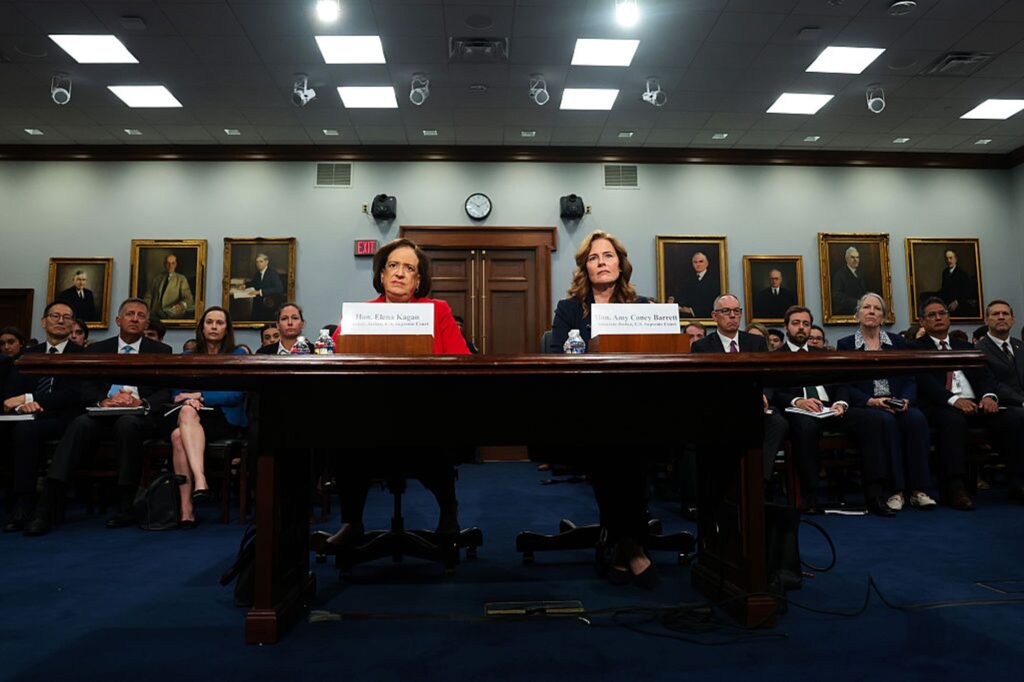
On Tuesday, Justices Elena Kagan and Amy Coney Barrett testified for nearly four hours in total before House and Senate subcommittees. Look to the On Site section below for key takeaways.
Read more Justices Kagan and Barrett testify before Congress
Plus, we’re now just one day away from Thursday’s LinkedIn Live event on the 2025-26 term’s most consequential cases, featuring SCOTUSblog’s Amy Howe and Briefly’s Adam Stofsky. The event is scheduled to start at noon EDT. Register here.
At the Court
On Tuesday, the court denied a request for a stay of execution from Dennis Sochor, who was sentenced to death for the 1982 murder of Patricia Gifford. Hours later, Sochor was executed in Florida.
The court is set to release the first of three summer order lists on Monday at 9:30 a.m. EDT. (We discussed what these lists typically address in a Closer Look earlier this week.)
Morning Reads
E. Jean Carroll is paid $5.6 million in Trump sex abuse and defamation case
Jennifer Peltz, Associated Press
On Monday, two weeks after the Supreme Court declined to hear President Donald Trump’s appeal of a $5 million jury verdict entered against him in a sexual abuse and defamation case filed by E. Jean Carroll, Carroll collected that payment, plus interest, according to court records and her legal team. Trump’s lawyers had attempted to block the payment and are now working to reverse it as they await word from the justices on whether the court will grant their , which was filed last week. The Associated Press noted that “Trump is also appealing $83 million in defamation compensation granted to Carroll by a separate Manhattan jury after a 2024 trial where Trump briefly testified.”
Kagan reflects on Graham’s role in her Supreme Court confirmation
Sophie Brams, The Hill
Before both the House and Senate subcommittees, “Justice Elena Kagan honored late Sen. Lindsey Graham (R-S.C.) on Tuesday, remembering the South Carolina Republican as a ‘vivid’ personality who helped secure her confirmation to the Supreme Court,” according to The Hill. “The senator was one of five Republicans who voted for Kagan, a liberal nominated by former President Obama, to join the high court in 2010.” Kagan, “who is Jewish, recalled a ‘funny’ moment during her confirmation hearing in which Graham asked her where she was on Christmas.” “I think Al Franken said he was the funniest man in the Senate,” Kagan said. “But what I remember about that hearing was that somehow Senator Graham made me look funny, which is a harder thing entirely. … I’ll skip the back and forth, but many people said to me afterwards that exchange with Senator Graham was the moment my confirmation was sealed.”
Tariff refunds push US June budget deficit to $120 billion
David Lawder, Reuters
The U.S. Treasury Department announced on Monday that “[g]rowing refunds from President Donald Trump’s tariffs,” which were struck down by the Supreme Court in February, “pushed the June federal budget deficit to $120 billion.” All told, $49.2 billion in refunds were paid out in June, according to Reuters, adding to approximately “$22 billion returned in May.” That $71 billion represents “42% of the $166 billion … subject to refunds.” Reuters noted that the Trump administration’s tariff “agenda is in flux as a temporary 10% global tariff is due to expire on July 24 and the administration prepares new duties over what it sees as lax enforcement of anti-forced labor laws and excess industrial capacity.”
4 Takeaways From the Supreme Court’s 2025–2026 Term
Damon Root, Reason
In his Injustice System newsletter for Reason, Damon Root outlined what he believes are the key takeaways from the Supreme Court’s 2025-26 term. Among other conclusions, Root contended that the court’s ruling in Trump v. Slaughter, giving presidents the power to “remove the current heads of ‘independent’ federal agencies at will,” amounts to a major “long-term victory for the executive branch.” Moving forward, he wrote, it will enable “presidents from both parties … to remake the federal bureaucracy in their own respective images.” Root further argued that the term showed us that “[t]he current Supreme Court majority is undoubtedly a very conservative one,” but not a MAGA majority. “[I]f this really was the Trump Court, rather than the Court led (mostly) by Chief Justice John Roberts,” Root wrote, “why didn’t Trump win the two cases that he clearly wanted most desperately to win?”
The See-No-Evil Supreme Court
Adam Serwer, The Atlantic
In a column for The Atlantic, Adam Serwer argued that “[a]cross multiple cases dealing with voting and immigration, a consistent theme has emerged from the Roberts Court’s jurisprudence: a determination to ignore, rationalize, or misrepresent the explicit animus of government officials—and the president in particular—toward the groups that have been targeted,” including “immigrants and ethnic minorities.” According to Serwer, this approach appears to have been “invented for a president who regularly says racist things. If the justices ruled against him every time he did so, a lot of right-wing policies wouldn’t be upheld. So the statements must be ignored or rationalized.”
On Site
Justices Kagan and Barrett testify before Congress
By Amy Howe
In the first appearances by members of the Supreme Court before Congress in seven years, Justices Elena Kagan and Amy Coney Barrett testified on Tuesday in both the House of Representatives and the Senate. Although the focus of the justices’ testimony was the court’s budget, which Congress appropriates, the two discussed a wide range of issues, from security and enforcement of the court’s ethics code to its emergency (Kagan’s preferred name for it) or interim docket.
The biggest Supreme Court surprises this term
By Erwin Chemerinsky
In his Courtly Observations column, Erwin Chemerinsky highlighted three developments from the 2025-26 term that surprised him, including an emergency docket decision barring President Donald Trump from federalizing National Guard troops and then deploying them in Illinois and the court’s ruling in Chatrie v. United States, on geofence warrants.
Two cheers – but not three – for Roberts and Barrett
By Edward Foley
In his Justice, Democracy, and Law column, Edward Foley revisited Trump v. Barbara, the birthright citizenship case, and Watson v. Republican National Committee, on mail-in voting, and contended that Chief Justice John Roberts and Justice Amy Coney Barrett, who voted with the three Democratic-appointed justices in these cases, “deserve high praise” for “act[ing] with judicial integrity.”
Read more Executive power and its limits
Podcasts
Plenty of Culture War Stuff
Sarah Isgur and David French preview the next Supreme Court term, discuss a dissent from a cert denial on defamation, and consider a few think pieces on the court. Finally, they address the circuit decision heard ‘round the world on Florida’s Stop WOKE Act.
Ask Amy
Q: I understand when there is a majority opinion, multiple concurrences, and multiple dissents. But can you break the votes in Trump v. Barbara down for me?:
“Roberts, C.J., delivered the opinion of the Court, in which Sotomayor, Kagan, Barrett, and Jackson, JJ., joined. Jackson, J., filed a concurring opinion, in which Sotomayor, J., joined as to the introduction and Part I. Kavanaugh, J., filed an opinion concurring in the judgment and dissenting in part. Thomas, J., filed a dissenting opinion, in which Gorsuch, J., joined. Alito, J., and Gorsuch, J., filed dissenting opinions.”
A: These can be thorny indeed – and this particular line-up is not nearly as complicated as some others can get. But, yes, let’s break it down.
“Roberts, C.J., delivered the opinion of the Court, in which Sotomayor, Kagan, Barrett, and Jackson, JJ., joined.” This means that Chief Justice John Roberts wrote the opinion for the majority of the court – here, striking down President Donald Trump’s executive order ending birthright citizenship as unconstitutional. Four justices – Sonia Sotomayor, Elena Kagan, Amy Coney Barrett, and Ketanji Brown Jackson – signed on to his opinion in full.
“Jackson, J., filed a concurring opinion, in which Sotomayor, J., joined as to the introduction and Part I.” This means that Jackson, although she signed on to the Roberts opinion, also wrote a separate opinion, in which she responded to some of the arguments made by Justice Clarence Thomas in his dissenting opinion (more on this below). Sotomayor did not sign on to all of Jackson’s opinion. Instead, she joined only the introduction – the first paragraph – and Part I, but not the second half of that opinion, which contained a broader criticism of the court’s recent 14th amendment rulings.
“Kavanaugh, J., filed an opinion concurring in the judgment and dissenting in part.” This is perhaps the key separate opinion of the case. “Concurring in the judgment” means that Kavanaugh agreed with the result that the majority reached – that the executive order could not stand – but not its reasoning. In his view, Trump’s executive order seeking to end birthright citizenship did not violate the Constitution (hence, the “dissenting in part”), but it was inconsistent with a federal law providing for birthright citizenship. If you are counting votes for this case, it means that the court divided 6-3 on the question of whether to strike down the executive order, but 5-4 on the question of whether the order was constitutional.
“Thomas, J., filed a dissenting opinion, in which Gorsuch, J., joined. Alito, J., and Gorsuch, J., filed dissenting opinions.” Thomas and Justices Samuel Alito and Neil Gorsuch disagreed with the result that the majority reached: they would have allowed the order to stand. Each wrote a dissenting opinion of his own, and Gorsuch joined Thomas’ opinion (although Thomas did not join Gorsuch’s). Alito also wrote alone.
SCOTUS Quote
“There are definitely issues with respect to the emergency – we call it the emergency docket. Some of us call it the interim docket. It’s a terminology nightmare. I call it the emergency docket.”
— Justice Elena Kagan during her July 14 testimony before the House Appropriations Subcommittee on Financial Services and General Government
Read more Two cheers – but not three – for Roberts and Barrett