
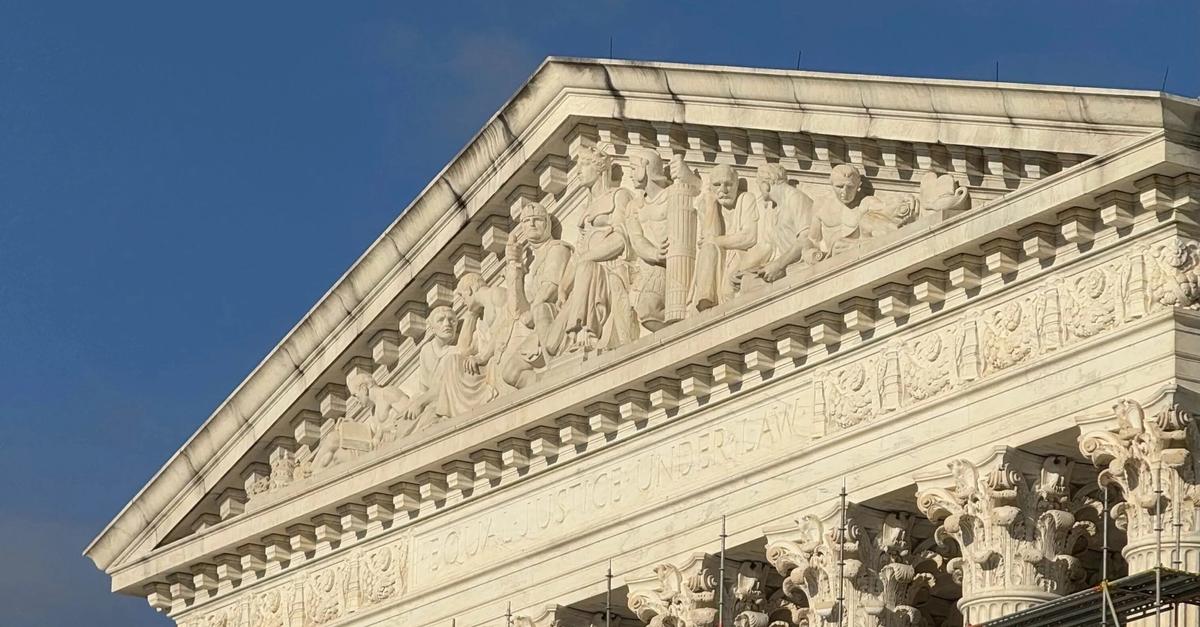
Justice John Paul Stevens died on this day in 2019. Stevens is among the top five longest-serving justices in Supreme Court history, having served on the court for nearly 35 years, from December 1975 until June 2010.
Plus, please join us today at noon EDT for a LinkedIn Live event on the 2025-26 term’s most consequential cases, featuring SCOTUSblog’s Amy Howe and Briefly’s Adam Stofsky. Register here.
At the Court
The court is set to release the first of three summer order lists on Monday at 9:30 a.m. EDT. (We discussed what these lists typically address in a Closer Look earlier this week.)
Morning Reads
Senate Republican on Supreme Court security funding request: ‘There’s not a money fairy up here’
Sophie Brams, The Hill
On Tuesday, Justices Elena Kagan and Amy Coney Barrett appeared before House and Senate subcommittees to address the Supreme Court’s budget request, including why the justices are seeking additional security funds. Hours later, Sen. John Kennedy, a Republican from Louisiana, raised questions about their testimony during a Fox News interview, “question[ing] why the high court needs a budget boost when they already have ‘better security than everybody else.’” “While acknowledging that the justices ‘feel insecure’ about their safety, Kennedy cautioned against simply ‘throwing money at the problem,’” according to The Hill. “I don’t mean to sound unsympathetic, but four to eight cops with you at all times as part of your security detail is strong as horseradish,” Kennedy said.
Trump birthright citizenship fight comes roaring back with ‘invaders’ play after Kavanaugh roadmap
Charles Creitz, Fox News
On June 30, the Supreme Court struck down President Donald Trump’s executive order seeking to limit access to birthright citizenship, prompting the president to urge Congress to take action on the issue. This week, Sen. Jim Banks, a Republican from Indiana, heeded that call, introducing legislation “aimed at ending birthright citizenship for children of illegal immigrants and birth tourists by defining them as children of ‘invaders’ under federal law,” according to Fox News. “In its summary, Banks’ bill declares ‘any person who enters the United States without authorization or for the purpose of engaging in birth tourism is considered an invader’ and amends the Immigration and Nationality Act to exclude children of such ‘invaders.’” In his press release on the bill, Banks emphasized that the Supreme Court, which held that Trump’s executive order violated the 14th Amendment, “left intact the longstanding constitutional exception that children born to foreign invaders are not entitled to birthright citizenship.”
Republican Mike Lee Next in Line to Lead Senate Judiciary Panel
Olivia Alafriz and Lillianna Byington, Bloomberg Law
Following the sudden death on Saturday of Sen. Lindsey Graham, “Utah Sen. Mike Lee is on track to become the top Republican on the Senate Judiciary Committee next year,” according to Bloomberg Law. “That opportunity would be hard to turn down,” Lee said in a Tuesday statement. “Federal courts and our Constitution have been a lifelong interest.” Bloomberg Law noted that Lee “twice clerked for US Supreme Court Justice Samuel Alito – on the high court, and earlier, when Alito sat on the US Court of Appeals for the Third Circuit.”
No, Justice Amy Coney Barrett Most Definitely Should Not Resign from the U.S. Supreme Court
Kathryn Jean Lopez, National Review
During her congressional testimony on Tuesday about the Supreme Court’s budget request, Justice Amy Coney Barrett described rising security threats, recalling “having to explain to her twelve-year-old son why she walked into her family’s house with a bulletproof vest.” As Kathryn Jean Lopez noted in a column for the National Review, Barrett’s comment fueled a social media backlash, as some viewers called on the justice to resign if she can’t handle the risks of her work. Lopez criticized the people behind those posts, arguing that “[t]here is something seriously wrong with us if we can’t agree we have a problem after hearing that testimony yesterday. And the problem is not Amy Coney Barrett.”
Are We Still Supposed to Take This Conservative Legal Theory Seriously?
Linda Greenhouse, The New York Times
In a column for The New York Times, Linda Greenhouse argued that “the court’s obsession with ‘originalism’ descended into parody” during the 2025-26 term, highlighting how complicated it can be to identify “an analogous regulation from the era of the country’s founding” in order to justify a modern restriction on gun rights. Greenhouse emphasized the government’s effort in United States v. Hemani to justify barring a marijuana user from possessing a gun with “‘habitual drunkard’ laws from the 18th and 19th centuries” and the court’s thorough rejection of that comparison. “Although I’ve had a bit of fun with the Hemani case,” Greenhouse wrote, “a serious question remains: Did it teach the court anything? Or will the justices continue stumbling through the history books under the fiction that at the end of the road lies objectivity?”
On Site
Trump administration asks justices to have lower court reconsider protected status for Venezuelan and Haitian nationals
By Amy Howe
In a filing submitted on July 9 and docketed on Monday, U.S. Solicitor General D. John Sauer urged the justices to order the U.S. Court of Appeals for the 9th Circuit to reconsider its ruling in a challenge to the decision by then-Secretary of Homeland Security Kristi Noem to end protections for Venezuelans and Haitians in the United States under the Temporary Protected Status program.
The court’s criminal law term: overview and observations
By Rory Little
In his SCOTUSCrim column, Rory Little reviewed the 16 (or 17) “pure” criminal law cases argued and decided during the 2025-26 term, and then highlighted some unifying themes and takeaways from the decisions, including that there is “broad agreement among the justices in criminal law cases.”
Narrow holdings with broad consequences
By Haley Proctor
In her A Second Opinion column, Haley Proctor revisited United States v. Hemani and Wolford v. Lopez, the two Second Amendment cases from the 2025-26 term. Although the rulings offered “narrow answers to the specific questions” raised in the cases, Proctor contended that “these are important decisions, and they provide unmistakable guidance that ought to lead to sounder adjudication of Second Amendment claims in the lower courts.”
D.A. ex rel. B.A. v. Tri County Area Schools
Forty years ago, the Supreme Court in Bethel School District No. 403 v. Fraser held that school officials do not run afoul of the First Amendment when they prohibit students from using vulgar and offensive language. The decision built on the court’s landmark 1969 ruling on student speech – Tinker v. Des Moines Independent Community School District – in which it held that administrators and teachers may bar speech that significantly disrupts school activities.
Now, the court has been asked to clarify Fraser in a case that centers on a phrase that is not vulgar on its face but that is commonly understood to reference profane language: “Let’s Go Brandon.”
Read more Narrow holdings with broad consequences
As the U.S. Court of Appeals for the 6th Circuit when addressing the dispute, “Let’s Go Brandon” became part of “the national lexicon” in 2021 after a reporter misunderstood or misrepresented what the crowd at a NASCAR Xfinity Series race was chanting, stating that the audience was saying “Let’s Go Brandon” when the chant was actually “Fuck Joe Biden.” Since that day, the phrase has been a popular way to express displeasure with Biden, becoming an enduring internet meme and inspiring “shirts, sweatshirts, and flags.”
The case originated in December 2021, when two brothers, both in middle school at the time, received “Let’s Go Brandon” sweatshirts for Christmas from their mother. Over the next few months, each wore their sweatshirt to school at least once, where they were asked by school officials to remove it because it referenced profane language.
In May 2022, the brothers, “through counsel, sent the district a cease-and-desist letter, outlining their view that the ban on wearing the ‘Let’s Go Brandon’ sweatshirts” violated their right to express their political beliefs, according to the 6th Circuit. The school district declined to change its policy, so the family sued in April 2023, alleging First Amendment violations.
A federal district court and then the sided with the school district, holding that the sweatshirts were the kind of “vulgar speech” that schools may restrict. While acknowledging that the euphemism “Let’s Go Brandon” can only be considered profane if you know the chant it’s referencing, it’s reasonable to treat it the same as “Fuck Joe Biden,” wrote Judge John Nalbandian for the 2-1 6th Circuit majority. “After all,” he continued, “Fraser— the first case that recognized the vulgarity exception—involved a school assembly speech that had a rather elaborate sexual metaphor instead of explicitly vulgar or obscene words” (feel free to read it for yourself).
In their , the brothers and their mother urge the Supreme Court to take up the case and hold that “fully sanitized” nondisruptive political speech is distinct from the “profane and sexually lewd speech” addressed in Fraser. “Allowing schools to equate sanitized euphemisms with their uncensored corollaries leads to absurd results. Words like ‘shoot’ and ‘frick’ would be sanctionable in America’s high schools because they ‘mean’ something else,” the family contends.
They further argue that the 6th Circuit’s decision deepened a split between the federal courts of appeals over whether Fraser allows for restrictions on student speech that references profane language but is not itself “plainly” vulgar. “While the Third and Ninth Circuits interpret Fraser to cover ‘plainly’ profane and sexual speech, the Sixth Circuit majority below embraced a far more expansive reading, allowing censorship of nondisruptive political speech that any single teacher or administrator ‘reasonably understands’ as vulgar.”
Initially, the school district and the school administrator and teacher named in the suit waived their right to respond to the petition, but the Supreme Court called for a response in May. In their , filed earlier this month, they contend that Fraser clearly applies to the circumstances of this dispute because “[a]lmost all lewd speech comes in sanitized code, innuendo, and double meaning.” They illustrate this point with images of a variety of shirts that show how clothing can have a “lewd meaning” without including vulgar language – for example, one of the shirts has a picture of Monica Lewinsky and reads “I’m Voting Trump. The last Clinton left a bad taste in my mouth.” “[T]hese examples vividly illustrate … the ease with which enterprising students could” take advantage of a ruling stating that student speech must be plainly profane in order to be subject to restrictions, they say.
They also assert that the case “does not implicate any circuit split,” because circuits that have distinguished “plainly” vulgar speech “from otherwise vulgar speech” have “never held that coded speech conveying a plainly vulgar message like ‘Let’s Go Brandon’ … is not ‘plainly’ vulgar.”
D.A. ex rel. B.A. v. Tri County Area Schools is scheduled to be considered by the justices at their first private conference after the summer recess, on Monday, Sept. 28.
SCOTUS Quote
JUSTICE BREYER: “My only problem with writing those words is somebody is going to direct me to the provision a little bit later where it says the word ‘State’ in Title 11, of which this is part, means Puerto Rico. Okay?”
MR. LANDAU: “Well, Your Honor –”
JUSTICE BREYER: “Now, that that’s hard for me to do because of that language.”
MR. LANDAU: “But, Your Honor, I would – your Honor has always been so sensitive to the contextual approach to –”
Read more The court’s criminal law term: overview and observations
JUSTICE BREYER: “That may be, but I can’t say that an ‘airplane’ means a horse.”
— (2016)