
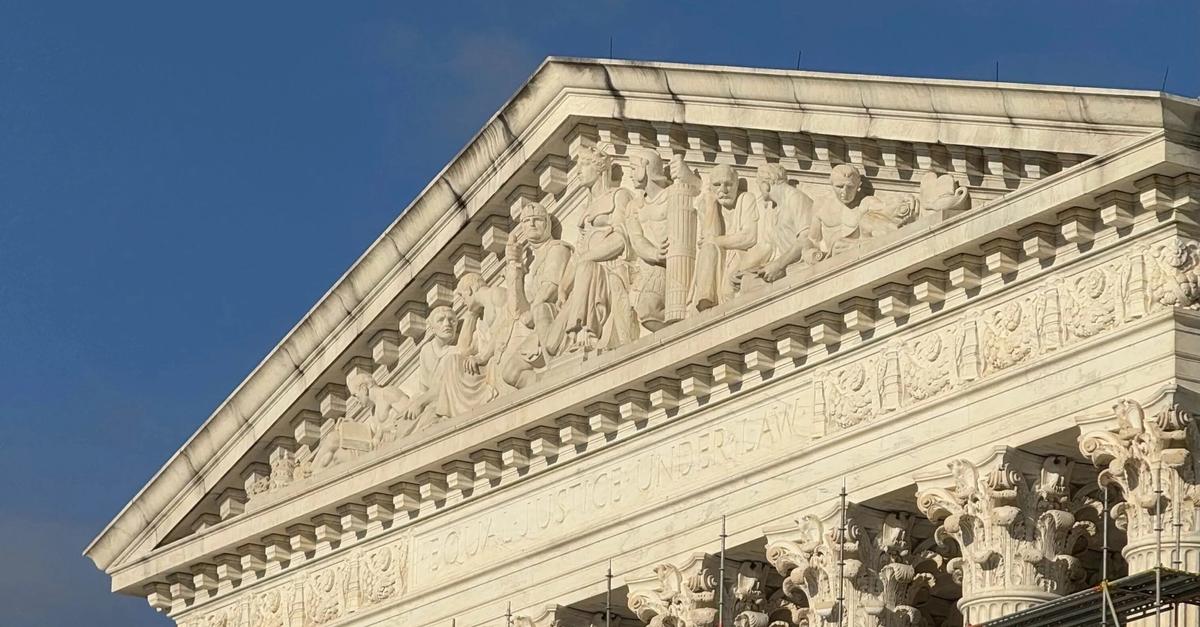
Chief Justice William Rehnquist died on this day in 2005. He served on the court for more than 33 years, the first 14 of which he spent as an associate justice.
Read more How William Howard Taft transformed from a portly president to a svelte chief justice
At the Court
Two Republican groups asked the court on its interim docket to block a decision by the U.S. Court of Appeals for the 4th Circuit preventing political parties and joint fundraising committees from paying preferential broadcast rates for political ads. The court has asked the four Democrats who challenged the groups’ access to more favorable rates to respond to the request by noon EDT today.
In another interim docket dispute, a Michigan group urged the court to require Michigan election officials to put on the November ballot its proposal for requiring proof of citizenship to vote in the state. Michigan officials filed their to that request on Wednesday. Learn more about their filing in the Morning Reads section.
This Friday at 9:30 a.m. EDT, the court will release its third and final summer order list. (We discussed what these lists typically address in our July 13 newsletter.)
Morning Reads
US judge blocks Trump’s newest order limiting birthright citizenship
Nate Raymond, Reuters
On Wednesday, U.S. District Judge Deborah Boardman in Maryland “blocked the Trump administration from enforcing a new executive order limiting the number of people eligible for birthright citizenship that President Donald Trump issued after the U.S. Supreme Court rejected his previous effort,” according to Reuters. Boardman imposed her preliminary injunction “at the request of immigrant rights advocates who had last year secured a ruling from her blocking” Trump’s first executive order on the issue on behalf of a class of babies who would have been denied citizenship under that earlier order. She cited the Supreme Court’s June ruling striking down Trump’s first order to explain her decision, asserting that the court had “already decided that the children in the class are citizens at birth.” “Her order bars agencies including the U.S. Department of State, the U.S. Department of Homeland Security, and the Social Security Administration from taking any action to interfere with, deny or fail to recognize citizenship of children covered by the class action.”
New Jersey Seeks High Court Review of Kalshi Sports Markets
Gillian R. Brassil, Bloomberg Law
On Wednesday, New Jersey brought the growing battle over regulatory control of prediction markets to the Supreme Court, asking the justices “to clear up a nationwide legal debate over whether sports prediction markets offer” sports bets, which are subject to state regulation, or if instead, they host “hedging tools called ‘swaps’ that are under the purview of” the federal government, according to Bloomberg Law. New Jersey’s appeal of a ruling from the U.S. Court of Appeals for the 3rd Circuit embracing this latter view comes less than a week after the U.S. Court of Appeals for the 9th Circuit sided with Nevada gaming regulators, creating what’s called a circuit split. In its petition, New Jersey said “[t]hat split has tremendous importance, as it will determine whether a multi-billion-dollar gaming industry can suddenly operate free from state sports-gaming laws.” Bloomberg Law noted that the Trump administration supports the prediction markets in these disputes, asserting that “it has sole oversight” of their offerings.
House squashes measure to prevent Supreme Court from expanding
Zachary Schermele, USA Today
On Wednesday, “Democrats in the House of Representatives batted down a longshot constitutional amendment to freeze the number of justices on the Supreme Court at nine,” according to USA Today. The vote was 212-206, “with only one Democrat, Rep. Don Davis of North Carolina, siding with Republicans.” The amendment “needed two-thirds support in the chamber to pass.” Rep. Andy Biggs, a Republican from Arizona, spoke in support of the amendment on the House floor before it failed. “We should not change the Supreme Court simply because we don’t like the people sitting on it,” he said.
State of Michigan responds to Americans for Citizen Voting appeal to US Supreme Court
Katherine Dailey, Michigan Advance
On Monday, the sponsors of a proposal for Michigan to impose a proof-of-citizenship requirement on voters asked the Supreme Court on its interim docket to require the state to put this proposal on the November ballot. They contend, among other things, “that the due process rights of Michiganders who signed the” petition to get the proposal on the ballot “were violated when the Board of State Canvassers determined that affidavits validating nine rejected signatures were submitted too late and as such could not be used to have those signatures – which would have put the petition over the threshold – count as valid.” On Wednesday, Michigan officials to the sponsors’ request, telling the justices “that the process of a referendum like this is a state-created right as opposed to one guaranteed by the First Amendment,” and is therefore not entitled to the same level of protection, according to Michigan Advance. “[M]any courts have held that private citizens lack a constitutional right to propose referenda or initiatives for any ballot, federal or state,” the officials asserted. They further argued that the sponsors have failed to account for “the high number of signatures that were found to be invalid.”
On Trump’s Ballroom, Chief Justice Finds Himself in an Unusual Spot: In Dissent
Ann E. Marimow, The New York Times
On Monday, the Supreme Court cleared the way for construction to continue on the new White House ballroom. Chief Justice John Roberts dissented, in an opinion joined by the court’s three Democratic appointees. The New York Times highlighted Roberts’ vote in an article about how rarely he is in dissent. “Since 2020, he has on average voted with the majority in argued cases that were not unanimous 91 percent of the time. Throughout his tenure, he has voted with the majority 83 percent of the time – the fifth highest of any justice and the highest of any chief justice since 1953, according to an analysis by Lee Epstein, a political scientist and law professor at Washington University in St. Louis.”
Maine’s high court rules father can restrict daughter’s church attendance
Sean Scott, The Maine Monitor
On Tuesday, the Maine Supreme Judicial Court ruled that “[a] Portland District Court judge was correct in giving a father the power to decide whether his daughter could attend an evangelical church following a clash with the girl’s mother over her religious upbringing.” The judge sided with Matthew Bradeen over Emily Bickford after determining that “some of the church’s language was ‘psychologically damaging the child,’” including teachings about “the rapture, a belief that Christians will join God at the end of the world and nonbelievers will be left behind,” according to The Maine Monitor. Bickford’s lawyer, Mathew Staver of Liberty Counsel, told The Monitor that they plan to appeal the decision to the U.S. Supreme Court. “I think it will be a case that will be very significant and catch the attention of the Supreme Court because of how far-reaching it is with regards to the First Amendment exercise clause,” Staver said.
On Site
Why religion and education will be in the spotlight next term
By Kelsey Dallas
As the back-to-school spirit sweeps across the nation, education is likely on the minds of the Supreme Court justices (especially those with kids still at home or in college). The court is preparing for a term that will involve at least one major dispute on religion in schools – and potentially more.

How William Howard Taft transformed from a portly president to a svelte chief justice
By Jordan Lorence
In a column for SCOTUSblog, Jordan Lorence highlighted William Howard Taft’s physical transformation in the years after his left the White House, including during his time as chief justice. “People remember Taft as a heavy president, but few are aware that he lost a great deal of weight later in life when he headed the court,” Lorence wrote, exploring the healthy changes Taft made and what can be learned from “Taft-maxxing.”
Read more Why religion and education will be in the spotlight next term

Podcasts
The Statesman’s Constitution – Special Guest Steven B. Smith
Originalists venerate the founders, who were by most reckonings a group of remarkable statesmen. Today, many Americans look seemingly in vain for a statesman worthy of the moment and its challenges. But what is a statesman? Does the Constitution assume a statesman will lead the country? Steven B. Smith, author of the new book On Statesmanship, joins to discuss.
Woodward v. Alabama
On Sept. 28, 2006, Montgomery, Alabama, police officer Keith Houts was shot during a traffic stop. The shooter fled the scene, but investigators were able to quickly track down the car’s owner, Morrie Surles, because Houts had recorded the license plate before he was hit. Surles told the police that she bought the car for her daughter, Tiffany. The next day, Tiffany’s boyfriend, Mario Woodward, was arrested and charged with attempted murder. When Houts died from his injuries, the charges were upgraded to capital murder, and Woodward was ultimately found guilty and sentenced to death.
Woodward has spent much of his time on Alabama’s death row pursuing challenges to his conviction, filing three different petitions for review at the Supreme Court over the past 13 years. The first two were denied, and the third is scheduled to be considered by the justices during their “long conference” on Sept. 28. Woodward that it raises a significant question about state courts’ application of Brady v. Maryland, a major ruling on postconviction relief.
In Brady, which was argued and decided in 1963, the Supreme Court held that prosecutors’ decision to withhold evidence favorable to John Brady from his legal team violated Brady’s due process rights under the 14th Amendment. The ruling is the basis of what is now referred to as the Brady rule, under which prosecutors must share with the defense “any information favorable to the accused which may reduce a defendant’s potential sentence, go against the credibility of an unfavorable witness, or otherwise allow a jury to infer against the defendant’s guilt.” Defendants who identify a potential Brady violation after their conviction can file a challenge seeking to have the conviction overturned.
Woodward’s pending petition centers on a Brady claim he filed in 2023, after he obtained records related to the Houts shooting from the U.S. Marshals Service based on a Freedom of Information Act request. The records, though partially redacted, showed that officers had investigated a different, previously undisclosed suspect before zeroing in on Woodward. Woodward asserts that prosecutors violated Brady by failing to make his legal team aware of this alternative suspect.
The Circuit Court of Montgomery County and the Alabama Court of Criminal Appeals both denied Woodward’s 2023 claim, concluding that he had waited too long after receiving the records from the U.S. Marshals Service to seek postconviction relief and that he had failed to adequately explain how knowledge of the alternative suspect would have changed his defense strategy. “In particular,” according to the Alabama Court of Criminal Appeals’ ruling, “Woodward failed to plead any facts in his amended petition explaining whether the result of his trial would have been different had the alleged newly discovered evidence been known at the time of trial.”
In March, Woodward asked the Supreme Court to review the Alabama courts’ treatment of his Brady claim, that they “erroneously reformulated” Supreme Court precedent. Specifically, Woodward asserts that, under the Brady line of cases, he needed only to show that knowledge of the alternative suspect would have had a “probable impact” on his trial to be entitled to postconviction relief. The lower courts improperly held him to a higher standard, according to Woodward, expecting him to more definitively prove that his trial would have turned out differently. Woodward further argues that the lower courts misapplied the time limit by failing to acknowledge the time he spent waiting for the Marshals Service to confirm that the records were redacted correctly.
In its response to Woodward’s petition for review, Alabama asserts that Woodward failed to raise the issues in his petition before the lower courts, which means “the record is entirely undeveloped” and a poor candidate for Supreme Court review. The case is also not worthy of the court’s attention, according to the state, because it is “heavily factbound” and “presents no important federal question for the Court to answer and no conflict among the lower courts requiring resolution.”
As noted above, Woodward v. Alabama is scheduled to be considered by the justices for the first time on Sept. 28.
SCOTUS Quote
“The plea was not guilty, and he was convicted. No matter what the evidence was against him, he had the right to have an impartial judge.”
Read more House to vote on number of justices
— Chief Justice William Howard Taft in Tumey v. Ohio (1927)