
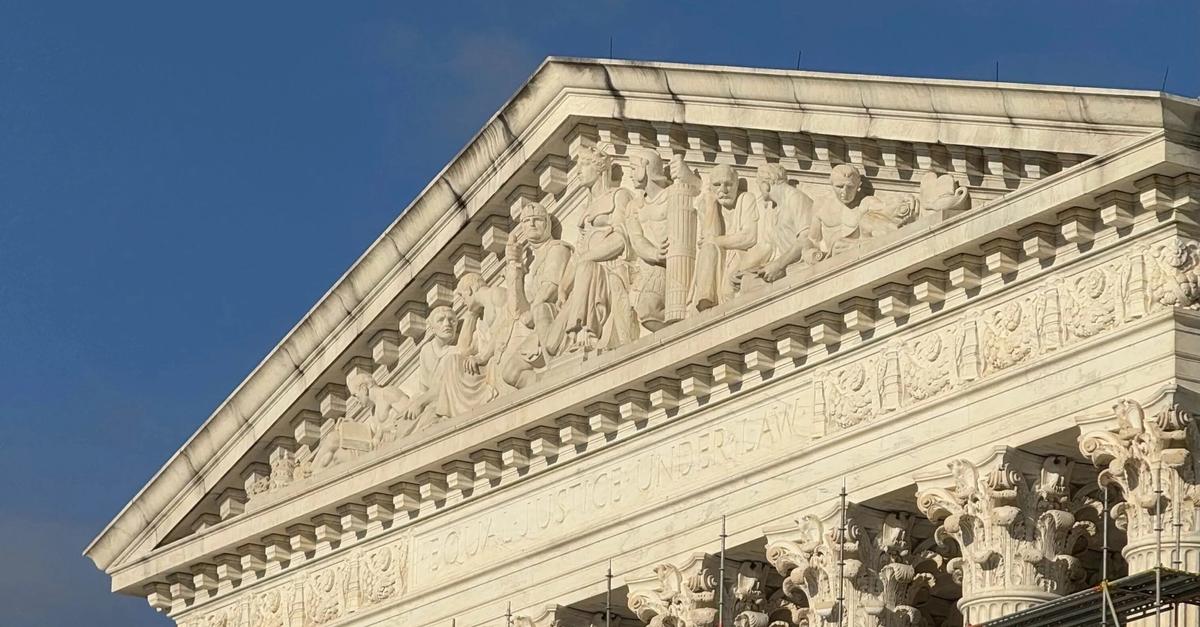
Good morning, and welcome to what’s expected to be another opinion day at the Supreme Court. We will be live blogging beginning at 9:30 a.m. EDT.
Read more Announcement of opinions for Thursday, May 28
At the Court
On Wednesday, Alabama again asked the Supreme Court to allow it to use the congressional map it adopted in 2023 in the 2026 midterm elections. For more on the latest chapter of a long-running dispute, see the On Site section below.
After the possible announcement of opinions this morning, the justices will meet in a private conference to discuss cases and vote on petitions for review. Orders from today’s conference are expected on Monday at 9:30 a.m. EDT.
Morning Reads
$20 billion in tariff refunds paid so far, with more on the way
Steve Kopack, NBC News
In a Tuesday filing with the Court of International Trade, Brandon Lord, executive director of trade programs at the U.S. Customs and Border Protection agency, stated that the “Trump administration has refunded more than $20 billion so far in tariffs to importers and shippers … after the Supreme Court struck down the cornerstone of President Donald Trump’s trade policy in February.” Lord also said that a total of “[a]pproximately $85 billion” in refund requests “have been accepted for processing.” NBC News noted that “[h]undreds of companies have lined up to get their money back, including Costco, Walmart, Home Depot, Target, General Motors, Ford Motor Company, FedEx, UPS and DHL.”
US Supreme Court settles long-running water dispute over dwindling Rio Grande
Susan Montoya Bryan, Associated Press
In a brief on Tuesday, the Supreme Court “approved a settlement package designed to rein in groundwater pumping along one of North America’s longest rivers and ensure enough water reliably makes it from New Mexico to Texas, ending a long-running dispute over management of the Rio Grande,” according to the Associated Press. “The settlement calls for reducing groundwater pumping along the dwindling river and retiring water rights from irrigated farmland in southern New Mexico.” It was “first proposed last year by New Mexico, Texas and Colorado” and recommended by a court-appointed special master.
Appeals court ruling will prevent Mahmoud Khalil’s removal while he seeks Supreme Court review
Armando Garcia, ABC News
On Tuesday, the U.S. Court of Appeals for the 3rd Circuit granted Mahmoud Khalil’s request to temporarily pause its ruling against him in order to “prevent the Trump administration from detaining Khalil while he seeks to have his case reviewed by the Supreme Court,” according to ABC News. Khalil is “a green card holder who is married to an American citizen” who was detained by ICE last year over his participation in pro-Palestinian campus demonstrations at Columbia University but then released after filing a federal lawsuit alleging First Amendment violations. The 3rd Circuit ruling that is now on hold cleared the way for Khalil’s case to proceed in immigration court and for him to be detained again.
Police hypnotized a witness. Now a Texas man faces death.
Jennifer Thompson, The Washington Post
In a column for The Washington Post, Jennifer Thompson described her experience accusing the wrong man of raping her, which she said resulted from “trauma and suggestive police procedures.” That man, Ronald Cotton, was convicted of the crime and “spent more than a decade behind bars before DNA evidence revealed the truth – he was innocent of the crime, and the real perpetrator was someone else,” Thompson wrote. She went on to highlight the case of Charles Flores, who is on death row in Texas and who she believes was the victim of similarly suggestive investigative tactics – namely, “investigative hypnosis.” Thompson noted that she wrote a brief supporting Flores’ effort to have the Supreme Court review his case and urged the justices to “ensure that Flores is not wrongfully executed based on unreliable eyewitness identification.”
On Site
Alabama urges Supreme Court to allow for use of congressional map struck by lower court as racially discriminatory
By Amy Howe
Just over two weeks after the Supreme Court cleared the way for Alabama to use a congressional map that a lower court had blocked as racially discriminatory, Alabama returned to the court on Wednesday and asked the justices to pause a new ruling by a panel of federal judges that once again barred the state from using the map.
New York Times v. Sullivan, service, and sentence credits
By John Elwood
In his Relist Watch column, John Elwood highlighted three newly relisted petitions for review, including Harvard Law professor emeritus Alan Dershowitz’s request for the court to revisit 1964’s New York Times v. Sullivan, holding that the First Amendment prohibits allowing a public figure from recovering for defamation absent “actual malice,” meaning a showing that the defendant knew the statement was false or was reckless in publishing it.
The Roberts court’s record on the First Amendment
By Adam Feldman
In his Empirical SCOTUS column, Adam Feldman analyzed the Roberts court’s record in cases involving free speech and religious freedom claims. He found that the “court is often pro-speech, strongly pro-religion, and most consistent when speech overlaps with religious identity or conscience.”
Criminal law update: some defense-friendly rulings and a big case that wasn’t
By Rory Little
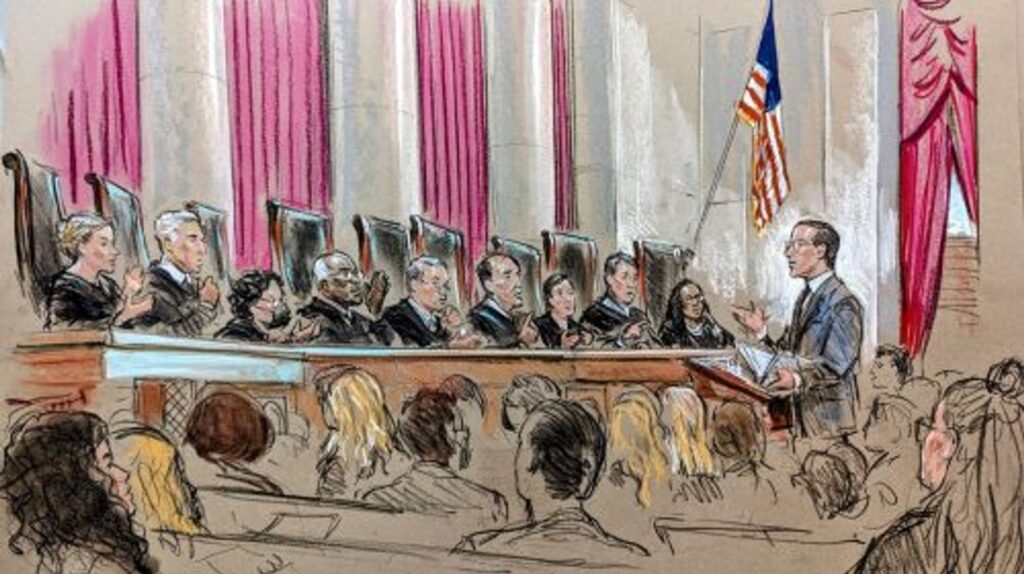
In his ScotusCrim column, Rory Little offered an update on how the court is handing its criminal cases this term and brief descriptions of the “big” criminal cases that still await decision. He also discussed the court’s decision to dismiss Hamm v. Smith as “improvidently granted,” which he had previously described as “one of the most important criminal law cases facing the court this term.”
Podcasts
Unrehearsed Answers
Akhil Amar and Andy Lipka answer listeners’ questions about pardons, illegal military orders, simultaneous office holding, and the Trump administration’s supposed weaponization slush fund.
Harris v. Bessent
Last year on its interim docket, the court considered multiple disputes over President Donald Trump’s firing of independent agency heads. The justices agreed to hear argument in one of those cases – Trump v. Slaughter, on the president’s effort to remove Rebecca Slaughter from the Federal Trade Commission without cause – as well as in Trump v. Cook, on the president’s effort to remove Lisa Cook, a member of the Federal Reserve’s Board of Governors, for cause. The court cleared the way for several of the firings, including Slaughter’s (but not Cook’s), to take effect while the lawsuits play out.
The court’s eventual rulings in Slaughter and Cook, which are expected by early July, may redefine the limits of executive power and determine the future of independent agencies. And the Slaughter decision will likely also influence how the court responds to the in Harris v. Bessent, which addresses Trump’s February 2025 firing of Cathy Harris from the Merit Systems Protection Board and which is scheduled to be considered during the justices’ private conference on Thursday.
Harris was appointed to the MSPB, which oversees the federal government’s personnel practices, in 2022 by then-President Joe Biden, and she was set to serve on the board until 2028. But on Feb. 10, 2025, Trump terminated her. Harris filed a federal lawsuit the next day, emphasizing that, under federal law, members of the MSPB can only be removed by the president for “inefficiency, neglect of duty, or malfeasance in office.”
U.S. District Judge Rudolph Contreras sided with Harris, holding that MSPB leaders can only be removed “for cause” and that such removal protections are constitutional. The Trump administration appealed his ruling to the U.S. Court of Appeals for the District of Columbia Circuit, where it was consolidated with a dispute over Trump’s effort to remove Gwynne Wilcox from the National Labor Relations Board. (Like Harris, Wilcox had won the right to return to her job before a federal district court.) A D.C. Circuit panel initially granted the administration’s request to be able to fire Harris and Wilcox while their lawsuits continue, but the full court vacated the panel’s order and denied the government’s request.
In April 2025, the Trump administration came to the Supreme Court on its interim docket and asked the justices to pause the orders allowing Harris and Wilcox to continue working. The court granted that request in late May in a two-page, unsigned that included a brief discussion of the majority’s views on executive control over federal agencies – views that will likely be more fully fleshed out in the upcoming Slaughter and Cook rulings.
“Because the Constitution vests the executive power in the President … he may remove without cause executive officers who exercise that power on his behalf, subject to narrow exceptions recognized by our precedents,” the order said. “The stay reflects our judgment that the Government is likely to show that both the NLRB and MSPB exercise considerable executive power.” (At the same time, the court noted that the Fed, as “a uniquely structured, quasi-private entity,” is distinct from these other federal agencies, and that the for-cause removal protections for Fed governors should therefore not be viewed through the same lens.)
Justice Elena Kagan dissented from the court’s decision, in an opinion joined by Justices Sonia Sotomayor and Ketanji Brown Jackson, and described the order as “nothing short of extraordinary.” “The President,” Kagan wrote, “has no legal right to relief. Congress, by statute, has protected members of the NLRB and MSPB (like Wilcox and Harris) from Presidential removal except for good cause.”
In December 2025, the D.C. Circuit issued its ruling in Wilcox’s and Harris’ cases. Echoing the Supreme Court’s interim order, the court that “Congress may restrict the President’s ability to remove principal officers who wield only quasi-legislative or quasi-judicial powers.” However, the court continued, “Congress may not restrict the President’s ability to remove principal officers who wield substantial executive power,” and thus Trump could remove Wilcox and Harris without cause.
In her , Harris contends that the D.C. Circuit failed to recognize the difference between policymaking agencies, like the FTC, and agencies, like the MSPB, “that do[] not make policy, and instead appl[y] the law to facts in discrete cases.” Those two categories of agencies wield significantly different amounts of executive power, according to the petition, and Congress can offer leaders of agencies that fall into the latter group for-cause removal protections without limiting the president’s authority to control the executive branch. Even if leaders of the MSPB wield some executive power, Harris adds, the appropriate legal remedy is not to invalidate the removal protections, but to adjust the MSPB’s scope of authority.
Harris presents her case to the justices as a natural follow-up to Slaughter that will allow them to determine “whether Congress may enact a for-cause removal statute for a purely ‘adjudicatory body.’” At the very least, she contends, her case should be remanded to the D.C. Circuit for reconsideration once the Slaughter ruling is released.
In the government’s to Harris’ petition, U.S. Solicitor General D. John Sauer counters that the D.C. Circuit’s decision was correct because the MSPB “plainly exercises executive power” and further argues that Harris’ suggested exception for “adjudicatory bodies” “is flawed in principle and contrary to precedent.”
The justices are scheduled to consider Harris v. Bessent for the first time during Thursday’s conference, but they will likely wait until the Slaughter ruling is released to take action on it.
SCOTUS Quote
CHIEF JUSTICE ROBERTS: “Well, just in terms of your position, do you think they could pull the car over?”
MR. KLEVEN: “No, Your Honor …”
CHIEF JUSTICE ROBERTS: “Really? Okay.”
MR. KLEVEN: “Because, again, it’s just the – the seriousness of the claim should not affect whether there is, in fact, reasonable suspicion.”
JUSTICE KENNEDY: “You get an A for consistency. I’m – I’m not sure about common sense.”
Read more New York Times v. Sullivan, service, and sentence credits
— (2014)